
Tocolytic Activity of Hydroethanol Leaf Extract of Momordica Charantia Linn. (Cucurbitaceae) in Isolated Non-Pregnant Mouse Uterus: Involvement of Extracellular Calcium Influx Inhibition
DOI:
https://doi.org/10.33003/Keywords:
Momordica charantia, Uterine contractility,, calcium channel blockade, Tocolytic Activity, Oxytocin-Induced Contractions, Smooth Muscle RelaxationAbstract
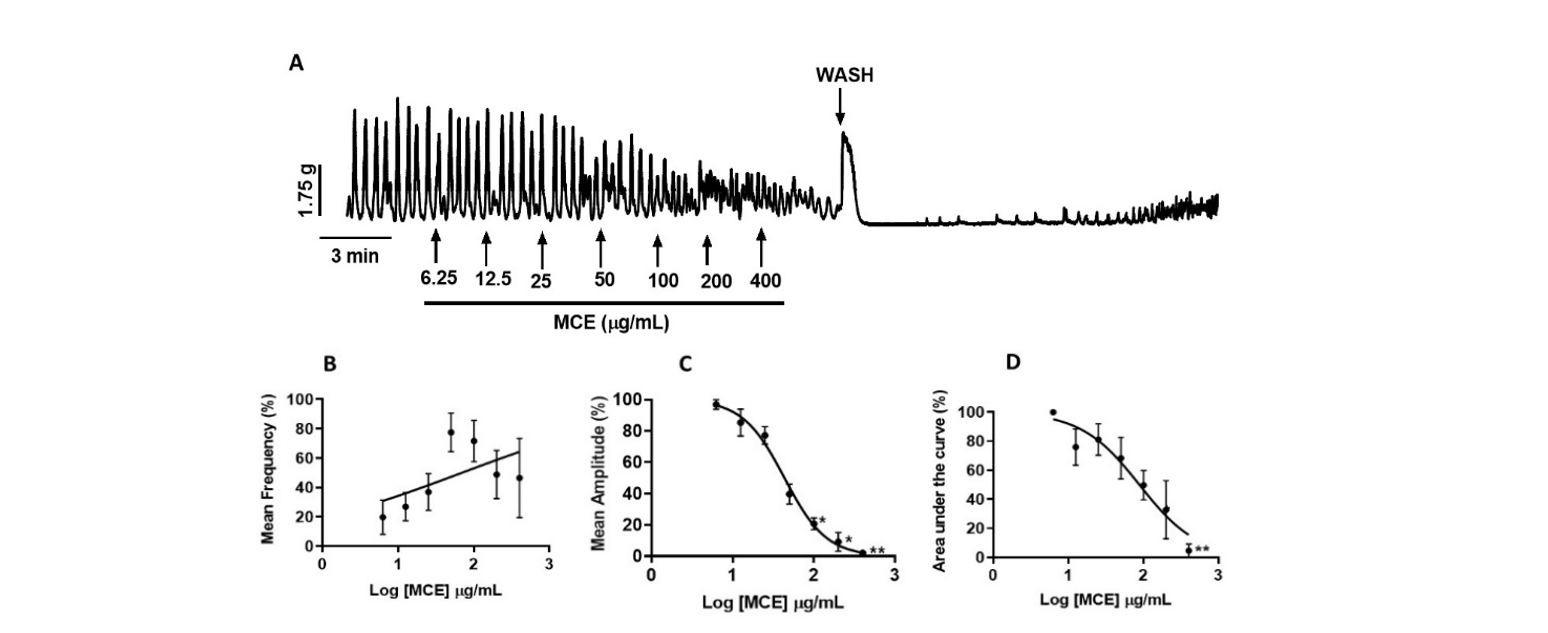
Momordica charantia L. (Cucurbitaceae) is widely used in traditional medicine for the management of various ailments, including reproductive disorders. However, its direct effects on uterine contractility remain poorly understood. This study investigated the tocolytic activity of the hydroethanol leaf extract of M. charantia (MCE) and its possible mechanisms of action in isolated non-pregnant mouse uterus. Uterine tissues obtained from estrus-phase Swiss albino mice were mounted in organ baths, and contractile responses were recorded using an isometric force transducer. The effects of cumulative concentrations of MCE (6.25–400 μg/mL) were evaluated on spontaneous contractions and contractions induced by oxytocin (14 nM), potassium chloride (KCl, 80 mM), prostaglandin F₂α (PGF₂α, 10⁻⁶ M), and methacholine (MCh, 10 μM). Mechanistic studies were conducted using calcium-free physiological salt solution containing EDTA, propranolol (20 μM), and tetraethylammonium (5 mM). MCE produced concentration-dependent inhibition of spontaneous uterine contractions, significantly reducing contraction amplitude and overall contractile activity (n = 5; p < 0.05, p < 0.01). Similar inhibitory effects were observed against oxytocin-, KCl-, PGF₂α-, and MCh-induced contractions. In calcium-free medium, MCE did not significantly inhibit oxytocin-induced transient contractions. Pretreatment with propranolol or tetraethylammonium did not abolish the inhibitory activity of MCE, although slight rightward shifts in concentration–response curves were observed. These findings provide evidence that MCE exerts potent uterine relaxant effects predominantly through inhibition of extracellular calcium influx, with a possible secondary contribution from potassium channel activation, supporting its potential as a source of novel tocolytic agents.
References
REFERENCE
1. Aguilar, H.N. & Mitchell, B.F., (2010) . Physiological pathways and molecular mechanisms regulating uterine contractility. Human reproduction update, 16(6): 725-744.
2. Alotaibi, M.F. (2020). Pimpinella anisum extract attenuates spontaneous and agonist-induced uterine contraction in term-pregnant rats. Journal of Ethnopharmacology 254: 112730.
3. Bafor, E.E., Ukpebor, F., Omoruyi, O., Ochoyama, E., Omogiade, G., Ekufu, J. and Edrada-Ebel, R., (2019). Tocolytic activity assessment of the methanol leaf extract of Justicia flava Vahl (Acanthaceae) on mouse myometrial contractility and preliminary mass spectrometric determination of secondary metabolites. Journal of ethnopharmacology, 243: 112087.
4. Berridge, M.J., Bootman, M.D. and Roderick, H.L., (2003). Calcium signalling: dynamics, homeostasis and remodelling. Nature reviews Molecular cell biology, 4(7): 517-529.
5. Bootman, M.D. & Bultynck, G., 2020. Fundamentals of cellular calcium signaling: a primer. Cold Spring Harbor perspectives in biology, 12(1), p.a038802.
6. Burdyga T, Wray S, Noble K (2007). In situ calcium signaling: no calcium sparks detected in rat myometrium. Annals of the New York Academy of Sciences. 1101(1):85-96.
7. Greenwood, I.A. & Tribe, R.M., (2014). Kv7 and Kv11 channels in myometrial regulation. Experimental physiology, 99(3): 503-509.
8. Grover, J.K. & Yadav, S.P., (2004). Pharmacological actions and potential uses of Momordica charantia: a review. Journal of ethnopharmacology, 93(1):123-132.
9. Handa, S.S., (2008). An overview of extraction techniques for medicinal and aromatic plants. Extraction technologies for medicinal and aromatic plants, 1(1): 21-40.
10. Kole, C., Matsumura, H., Behera, T.K. eds., (2020). The bitter gourd genome, 10: 978-3. Cham Switzerland: Springer.
11. Kudlak, M., & Tadi, P. (2023). Physiology, muscarinic receptor. In: StatPearls [Internet]. Treasure Island (FL): StatPearls Publishing.
12. Li, Z., Xia, A., Li, S., Yang, G., Jin, W., Zhang, M., Wang, S., (2020). The pharmacological properties and therapeutic use of bitter melon (Momordica charantia L.). Current Pharmacology Reports, 6(3):103-109.
13. Malik, M., Roh, M., England, S.K. (2021). Uterine contractions in rodent models and humans. Acta Physiologica 231(4): e13607.
14. Marieb, E.N. & Hoehn, K., (2007). Human anatomy & physiology. Pearson education.
15. Mayer, C. & Apodaca-Ramos, I., (2023). Tocolysis. In StatPearls [Internet]. StatPearls Publishing.
16. National Research Council. Guide for the care and use of laboratory animals. In: Guide for the Care and Use of Laboratory Animals, eighth ed. National Academies Press 2010;118.
17. Nicolì, P., Viganò, P., De Ziegler, D., Saccone, G., Saponara, S., Vitale, S.G., Di Naro, E., Cicinelli, E., Pinto, V. and Vitagliano, A., (2026). Decoding uterine contractility: from physiology to pathology, through emerging technologies. Reproductive BioMedicine Online, 52(3):105355.
18. Pehlivanoğlu, B., Bayrak, S., Doğan, M., (2013). A close look at the contraction and relaxation of the myometrium; the role of calcium. Journal of the Turkish German Gynecological Association, 14(4): 230.
19. Rabizadeh, F., (2025). A review of medicinal plants used for uterine disorders in Makhzan al-Adwiyyah: Insights from Persian Medicine. Iranian Journal of Pharmaceutical Research, 24(1): e160193.
20. Riaposova. L., Kim, S.H., Hanyaloglu, A.C. et al (2023). Prostaglandin F2α requires activation of calcium-dependent signalling to trigger inflammation in human myometrium. Frontiers in Endocrinology 14: 1150125.
21. Sharmin, Z.R., Akter, M.T., Rahman, R., Hoque, M., Khan, I., Mosaddek, A.S.M. (2017). Comparative study of hypolipidemic effects of Momordica charantia (karela) with atorvastatin in fat fed rats. Journal of Human Health Research, 1(1):11.
22. Shmygol, A., Blanks, A.M., Bru‐Mercier, G.I.L.L.E.S., Gullam, J.E., Thornton, S., (2007). Control of uterine Ca2+ by membrane voltage: toward understanding the excitation–contraction coupling in human myometrium. Annals of the New York Academy of Sciences, 1101(1): 97-109.
23. Shobha, C.R., Vishwanath, P., Suma, M.N., Prashant, A., Rangaswamy, C., Gowdappa, B.H., (2015). In vitro anti-cancer activity of ethanolic extract of Momordica charantia on cervical and breast cancer cell lines. International Journal of Health Allied Science, 4(4): 210-210.
24. Sukwan, C., Wray, S., Kupittayanant, S. (2014). The effects of Ginseng Java root extract on uterine contractility in nonpregnant rats. Physiological Reports, 2(12): e12230.
25. Tamilanban, T. (2018) In vitro neuroprotective effect of charantin from Momordica charantia against neurotoxin and endoplasmic reticulum stress-induced cell death in SH-SY5Y cells. International Journal of Green Pharmacy, 12(03): S555–S560.
26. Tortora, G.J. & Derrickson, B.H., (2018). Principles of anatomy and physiology. John wiley & sons, pp.1055–1104).
27. Uchendu, A.P., & Eghianruwa, E.E. (2026) Effects of Syzygium aromaticum (L.) Merr. & L.M Perry (Cloves) Extract on Uterine Contractions and its Underlying Mechanisms: An Ex vivo Study. Trend of Natural Products Research, 7(2): 95-111
28. Uchendu, A., & Nwachukwu, M. U. (2026). Uterorelaxant Activity of Laurus nobilis L. Leaf Extract on Mouse Uterine Contractility. Nigerian Journal of Pharmaceutical and Applied Science Research, 15(1): 36–46.
29. Vrachnis, N., Malamas, F.M., Sifakis, S., Deligeoroglou, E. and Iliodromiti, Z., (2011). The oxytocin‐oxytocin receptor system and its antagonists as tocolytic agents. International Journal of Endocrinology, (1), p.350546.
30. World Health Organization, (2005). National policy on traditional medicine and regulation of herbal medicines: Report of a WHO global survey. World Health Organization.
31. Wray, S., & Prendergast, C. (2019). The Myometrium: From Excitation to Contractions and Labour. Advances in Experimental Medicine and Biology, 1124, 233–263.
32. Wray, S., (2007). Insights into the uterus. Experimental physiology, 92(4): 621-631.
33. Zainol, S., Dewa, A., Mohamed, N., Razali, N., Manshor, N.M. and Jusoh, R.R., (2024). Vasorelaxant Activity and Its Mechanisms of Momordica charantia Fruit Extract in Diabetic Rat Aorta. Malaysian Journal of Medicine & Health Sciences, 20 (SUPP1): 93-104
Downloads
Published
Issue
Section
Categories
License
Copyright (c) 2026 Adaeze Phina Uchendu, Annabella Chinyere Chukwuemeka

This work is licensed under a Creative Commons Attribution 4.0 International License.


