
An Intrusion Detection System Based on Hybridized Firefly and Artificial Bee Colony Optimization Algorithms
DOI:
https://doi.org/10.33003/fjs-2026-10(ANB-K)-5306Keywords:
Intrusion Detection System, Firefly Algorithm, Artificial Bee Colony, Swarm Intelligence, Cyber securityAbstract
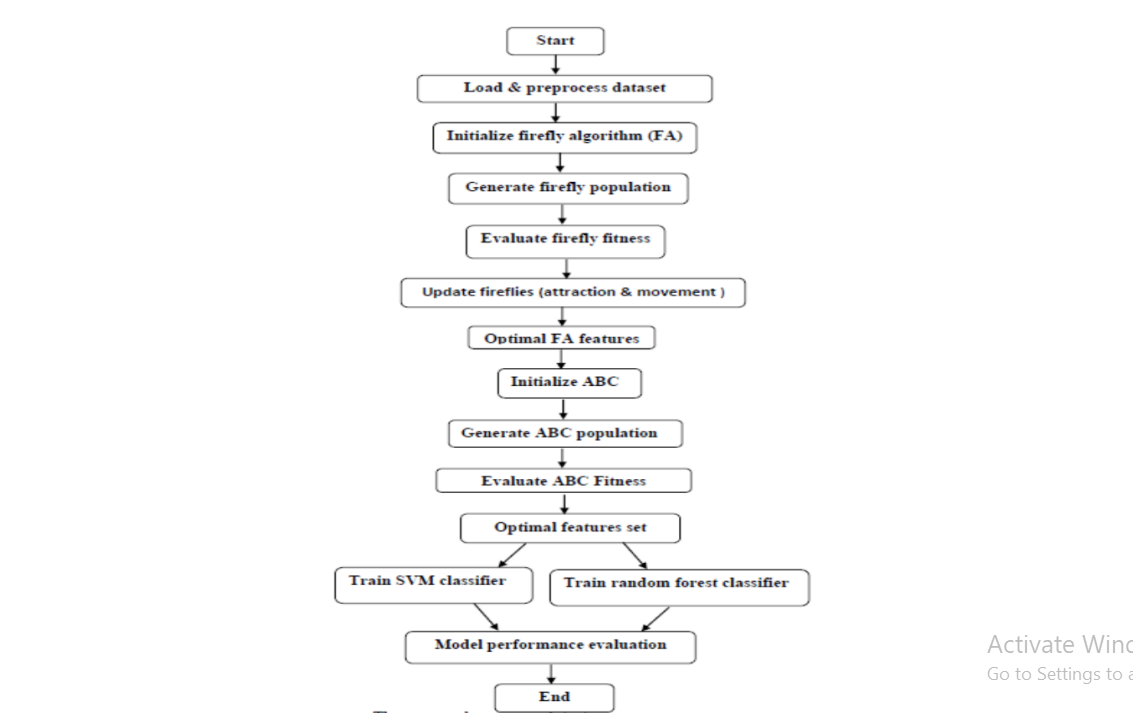
Intrusion Detection Systems (IDS) are fundamental to safeguarding network infrastructures against evolving cyber threats; however, traditional detection techniques often face challenges associated with high-dimensional datasets, limited adaptability, and suboptimal detection accuracy. This study presents a hybrid intrusion detection framework that combines the Firefly Algorithm (FA) and Artificial Bee Colony (ABC) optimization algorithm to improve detection performance through optimized feature selection and reduced false alarm rates. The NSL-KDD dataset was preprocessed by eliminating irrelevant attributes and normalizing input features to enhance data consistency and analytical efficiency. The proposed hybrid FA-ABC approach exploits the local search capability of the FA and the global exploration strength of the ABC algorithms to achieve effective intrusion detection. Performance evaluation was conducted using different data partitioning ratios, including 80:20, 70:30, 75:25, and 65:35. Experimental results demonstrated that the hybrid framework consistently outperformed the standalone FA and ABC approaches across key performance indicators. Among the evaluated partitions, the 80:20 ratio achieved the highest Area under Receiver Operating Characteristic (AUC-ROC) score of 0.90, indicating superior classification accuracy and stable convergence characteristics. Despite these improvements, the 75:25 partition exhibited extremely low population diversity, reflecting reduced adaptability under certain optimization conditions. This limitation highlights the necessity for future enhancement strategies aimed at preserving diversity during optimization. Overall, the proposed framework provides an efficient and reliable IDS suitable for real-time cybersecurity applications and offers potential for future integration with deep learning-based security systems.
References
Abass, M. N. (2020). Intelligent Hybrid Approach for Classification Accuracy of Intrusion Detection System. Isra University, Amman, Jordan.
Akoul, N., Ahmad, A. A., & Pro, S. (2026). A hybrid approach for network intrusion detection using artificial bee colony optimization and ensemble learning. Journal of Engineering and Applied Science, 73(37), 1–22.
Aldwairi, M., Khamayseh, Y., & Al-Masri, M. (2012). Application of artificial bee colony for intrusion detection systems. Security and Communication Networks. https://doi.org/10.1002/sec
Almomani, O. (2021). A Hybrid Model Using Bio-Inspired Metaheuristic Algorithms for Network Intrusion Detection System. Computers, Materials & Continua, 68(1), 409–429. https://doi.org/10.32604/cmc.2021.016113
Alwan, K. M., AbuEl-Atta, A. H., & Zayed, H. H. (2021). Feature Selection Models Based on Hybrid Firefly Algorithm with Mutation Operator for Network Intrusion Detection. International Journal of Intelligent Engineering & Systems, 14(1), 192–202. https://doi.org/10.22266/ijies2021.0228.19
Awotunde, J. B., & Misra, S. (2022). Feature Extraction and Artificial Intelligence-based Intrusion Detection Model for a Secure Internet of Things Networks (S. Misra & C. Arumugam (eds.)). Springer Nature.
Aydilek, I. B. (2018). A hybrid firefly and particle swarm optimization algorithm for solving numerical optimization problems. Applied Soft Computing, 73, 748–764.
Balasaraswathi, V. R., Sugumaran, M., & Hamid, Y. (2017). Feature selection techniques for intrusion detection using non-bio-inspired and bio-inspired optimization algorithms. Journal of Communication and Information Networks, 2(4), 107–119.
Ghanem, W. A. L. I. H. M., Jantan, A., Abduljabbar, S., Ghaleb, A., & Nasser, A. B. (2020). An Efficient Intrusion Detection Model Based on Hybridization of Artificial Bee Colony and Dragonfly Algorithms for Training Multilayer Perceptrons. IEEE Access, 8, 130452–130475. https://doi.org/10.1109/ACCESS.2020.3009533
Kamil, S., Sheikh Abdullah, S.N.H., Firdaus, A. and Usman, O.L. (2022), The Rise of Ransomware: A Review of Attacks, Detection Techniques, and Future Challenges. Proceedings of the 2022 International Conference on Business Analytics for Technology and Security (ICBATS), Dubai, United Arab Emirates, 16-17 February 2022. https://doi.org/10.1109/ICBATS54253.2022.9759000
Kaur, A., Pal, S. K., & Pal, A. (2018). Hybridization of K-Means and Firefly Algorithm for intrusion detection system. International Journal of System Assurance Engineering and Management, 9, 901–910. https://doi.org/10.1007/s13198-017-0683-8
Lee, W., & Stolfo, S. J. (1998). Data mining approaches for intrusion detection. In USENIX Security Symposium (79–94).
Majdouli, A., Boudguiga, A., & Kachouri, A. (2017). Comparative study of swarm intelligence for big data classification. Procedia Computer Science, 112, 447–456.
Mashhour, A., El-Masri, S., & Farouk, H. (2018). A novel firefly-based classifier for network intrusion detection. Information Security Journal: A Global Perspective, 27(3), 102–110.
Mazini, M., Shirazi, B., & Mahdavi, I. (2019). Anomaly network-based intrusion detection system using a reliable hybrid artificial bee colony and AdaBoost algorithms. Journal of King Saud University - Computer and Information Sciences, 31(4), 541–553. https://doi.org/10.1016/j.jksuci.2018.03.011
Ogundokun, R. O., Misra, S., Bajeh, A. O., Okoro, U. O., & Ahuja, R. (2022). An Integrated IDS using ICA-based Feature Selection and SVM Classification Method (S. Misra & C. Arumugam (Eds.)). Springer Nature.
Panliang, M., Madaan, S., Ahmed, S., Ali, B., Gowrishankar, J., & Khatibi, A. (2025). Enhancing feature selection for multi-pose facial expression recognition using a hybrid of quantum inspired firefly algorithm and artificial bee colony algorithm. Scientific Reports, 15(4665), 1–23.
Prithi, S., & Sumathi, S. (2024). A technical research survey on bio-inspired intelligent optimization grouping algorithms for finite state automata in intrusion detection system. MultiCraft International Journal of Engineering, Science and Technology, 16(2), 48–67. https://doi.org/10.4314/ijest.v16i2.6
Radhakrishnan, S., Aljawarneh, P., & Kumar, V. (2019). Snort – Lightweight intrusion detection for networks. In Proceedings of the 13th USENIX Conference on System Administration (LISA ’99), 229–238.
Rufai, K.I., Usman, O.L., Muniyandi, R.C. and Oyinkanola, L.O.A. (2021a), Modelling Credit Card Payment Fraud Detection System for Financial Institutions in Nigeria Using an Improved Firefly Algorithm. International Journal of Information Processing and Communication (IJIPC), 11(1): 9-25. A Publication of Faculty of Communication and Information Sciences, University of Ilorin, Kwara State, Nigeria.
Rufai, K. I., Usman, O. L., Olusanya, O. O. and Adedeji, O. B. (2021b), Solving Travelling Salesman Problem using an Improved Ant Colony Optimization Algorithm. University of Ibadan Journal of Science and Logics in ICT Research (UIJSLICTR), 6(2): 158-170.
Rufai, K.I., Muniyandi, R. C., and Usman, O.L. (2016), Tacking the Course of Dimensionality in Intrusion Detection Systems: Membrane Computing Approach. Proceedings of the 2nd TASUED-UCC International Conference, Tai Solarin University of Education, Nigeria, August 22nd -25th, 2016, pp. 1539-1549.
Saheed, Y. K. (2022). A Binary Algorithm based Feature Selection Method on High Dimensional Intrusion Detection Data (S. Misra & C. Arumugam (Eds.)). Springer Nature.
Shang‑fu, Z., Zhao, X., Li Y., & Chen, W. (2012). An improved intrusion detection algorithm based on classification. Journal of Software, 7(7), 1549–1556.
Usman, O. L. (2025). Identifying Significant Structural Factors associated with Knee Pain Severity in Patients with Osteoarthritis using Hybrid Bio-BERT Bi-LSTM CNN Model. Journal of Science and Information Technology (JOSIT), 19(2): 18-28.
Usman O.L, & Adeusi O.O. (2025). Optimization of an efficient net-based transfer learning model for automated pneumonia detection from chest x-ray images. Dutse Journal of Pure and Applied Sciences, 11(4a), 397–411. Retrieved from https://www.ajol.info/index.php/dujopas/article/view/311486
Usman, O. L. & Muniyandi, R. C. (2020). CryptoDL: Predicting Dyslexia Biomarkers from Encrypted Neuroimaging Dataset Using Energy-Efficient Residue Number System and Deep Convolutional Neural Network. Symmetry MDPI-Basel, 12(836), 1–24. https://doi.org/10.3390/sym12050836
Usman, O. L., Muniyandi, R. C., Omar, K., & Mohamad, M. (2021). Advanced machine learning methods for dyslexia biomarker detection: A review of implementation details and challenges. IEEE Access, 9, 36879–36894. https://doi.org/10.1109/ACCESS.2021.3062709
Usman, O. L., Adeusi, O. O., Kareem, M. A., Owoade, A. A., Muniyandi, R. C. (2026). Quantitative Study on Impact of EfficientNet-based Deep Transfer Learning Model for Pneumonia Detection with Explainable Artificial Intelligence using Chest Radiographs. Zamfara International Journal of Science, Technology, Education & Mathematics (ZIJSTEM), 3(1). 1-11.
Yinka-Banjo, C., Alli, P., Misra, S., Oluranti, J., & Ahuja, R. (2022). Intrusion Detection using Anomaly Detection Algorithm and Snort (S. Misra & C. Arumugam (Eds.)). Springer Nature.
Zivkovic, M., Tair, M., Venkatachalam, K., Bacanin, N., & Trojovský, P. (2022). Novel hybrid firefly algorithm : an application to enhance XGBoost tuning for intrusion detection classification. PeeJ Computer Science, 8(e956), 1–38. https://doi.org/10.7717/peerj-cs.956
Downloads
Published
Issue
Section
Categories
License
Copyright (c) 2026 Opeyemi Lateef Usman, Morufat Adebola Kareem

This work is licensed under a Creative Commons Attribution 4.0 International License.


