
Comparative Analysis of Supervised Machine Learning Models for Crime Type Classification on Chicago Data
DOI:
https://doi.org/10.33003/fjs-2026-1008-5296Keywords:
Artificial Intelligence (AI), Machine Learning (ML), Deep Learning (DL), Crime Prediction (CP), Cyber Security (CS)Abstract
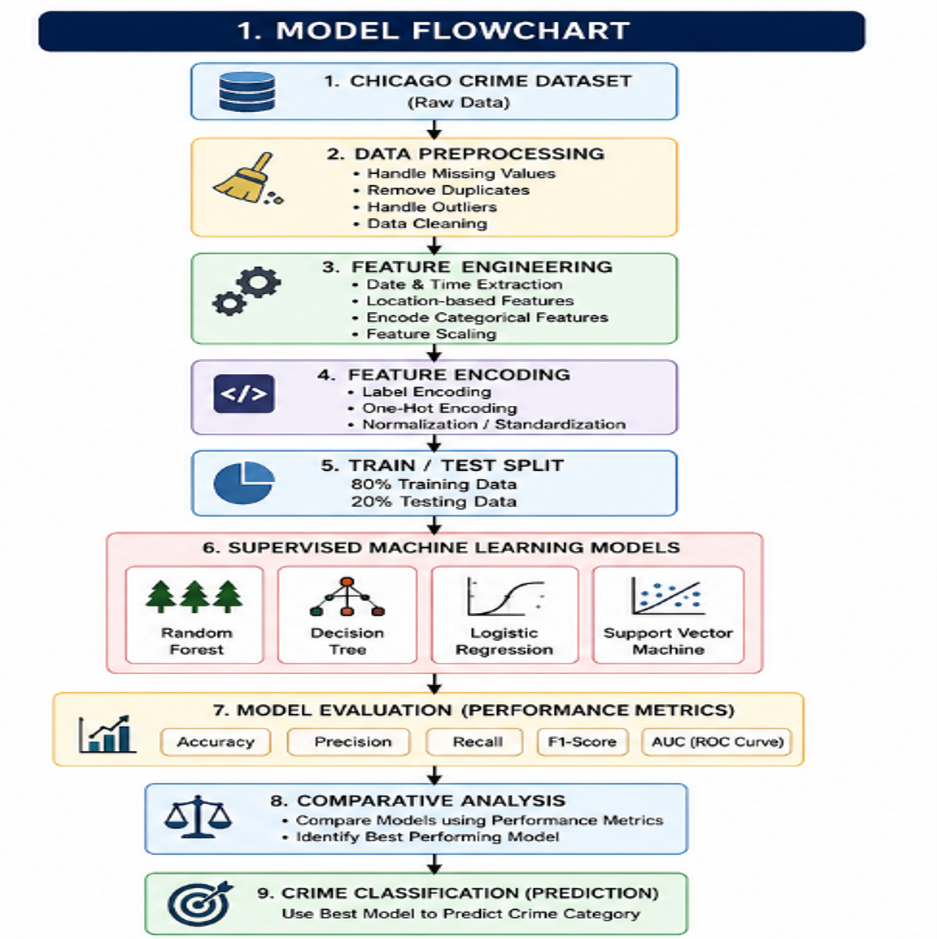
The increase in crime can be caused by several factors. As growth in population and density, criminal behavior, domestic crime growth, and so on. This causes difficulties for the law enforcement agencies to control and monitor on a regular crime basis since it requires forecasting and probabilities, significant progress has been made from traditional machine learning techniques (ML) to modern techniques neural networks (NNs), the advancement of these technologies have improved the operational efficiency of critical infrastructures but have also rendered these substantially more vulnerable to domestic crime. In this study, we explore how at least four machine learning techniques perform in prediction of crime under measured experimental conditions. A dataset comprising 3,000 crime records was used for the experiment, consisting of three balanced classes: narcotics, burglary, and robbery, with 1,000 samples allocated to each category. The results show that decision tree (DT) achieved accuracy of 90.33%, and random forest (RF) with an accuracy of 90.33% consistently outperformed logistic regression (LR), support Vector machine (SVM), the SVM [UY1] model reached a higher 90.16%, while the accuracy obtained by LR is peak at 90.03%.
[UY1]Add the full meaning of these similar to what you did for ML, RF, DT…...
References
Algefes, A., Aldossari, N., Masmoudi, F., & Kariri, E. (2022). A Text-mining approach for crime tweets in Saudi Arabia: From analysis to prediction. Proceedings - 2022 7th International Conference on Data Science and Machine Learning Applications, CDMA 2022, 109–114. https://doi.org/10.1109/CDMA54072.2022.00023
Alves, L. G. A., Ribeiro, H. V., & Rodrigues, F. A. (2018). Crime prediction through urban metrics and statistical learning. Physica A: Statistical Mechanics and Its Applications, 505, 435–443. https://doi.org/10.1016/j.physa.2018.03.084
Araujo, A., Cacho, N., Bezerra, L., Vieira, C., & Borges, J. (2019). Towards a Crime Hotspot Detection Framework for Patrol Planning. Proceedings - 20th International Conference on High Performance Computing and Communications, 16th International Conference on Smart City and 4th International Conference on Data Science and Systems, HPCC/SmartCity/DSS 2018, 1256–1263. https://doi.org/10.1109/HPCC/SmartCity/DSS.2018.00211
Azhari, & Utomo, P. E. P. (2018). Prediction the crime motorcycles of theft using ARIMAX-TFM with single input. Proceedings of the 3rd International Conference on Informatics and Computing, ICIC 2018, 1–7. https://doi.org/10.1109/IAC.2018.8780520
Bharadiya, J. (2023). Machine Learning in Cybersecurity: Techniques and Challenges. European Journal of Technology, 7(2), 1–14. https://doi.org/10.47672/ejt.1486
Chapman, A., Grylls, P., Ugwudike, P., Gammack, D., & Ayling, J. (2022). A Data-driven analysis of the interplay between Criminological theory and predictive policing algorithms. ACM International Conference Proceeding Series, 36–45. https://doi.org/10.1145/3531146.3533071
Chun, S. A., Pathak, R., Paturu, V. A., Atluri, V., Yuan, S., & Adam, N. R. (2019). Crime Prediction Model using Deep Neural Networks. ACM International Conference Proceeding Series, 512–514. https://doi.org/10.1145/3325112.3328221
Da Silva, A. R. C., De Paula Junior, I. C., Da Silva, T. L. C., De Macedo, J. A. F., & Silva, W. C. P. (2020). Prediction of crime location in a brazilian city using regression techniques. Proceedings - International Conference on Tools with Artificial Intelligence, ICTAI, 2020-Novem, 331–336. https://doi.org/10.1109/ICTAI50040.2020.00059
Das, P., Das, A. K., Nayak, J., Pelusi, D., & Ding, W. (2021). Incremental classifier in crime prediction using bi-objective Particle Swarm Optimization. Information Sciences, 562, 279–303. https://doi.org/10.1016/j.ins.2021.02.002
Elluri, L., Mandalapu, V., & Roy, N. (2019). Developing machine learning based predictive models for smart policing. Proceedings - 2019 IEEE International Conference on Smart Computing, SMARTCOMP 2019, 198–204. https://doi.org/10.1109/SMARTCOMP.2019.00053
Gong, J., Zhang, H., & Du, W. (2020). Research on integrated learning fraud detection method based on combination classifier fusion (thbagging): A case study on the foundational medical insurance dataset. Electronics (Switzerland), 9(6). https://doi.org/10.3390/electronics9060894
Han, X., Hu, X., Wu, H., Shen, B., & Wu, J. (2020). Risk Prediction of Theft Crimes in Urban Communities: An Integrated Model of LSTM and ST-GCN. IEEE Access, 8, 217222–217230. https://doi.org/10.1109/ACCESS.2020.3041924
Hossain, S., Abtahee, A., Kashem, I., Hoque, M. M., & Sarker, I. H. (2020). Crime prediction using spatio-temporal data. In Communications in Computer and Information Science: 1235 CCIS. Springer Singapore. https://doi.org/10.1007/978-981-15-6648-6_22
Ingilevich, V., & Ivanov, S. (2018). Crime rate prediction in the urban environment using social factors. Procedia Computer Science, 136, 472–478. https://doi.org/10.1016/j.procs.2018.08.261
Kapadiya, K., & Patel, U. (2022). Blockchain and AI-Empowered Healthcare Insurance Fraud Detection : An Analysis, Architecture , and Future Prospects. IEEE Access, 10(August), 79606–79627. https://doi.org/10.1109/ACCESS.2022.3194569
Kim, S., Joshi, P., Kalsi, P. S., & Taheri, P. (2018). Crime Analysis Through Machine Learning. 2018 IEEE 9th Annual Information Technology, Electronics and Mobile Communication Conference, IEMCON 2018, (January), 415–420. https://doi.org/10.1109/IEMCON.2018.8614828
Kshatri, S. S., Singh, D., Narain, B., Bhatia, S., Quasim, M. T., & Sinha, G. R. (2021). An Empirical Analysis of Machine Learning Algorithms for Crime Prediction Using Stacked Generalization: An Ensemble Approach. IEEE Access, 9, 67488–67500. https://doi.org/10.1109/ACCESS.2021.3075140
Mandalapu, V., Elluri, L., Vyas, P., & Roy, N. (2023). Crime Prediction Using Machine Learning and Deep Learning: A Systematic Review and Future Directions. IEEE Access, 11(April), 60153–60170. https://doi.org/10.1109/ACCESS.2023.3286344
Meijer, A., & Wessels, M. (2019). Predictive Policing: Review of Benefits and Drawbacks. International Journal of Public Administration, 42(12), 1031–1039. https://doi.org/10.1080/01900692.2019.1575664
Nakib, M., Khan, R. T., Hasan, M. S., & Uddin, J. (2018). Crime Scene Prediction by Detecting Threatening Objects Using Convolutional Neural Network. International Conference on Computer, Communication, Chemical, Material and Electronic Engineering, IC4ME2 2018, 1–4. https://doi.org/10.1109/IC4ME2.2018.8465583
Neil, S., Nandish, B., & Manan, S. (2013). Crime forecasting: a machine learning and computer vision approach to crime prediction and prevention. Visual Computing for Industry, Biomedicine, and Art, 7(9), 1–14.
Opeyemi Babatunde, G., Damilola Mustapha, S., Ike, C. C., Alabi, A. A., & Babatunde, G. O. (2025). A holistic cyber risk assessment model to identify and mitigate threats in us and canadian enterprises. Article in International Journal of Multidisciplinary Research and Growth Evaluation, 773–787. www.allmultidisciplinaryjournal.com
Papathanasiou, A., Liontos, G., Katsouras, A., Liagkou, V., & Glavas, E. (2025). Cybersecurity Guide for SMEs: Protecting Small and Medium-Sized Enterprises in the Digital Era. Journal of Information Security, 16(01), 1–43. https://doi.org/10.4236/jis.2025.161001
Raza, D. M., & Victor, D. B. (2021). Crime Using Random Forest. Proceedings of the International Conference on Artificial Intelligence and Smart Systems (ICAIS-2021), 7, 980–987.
Safat, W., Asghar, S., & Gillani, S. A. (2021). Empirical Analysis for Crime Prediction and Forecasting Using Machine Learning and Deep Learning Techniques. IEEE Access, 9, 70080–70094. https://doi.org/10.1109/ACCESS.2021.3078117
Saraiva, M., Matijošaitienė, I., Mishra, S., & Amante, A. (2022). Crime Prediction and Monitoring in Porto, Portugal, Using Machine Learning, Spatial and Text Analytics. ISPRS International Journal of Geo-Information, 11(7). https://doi.org/10.3390/ijgi11070400
Sathiyanarayanan, M., Junejo, A. K., & Fadahunsi, O. (2019). Visual Analysis of Predictive Policing to Improve Crime Investigation. Proceedings of the 4th International Conference on Contemporary Computing and Informatics, IC3I 2019, 197–203. https://doi.org/10.1109/IC3I46837.2019.9055515
Sharma, S., & Chaudhary, P. (2023). Machine learning and deep learning. Quantum Computing and Artificial Intelligence: Training Machine and Deep Learning Algorithms on Quantum Computers, 71–84. https://doi.org/10.1515/9783110791402-004
Trinhammer, M. L., Merrild, A. C. H., Lotz, J. F., & Makransky, G. (2022). Predicting crime during or after psychiatric care: Evaluating machine learning for risk assessment using the Danish patient registries. Journal of Psychiatric Research, 152(June), 194–200. https://doi.org/10.1016/j.jpsychires.2022.06.009
Tsiodra, M., Panda, S., Chronopoulos, M., & Panaousis, E. (2023). Cyber Risk Assessment and Optimization: A Small Business Case Study. IEEE Access, 11(April), 44467–44481. https://doi.org/10.1109/ACCESS.2023.3272670
Zhang, X., Liu, L., Lan, M., Song, G., Xiao, L., & Chen, J. (2022). Interpretable machine learning models for crime prediction. Computers, Environment and Urban Systems, 94(November 2021), 101789. https://doi.org/10.1016/j.compenvurbsys.2022.101789
Downloads
Published
Issue
Section
Categories
License
Copyright (c) 2026 Yazid Salihu, Musab Hassan Bodinga

This work is licensed under a Creative Commons Attribution 4.0 International License.


