
Epidemiological Pattern and Clinical Outcomes of Measles among Children Managed at Modibbo Adama University Teaching Hospital, Yola, North-East Nigeria: A Retrospective Study
DOI:
https://doi.org/10.33003/fjs-2026-1014-5291Keywords:
Measles, Epidemiology, Vaccination Coverage, Case Fatality Rate, Child Mortality, North-Eastern NigeriaAbstract
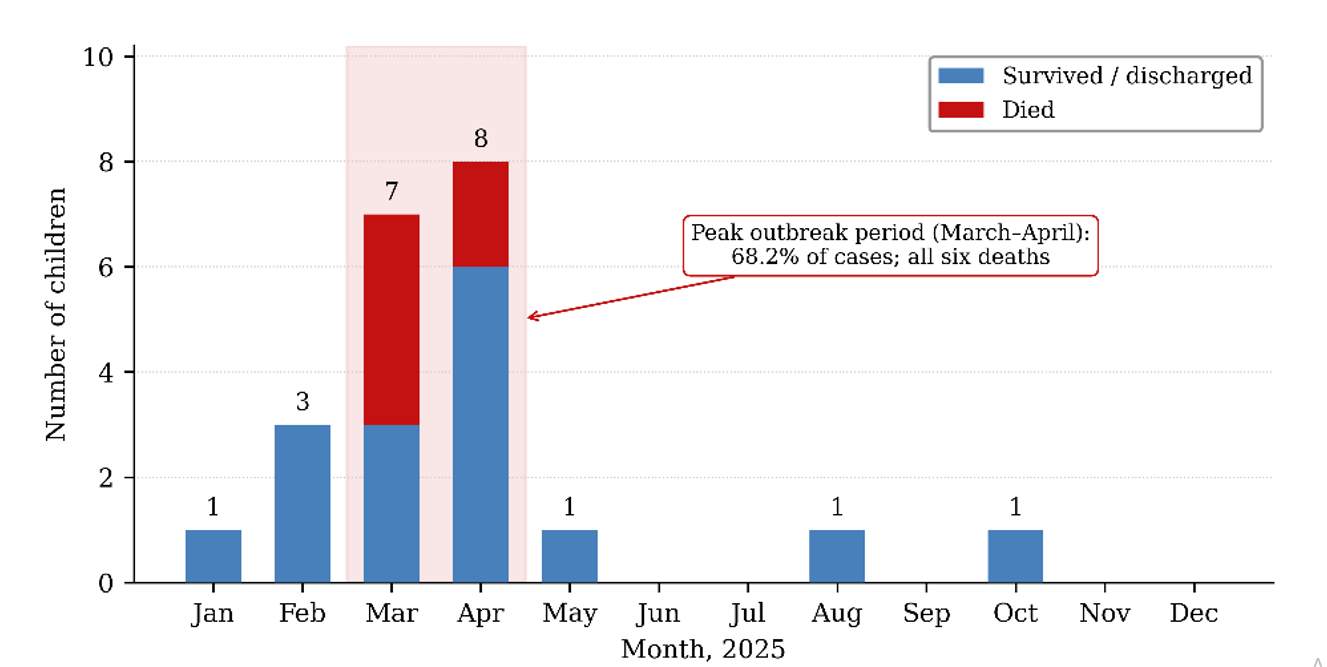
Measles is a vaccine-preventable disease that continues to cause substantial childhood morbidity and mortality in Nigeria, particularly in the north, where vaccination coverage remains suboptimal, population displacement is widespread, and access to healthcare is limited. Objectives: This study aimed to describe the epidemiological pattern, vaccination status, clinical complications, and outcomes of measles among children managed at Modibbo Adama University Teaching Hospital (MAUTHY), Yola, Adamawa State, North-East Nigeria. Methods: A retrospective cross-sectional study was conducted among 22 children aged 1 month to 17 years admitted with clinical measles between January and December 2025. Data were extracted from medical records using a structured form and analysed with IBM SPSS Statistics version 21; Fisher’s exact test was used for categorical associations (p < 0.05). Results and Discussion: Children under five years accounted for 86.4% of admissions; children aged 1–4 years formed the largest age group (54.5%). Sex distribution was equal. Most children (81.8%) were unvaccinated or incompletely vaccinated. A marked seasonal peak occurred in March–April, accounting for 68.2% of cases and all deaths. Bronchopneumonia (90.9%), severe acute malnutrition (81.8%), and diarrhoea (68.1%) were the commonest complications. Six children died, yielding a case fatality rate of 27.3%; four deaths occurred within 24 hours of admission. No statistically significant association was detected between age group and outcome (p = 1.000). Conclusion: Measles imposes a severe, preventable burden on children in Adamawa State. Strengthening routine immunization, nutritional support, and early care-seeking behaviour are essential priorities.
References
Adamawa State Bureau of Statistics. (2021). Adamawa at a glance. Adamawa State Bureau of Statistics. Available on: https://adsbs.ad.gov.ng/about/adamawaataglance Accessed on: 27 August 2026.
Adamawa State Government. (2020). Adamawa State situation analysis of children. Adamawa State Planning Commission.
Bala, H. A., Yahaya, M., Barau, N., Surajudeen, L., Abdullateef, I. R., & Amaza, C. R. (2025). Descriptive characterization of measles in Kebbi State, Nigeria, 2013–2017. Journal of Interventional Epidemiology and Public Health, 8, 12. Available on: https://www.afenet-journal.net/content/article/8/12/full Accessed on: 27 August 2026.
de Vries, R. D., Mesman, A. W., Geijtenbeek, T. B. H., Duprex, W. P., & de Swart, R. L. (2012). The pathogenesis of measles. Current Opinion in Virology, 2(3), 248–255. https://doi.org/10.1016/j.coviro.2012.03.005
Eze, U., Adewuyi, O., & Abubakar, M. (2020). Investigation of the 2019 measles outbreak in Yobe State, North-East Nigeria. International Journal of Infectious Diseases, 101(Suppl. 1), 319. https://doi.org/10.1016/j.ijid.2020.09.832
Garba, F., Usman, R., Umeokonkwo, C., Okolocha, E., Yahaya, M., AbdulQadir, I., Oyeladun, O., Dada, A., & Balogun, M. (2022). Descriptive epidemiology of measles cases in Zamfara State, Nigeria, 2012–2018. Journal of Interventional Epidemiology and Public Health, 5, 21. Available on: https://www.afenet-journal.net/content/article/5/21/full Accessed on: 27 August 2026.
Gaythorpe, K. A. M., Abbas, K., Huber, J., Karachaliou, A., Thakkar, N., Woodruff, K., Li, X., Echeverria-Londono, S., Ferrari, M., Jackson, M. L., McCarthy, K., Perkins, T. A., Trotter, C., & Jit, M. (2021). Impact of COVID-19-related disruptions to measles, meningococcal A, and yellow fever vaccination in 10 countries. eLife, 10, e67023. https://doi.org/10.7554/eLife.67023
Goodson, J. L., Masresha, B. G., Wannemuehler, K. A., Uzicanin, A., Cochi, S. L., & Reef, S. E. (2011). Changing epidemiology of measles in Africa. The Journal of Infectious Diseases, 204(Suppl. 1), S205–S214. https://doi.org/10.1093/infdis/jir129
Ibrahim, B., & Gana, G. (2016). Outbreak of measles in Sokoto State, Northwestern Nigeria, three months after a supplementary immunization campaign. Australasian Medical Journal, 9(1), 21–26. https://doi.org/10.4066/AMJ.2016.2697
Ibrahim, B. S., Usman, R., Mohammed, Y., Ahmed, Z. D., Okunromade, O., Abubakar, A. A., & Nguku, P. M. (2019). Burden of measles in Nigeria: A five-year review of case-based surveillance data, 2012–2016. Pan African Medical Journal, 32(Suppl. 1), 5. https://doi.org/10.11604/pamj.supp.2019.32.1.16169
Idé, H., Yanogo, P., Barry, D., Togola, O., Adehossi, E., & Meda, N. (2022). Epidemiological profile of measles in Niger: Analysis of measles case-based surveillance data from 2010 to 2019. Pan African Medical Journal, 43, 18. https://doi.org/10.11604/pamj.2022.43.18.33443
Jean Baptiste, A. E., Masresha, B., Wagai, J., Luce, R., Oteri, J., Dieng, B., Bawa, S., Ikeonu, O. C., Chukwuji, M., Braka, F., Sanders, E. A. M., Hahné, S. J. M., & Hak, E. (2021). Trends in measles incidence and measles vaccination coverage in Nigeria, 2008–2018. Vaccine, 39(Suppl. 3), C89–C95. https://doi.org/10.1016/j.vaccine.2021.03.095
Mahase, E. (2025). WHO warns that measles is back as the virus spreads across Europe, America, and Afghanistan. British Medical Journal, 388, r528. https://doi.org/10.1136/bmj.r528
Moss, W. J. (2017). Measles. The Lancet, 390(10111), 2490–2502. https://doi.org/10.1016/S0140-6736(17)31463-0
National Population Commission & ICF. (2019). Nigeria Demographic and Health Survey 2018. NPC and ICF. Available on: https://dhsprogram.com/pubs/pdf/FR359/FR359.pdf Accessed on: 27 August 2026.
Nigeria Centre for Disease Control and Prevention. (2025). Measles situation report, week 52, 2025. NCDC. Available on: https://www.ncdc.gov.ng Accessed on: 27 August 2026.
Nigerian Meteorological Agency. (2025). State of the climate in Nigeria 2025. Nigerian Meteorological Agency. Available on: https://nimet.gov.ng/socn. Accessed on: 27 August 2026.
Ochi, P. O., Agada, A. A., Nworah, I. B., Nworah, D. A., & Goni, A. N. (2024). Local and global stability analysis of measles epidemic model at disease-free equilibrium. FUDMA Journal of Sciences, 8(1), 369–379. https://doi.org/10.33003/fjs-2024-0801-2219
Olasoju, T. I., Olasoju, M. I., Daggash, B. B., Abaye, B. B., Enumah, C., Isah, S., Bolori, M. T., & Adebowale, O. O. (2024). Measles outbreak in Lambu Internally Displaced Persons’ Camp, Maiduguri, Borno State, Nigeria, 2017. Journal of Interventional Epidemiology and Public Health, 7(2), 25. Available on: https://www.afenet-journal.net/content/article/7/25/full Accessed on: 27 August 2026.
Ori, P. U., Adebowale, A., Umeokonkwo, C. D., Osigwe, U., & Balogun, M. S. (2021). Descriptive epidemiology of measles cases in Bauchi State, 2013–2018. BMC Public Health, 21, 1311. https://doi.org/10.1186/s12889-021-11063-6
Osigwe, U., Usuwa, I., Bamgboye, E., Bomoi, I., Umeokonkwo, C., & Balogun, M. (2020). Epidemiology of measles in a security-compromised setting: A retrospective analysis of surveillance data in Borno State, Nigeria, 2007–2017. International Journal of Infectious Diseases, 101(Suppl. 1), 340. https://doi.org/10.1016/j.ijid.2020.09.896
Sato, R., Makinde, O. A., Daam, K. C., & Lawal, B. (2022). Geographical and time trends of measles incidence and measles vaccination coverage and their correlation in Nigeria. Human Vaccines & Immunotherapeutics, 18(6), 2114697. https://doi.org/10.1080/21645515.2022.2114697
United Nations Office for the Coordination of Humanitarian Affairs. (2025). Nigeria 2025 humanitarian needs and response plan. OCHA. Available on: https://humanitarianaction.info/plan/1274 Accessed on: 27 August 2026.
Wolfson, L. J., Grais, R. F., Luquero, F. J., Birmingham, M. E., & Strebel, P. M. (2009). Estimates of measles case fatality ratios: A comprehensive review of community-based studies. International Journal of Epidemiology, 38(1), 192–205. https://doi.org/10.1093/ije/dyn224
World Health Organization. (2018). Measles vaccines: WHO position paper, April 2017. Weekly Epidemiological Record, 92(17), 205–228. Available on: https://www.who.int/docs/default-source/immunization/position_paper_documents/measles/measles-PP-2017.pdf Accessed on: 27 August 2026.
World Health Organization. (2024). Immunization data: Provisional measles and rubella data. WHO. Available on: https://www.who.int/teams/immunization-vaccines-and-biologicals/immunization-analysis-and-insights/surveillance/monitoring/provisional-monthly-measles-and-rubella-data Accessed on: 27 August 2026
World Health Organization Regional Office for Africa. (2023). Measles and rubella surveillance data in the African Region. WHO Regional Office for Africa. Available on: https://www.afro.who.int Accessed on: 27 August 2026.
Downloads
Published
Issue
Section
Categories
License
Copyright (c) 2026 Hayatu Ahmad

This work is licensed under a Creative Commons Attribution 4.0 International License.


