
A Systematic Ablation-Based Optimisation Protocol for Convolutional Neural Networks in Electronic Banking Fraud Detection
DOI:
https://doi.org/10.33003/fjs-2026-1012-5285Keywords:
Class imbalance, deep learning, regularisation, minority-class detection, synthetic oversamplingAbstract
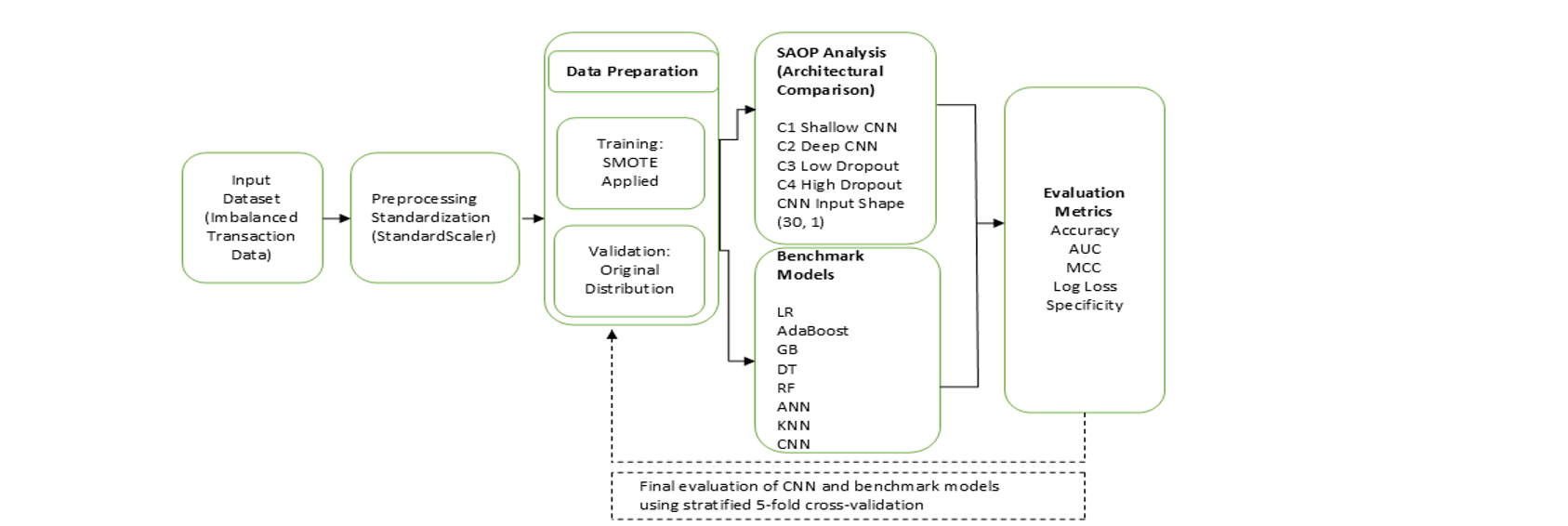
Reliable deep learning for electronic banking fraud detection remains constrained by extreme class imbalance. Standard evaluation methods frequently struggle because convolutional network choices are often assessed alongside simultaneous methodological modifications, making it difficult to determine the independent contribution of architectural design decisions. To address this problem, this study introduces the Systematic Ablation-Based Optimisation Protocol (SAOP) as a controlled evaluation framework. The protocol examines predefined CNN variations in convolutional depth and dropout regularisation under identical preprocessing, resampling, training, and evaluation conditions. Empirical testing relied on the Credit Card Fraud Detection benchmark dataset, which contains 284,807 transactions with an explicit fraud prevalence of 0.172%. Within this heavily skewed search space, internal ablation results indicate that dropout regularisation variations exerted a more measurable influence on performance than changes in convolutional depth. The proposed CNN was benchmarked against traditional machine learning models using stratified five-fold cross-validation. This architecture achieved a mean accuracy of 0.9988 ± 0.0003, a Matthews Correlation Coefficient (MCC) of 0.7081, a Receiver Operating Characteristic–Area Under the Curve (ROC-AUC) of 0.9659, and a Log Loss of 0.0104. The CNN recorded both the highest MCC and the lowest Log Loss among all evaluated models, showing stable minority-class discrimination alongside reliable probability calibration. These results indicate that architectural design choices remain an important consideration in CNN-based fraud detection under severe class imbalance.
References
European Banking Authority. (2023). EBA report on payment fraud data under the PSD2 framework. https://www.eba.europa.eu
Nasdaq Verafin. (2024). 2024 global financial crime report. https://www.nasdaq.com/global-financial-crime-report
Baisholan, N., Dietz, J. E., Gnatyuk, S., Turdalyuly, M., Matson, E. T., & Baisholanova, K. (2025). A systematic review of machine learning in credit card fraud detection under original class imbalance. Computers, 14(10), 437. https://doi.org/10.3390/computers14100437
Du, H., Lv, L., Wang, H., & Guo, A. (2024). A novel method for detecting credit card fraud problems. PLOS ONE, 19(3), e0294537. https://doi.org/10.1371/journal.pone.0294537
Dal Pozzolo, A., Boracchi, G., Caelen, O., Alippi, C., & Bontempi, G. (2017). Credit card fraud detection: A realistic modeling and a novel learning strategy. IEEE Transactions on Neural Networks and Learning Systems, 29(8), 3784–3797. https://doi.org/10.1109/TNNLS.2017.2736643
Bolton, R. J., & Hand, D. J. (2002). Statistical fraud detection: A review. Statistical Science, 17(3), 235–249. https://doi.org/10.1214/ss/1042727940
Ojugo, A. A., Oyemade, D. A., Allenotor, D., Longe, O. B., & Anujeonye, C. N. (2015). Comparative stochastic study for credit-card fraud detection models. African Journal of Computing & ICT, 8(1), 15–24.
Whitrow, C., Hand, D. J., Juszczak, P., Weston, D., & Adams, N. M. (2009). Transaction aggregation as a strategy for credit card fraud detection. Data Mining and Knowledge Discovery, 18(1), 30–55. https://doi.org/10.1007/s10618-008-0116-z
Sun, W., Shen, Q., Gao, Y., Mao, Q., Qi, T., & Xu, S. (2025). Objective over architecture: Fraud detection under extreme imbalance in bank account opening. Computation, 13(12), 290. https://doi.org/10.3390/computation13120290
Carvalho, M., Pinho, A. J., & Brás, S. (2025). Resampling approaches to handle class imbalance: A review from a data perspective. Journal of Big Data, 12(1), 71. https://doi.org/10.1186/s40537-025-01119-4
Chicco, D., & Jurman, G. (2020). The advantages of the Matthews correlation coefficient (MCC) over F1 score and accuracy in binary classification evaluation. BMC Genomics, 21(1), 6. https://doi.org/10.1186/s12864-019-6413-7
He, H., & Garcia, E. A. (2009). Learning from imbalanced data. IEEE Transactions on Knowledge and Data Engineering, 21(9), 1263–1284. https://doi.org/10.1109/TKDE.2008.239
Krawczyk, B. (2016). Learning from imbalanced data: Open challenges and future directions. Progress in Artificial Intelligence, 5(4), 221–232. https://doi.org/10.1007/s13748-016-0094-0
Chawla, N. V., Bowyer, K. W., Hall, L. O., & Kegelmeyer, W. P. (2002). SMOTE: Synthetic minority over-sampling technique. Journal of Artificial Intelligence Research, 16, 321–357. https://doi.org/10.1613/jair.953
Okpor, M. D., Aghware, F. O., Akazue, M. I., Eboka, A. O., Ako, R. E., Ojugo, A. A., Odiakaose, C. C., Binitie, A. P., Geteloma, V. O., & Ejeh, P. O. (2024). Pilot study on enhanced detection of cues over malicious sites using data balancing on the Random Forest ensemble. Journal of Future Artificial Intelligence and Technologies, 1(2), 109–123. https://doi.org/10.62411/faith.2024-14
Han, H., Wang, W.-Y., & Mao, B.-H. (2005). Borderline-SMOTE: A new over-sampling method in imbalanced data sets learning. In Proceedings of the International Conference on Intelligent Computing (pp. 878–887). Springer. https://doi.org/10.1007/11538059_91
He, H., Bai, Y., Garcia, E. A., & Li, S. (2008). ADASYN: Adaptive synthetic sampling approach for imbalanced learning. In Proceedings of the 2008 IEEE International Joint Conference on Neural Networks (pp. 1322–1328). IEEE. https://doi.org/10.1109/IJCNN.2008.4633969
Blagus, R., & Lusa, L. (2013). SMOTE for high-dimensional class-imbalanced data. BMC Bioinformatics, 14(1), 106. https://doi.org/10.1186/1471-2105-14-106
Elkan, C. (2001). The foundations of cost-sensitive learning. In Proceedings of the 17th International Joint Conference on Artificial Intelligence (IJCAI-01) (Vol. 1, pp. 973–978). Morgan Kaufmann Publishers.
Zadrozny, B., Langford, J., & Abe, N. (2003). Cost-sensitive learning by cost-proportionate example weighting. In Proceedings of the Third IEEE International Conference on Data Mining (ICDM 2003) (pp. 435–442). IEEE. https://doi.org/10.1109/ICDM.2003.1250950
Davis, J., & Goadrich, M. (2006). The relationship between precision-recall and ROC curves. In Proceedings of the 23rd International Conference on Machine Learning (ICML '06) (pp. 233–240). Association for Computing Machinery. https://doi.org/10.1145/1143844.1143874
Saito, T., & Rehmsmeier, M. (2015). The precision-recall plot is more informative than the ROC plot when evaluating binary classifiers on imbalanced datasets. PLOS ONE, 10(3), e0118432. https://doi.org/10.1371/journal.pone.0118432
Aghware, F. O., Yoro, R. E., Ejeh, P. O., Odiakaose, C. C., Emordi, F. U., & Ojugo, A. A. (2023). DeLClustE: Protecting users from credit-card fraud transaction via the deep-learning cluster ensemble. International Journal of Advanced Computer Science and Applications, 14(6). https://doi.org/10.14569/IJACSA.2023.0140610
Umaru, I. A., Aliyu, A. A., Ibrahim, M., Abdulkadir, S., Ahmed, M. A., Abubakar, M. A., Ahmed, A. A., & Tanko, S. A. (2025). An enhanced hybrid model combining LSTM, ResNet, and an attention mechanism for credit card fraud detection. FUDMA Journal of Sciences, 9(2), 42–48. https://doi.org/10.33003/fjs-2025-0902-3072
Akour, I., Mohamed, N., & Salloum, S. (2025). Hybrid CNN-LSTM with attention mechanism for robust credit card fraud detection. IEEE Access, 13, 114056–114068. https://doi.org/10.1109/ACCESS.2025.3583253
Fu, K., Cheng, D., Tu, Y., & Zhang, L. (2016). Credit card fraud detection using convolutional neural networks. In Neural Information Processing: Proceedings of the 23rd International Conference on Neural Information Processing (ICONIP 2016) (pp. 483–490). Springer International Publishing. https://doi.org/10.1007/978-3-319-46675-0_53
Ndama, O., Bensassi, I., & En-Naimi, E. M. (2024). Optimizing credit card fraud detection: A deep learning approach to imbalanced datasets. International Journal of Electrical and Computer Engineering, 14(4), 4802–4814. https://doi.org/10.11591/ijece.v14i4.pp4802-4814
Ojugo, A. A., Akazue, M. I., Ejeh, P. O., Ashioba, N. C., Odiakaose, C. C., Ako, R. E., & Emordi, F. U. (2023). Forging a user-trust memetic modular neural network card fraud detection ensemble: A pilot study. Journal of Computational Theory and Applications, 1(2), 50–60. https://doi.org/10.33633/jcta.v1i2.9259
Akazue, M. I., Ojugo, A. A., Yoro, R. E., Malasowe, B. O., & Nwankwo, O. (2022). Empirical evidence of phishing menace among undergraduate smartphone users in selected universities in Nigeria. Indonesian Journal of Electrical Engineering and Computer Science, 28(3), 1756–1765. https://doi.org
Akazue, M. I., Ahweyevu, K. O., Ogeh, C. O., & Asuai, C. (2024). Development of a real-time phishing detection website via a triumvirate of information retrieval, natural language processing, and machine learning modules. International Journal of Trend in Research and Development. http://www.ijtrd.com
Ojugo, A. A., Eboka, A. O., Okonta, O. E., Yoro, R. E., & Aghware, F. O. (2012). Genetic algorithm rule-based intrusion detection system (GAIDS). Journal of Emerging Trends in Computing and Information Sciences. http://www.cisjournal.org
Ojugo, A. A., & Ekurume, E. (2021). Deep learning network anomaly-based intrusion detection ensemble for predictive intelligence to curb malicious connections: An empirical evidence. International Journal of Advanced Trends in Computer Science and Engineering, 10(3), 2090–2102. https://doi.org/10.30534/ijatcse/2021/851032021
Ojugo, A. A., Akazue, M. I., Ejeh, P. O., Odiakaose, C. C., & Emordi, F. U. (2023). DeGATraMoNN: Deep learning memetic ensemble to detect spam threats via a content-based processing. Kongzhi yu Juece (Control and Decision). https://www.researchgate.net/publication/374874600_DeGATraMoNN_Deep_learning_memetic_ensemble_to_detect_spam_threats_via_a_content-based_processing
Yoro, R. E., Ojugo, A. A., Akazue, M. I., Ejeh, P. O., Odiakaose, C. C., Aghware, F. O., Emordi, F. U., & Okpor, M. D. (2025). Adaptive DDoS detection model in software-defined SIP-VoIP using transfer learning with boosted meta-learner. PLOS ONE, 20(6), e0326571. https://doi.org/10.1371/journal.pone.0326571
Akazue, M. I., Ojugo, A. A., Ejeh, P. O., Odiakaose, C. C., Aghware, F. O., Emordi, F. U., Yoro, R. E., & Ako, R. E. (2024). Handling transactional data features via associative rule mining for mobile online shopping platforms. International Journal of Advanced Computer Science and Applications, 15(3). https://doi.org/10.14569/IJACSA.2024.0150354
Deborah, O., Maureen, A., & Anthony, I. (2023). A framework for feature selection using data value metric and genetic algorithm. International Journal of Computer Applications, 184(43), 14–21. https://doi.org/10.5120/ijca2023922533
Akazue, M. I., Debekeme, I. A., Edje, A. E., Asuai, C., & Osame, U. J. (2023). Unmasking fraudsters: Ensemble feature selection to enhance Random Forest fraud detection. Journal of Computational Theory and Applications, 1(2), 201–211. https://doi.org/10.33633/jcta.v1i2.9462
Downloads
Published
Issue
Section
Categories
License
Copyright (c) 2026 Karen Ohwomado, Maureen Ifeanyi Akazue, Arnold Adimabua Ojugo

This work is licensed under a Creative Commons Attribution 4.0 International License.


