
Experimental Investigation of the Dielectric Characterization of a Low-Density Polyethylene/Polypropylene/2D-Nanomaterial Based Polymer Nanocomposite for Electrical Insulation Application
DOI:
https://doi.org/10.33003/fjs-2026-1013-5256Keywords:
Solid Insulation, Composite Polymer, Layered Nanoparticles, NanopolymerAbstract
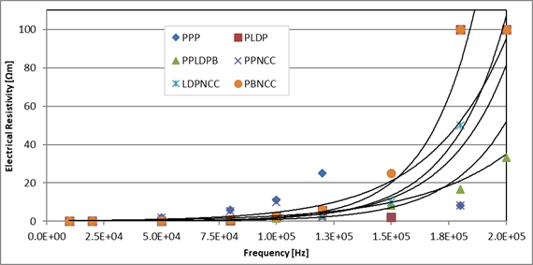
Many polymer composites do have the problem of fundamental microstructural mechanisms. In this study, polymer nanocomposite was developed from 2D layered nanomaterial (clay) as filler particles in Polyethylene (PE) and Polypropylene blend. The developed materials were characterized for its dielectric properties and electrical conductivity. The study deeply investigates the frequency-dependent electrical conductivity and dielectric properties of polypropylene (PP) and low-density polyethylene composite polymer blends reinforced with nanoparticles over a frequency range of 10 kHz to 200 kHz. Experimental results of the nanocomposites (NC) formed indicates that electrical conductivity for all composite polymer formulations follows an exponential increase with frequency, a behavior characteristic of AC conduction in heterogeneous polymer systems. The highest conductivity values (approximately 100) were observed in the nanopolymer PP/NC and PE/NC, suggesting the formation of efficient conductive networks and charge transport via hopping and tunneling mechanisms. Logarithmic analysis of AC conductivity reveals a linear trend consistent with Jonscher’s universal power law, indicating a transition from frequency-independent to frequency-dependent regimes. The dielectric constant exhibited significant frequency dispersion, with pure PP showing high initial values (~420) that declined sharply at higher frequencies. Incorporating nanoparticles into the matrix may have introduced distinct relaxation peaks, particularly in LDPE/NC (~290 at 150 kHz), attributed to Maxwell-Wagner-Sillars interfacial polarization at the filler-matrix boundaries. These findings demonstrate that the nanoparticles reinforcement effectively tunes the electrical and dielectric behaviour of the polymer nanocomposite blends, making them suitable for advanced functional applications such as solid insulation, flexible electronics, and dielectric sensors where frequency-controllable permittivity is required.
References
Aliyu, A., Umar, S., Abdelmalik, A. A., Galadima, A. I., & Maidawa, S. S., (2025). “Dielectric Response Analysis of Polyvinylidene Flouride Doped With Alumina, Titanium Oxides, and Calcium Carbonate Nanoparticles” UMYU Scientifica, 4(2), 475 – 479. https://doi.org/10.56919/usci.2542.049
Andreas, S., Harald, G., Francis, R. C., Udo W., Gert H. (2009). Dielectric Properties of Nanocomposites Based on Polyethylene and Layered Double Hydroxide,. Macromolecules, Volume 42 issue 12 4165–4174
Barrau, S., Demont, P., Peigney, A., Laurent, C., & Lacabanne, C. (2003). DC and AC conductivity of carbon nanotubes-polyepoxy composites. Macromolecules, 36, 5187–5194.
Greenhoe, B. M., Hassan, M. K., Wiggins, J. S., & Mauritz, K. A. (2016). Universal power law behavior of the AC conductivity versus frequency of agglomerate morphologies in conductive carbon nanotube-reinforced epoxy networks. Journal of Polymer Science Part B: Polymer Physics, 54, 1918–1923.
Huang, X., Jiang, P., & Kim, C. U. (2007). Electrical properties of polyethylene/aluminum nanocomposites. Journal of Applied Polymer Science, 105, 10–17.
Lee, S. J., Yoon, S. J., & Jeon, I. (2022). Graphene/Polymer Nanocomposites: Preparation, Mechanical Properties, and Application. Polymers; Multidisciplinary Digital Publishing Institute. https://doi.org/10.3390/polym14214733
Linares, A., Canalda, J. C., Cagiao, M. E., García-Gutiérrez, M. C., Rueda, D. R., & Ezquerra, T. A. (2008). Broad-band electrical conductivity of high density polyethylene nanocomposites with carbon nanoadditives: Multiwall carbon nanotubes and carbon nanofibers. Macromolecules, 41, 7090–7097.
Mahdy M. Elmahdy, Dimitrios Gournis, Athanasios Ladavos, Christos Spanos, George Floudas.(2020).
H-Shaped Copolymer of Polyethylene and Poly(ethylene oxide) under Severe Confinement: Phase State and Dynamics. Langmuir, 36 (16) , 4261-4271. https://doi.org/10.1021/acs.langmuir.0c00127
Mahrous, N., Motawie, A. M., Hakim, A. E. A., & Madani, M. (2018). Study of some polypropylene nanocomposite properties. International Journal of Theoretical and Applied Sciences, 10, 136–144.
Muhammad Adnan, Zulkurnain Abdul-Malek, Kwan Yiew Lau, Muhammad Tahir, (2024).Tailored dielectric properties of polypropylene nanocomposites through laboratory synthesized titania, Materials Today Communications, Volume 41, 110919, ISSN 2352-4928,
https://doi.org/10.1016/j.mtcomm.2024.110919
Pielichowska, K. (2022). Polymer Nanocomposites: Preparation, Characterisation and Applications. Nanomaterials; Multidisciplinary Digital Publishing Institute. https://doi.org/10.3390/nano1211190
Prashantha, K., Soulestin, J., Lacrampe, M. F., Krawczak, P., Dupin, G., & Claes, M. (2010). Electrical and dielectric properties of multi-walled carbon nanotube filled polypropylene nanocomposites. Express Polymer Letters, 3, 744–751.
Suleiman S. A., Abubakar Y. M., Aliyu A., Galadima A. I., Abdelmalik A. A. (2023): Influence of Blending on Mechanical Behavior of Low-density Polyethylene, Polypropylene, Polyvinylchloride. UMYU Scientifica 2(2), 037-043. Published by Umaru Musa Yaradua University, Katsina https://doi.org/10.56919/usci.2223.006.
Tanaka, T., Montanari, G. C., and R. Mulhaupt,(2004). "Polymer nanocomposites as dielectrics and electrical insulation-perspectives for processing technologies, material characterization and future applications," in IEEE Transactions on Dielectrics and Electrical Insulation, vol. 11, no. 5, pp. 763-784, Oct. 2004, doi: https://doi.org/10.1109/TDEI.2004.1349782
Toshikatsu T, Gian C.M., Rolf Mulhaupt (2004) Polymer nanocomposites as dielectrics and electrical insulation- perspectives for processing technologies, material characterization and future applications. IEEE Transactions on Dielectrics and Electrical Insulation11(5):763 - 784
DOI: 10.1109/TDEI.2004.1349782
Verma, P. K., Bansala, T., Chauhan, S. S., & Choudhary, V. (2021). Electromagnetic interference shielding performance of carbon nanostructure reinforced, 3D printed polymer composites. Journal of Materials Science: Materials in Electronics, 32, 11124–11136.
Wenwen Yu, Yongli Liu, Lei Wang, Jiangao Shi. (2019). Cu Nanoparticle-Modified High-Density Polyethylene Monofilament and Its Antifouling Performance on Fishing Netting. International Journal of Polymer Science, 1-10. https://doi.org/10.1155/2019/7250348
Xi Zhang, Qingliang He, Hongbo Gu, Henry A. Colorado, Suying Wei, and Zhanhu Guo . Flame-Retardant Electrical Conductive Nanopolymers Based on Bisphenol F Epoxy Resin Reinforced with Nano Polyanilines. ACS Applied Materials & Interfaces 2013, 5 (3), 898-910. https://doi.org/10.1021/am302563w
Zhang, X., Yan, X., He, Q., Wei, H., Guo, J., Gu, H., ... Guo, Z. (2015). Electrically conductive polypropylene nanocomposites with negative permittivity at low carbon nanotube loading levels. ACS Applied Materials & Interfaces, 7, 6122–6138.
Downloads
Published
Issue
Section
Categories
License
Copyright (c) 2026 Aliyu Abdulraheem, Sadiq Umar, Mikhail Olakunle, Saidu Maidawa Shuaibu, Shaibu Asuku Suleiman

This work is licensed under a Creative Commons Attribution 4.0 International License.


