
Evaluation of Livelihood Dependence on Ecosystem Services and Willingness to Participate in Payment for Ecosystem Services in Oluwa Forest Reserve, Nigeria
DOI:
https://doi.org/10.33003/fjs-2026-1012-5229Keywords:
Livelihood Diversification, Payment for Ecosystem Services, Forest Governance, Rural Households, Environmental Valuation, Socio-ecological systemsAbstract
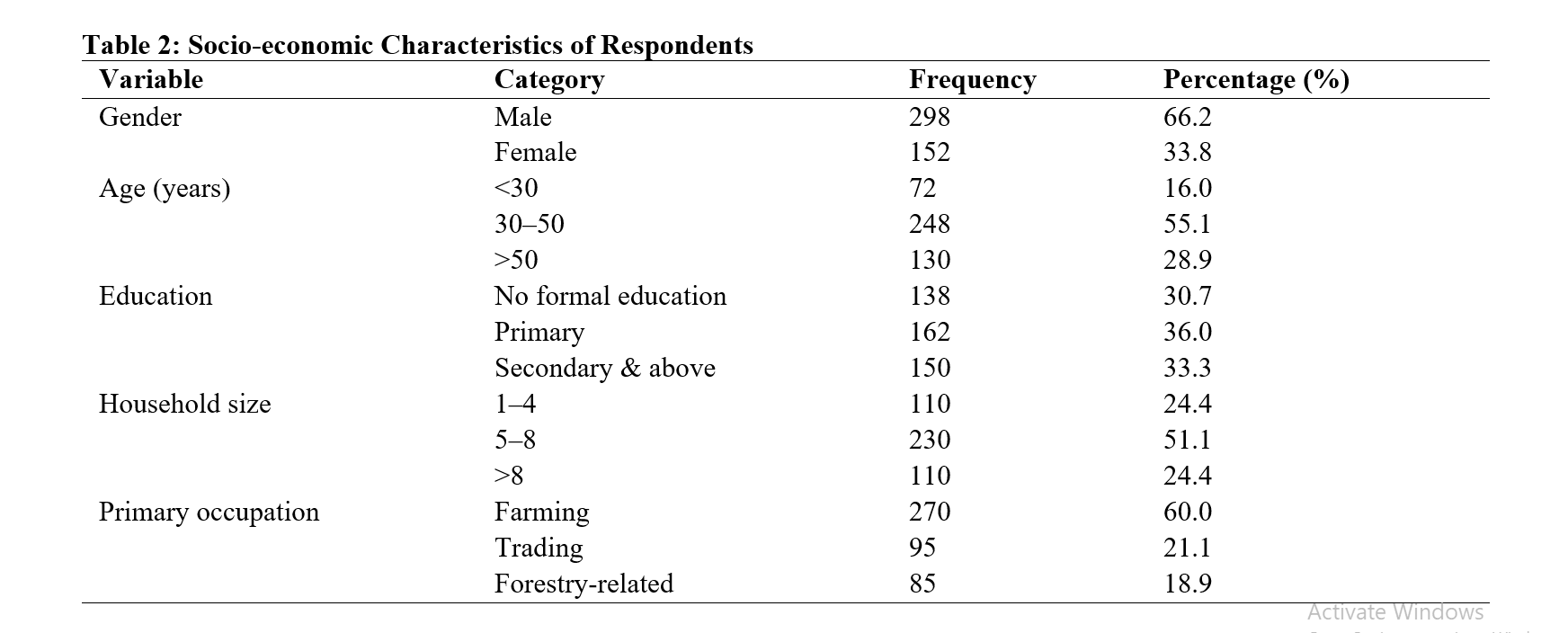
Ecosystem services provided by tropical forests are fundamental to rural livelihoods, yet increasing anthropogenic pressures threaten their sustainability. This study evaluated livelihood dependence on ecosystem services and willingness to participate in Payment for Ecosystem Services (PES) in the Oluwa Forest Reserve, southwestern Nigeria, using an integrated ecosystem service–livelihood–valuation framework. Primary data were collected from 450 households in eight forest-adjacent communities through structured questionnaires, complemented by key informant interviews and field observations. Descriptive statistics, the Livelihood Dependence Index (LDI), economic valuation techniques (market price, contingent valuation and benefit transfer methods), multiple regression and binary logistic regression were employed for data analysis. Provisioning services, particularly fuelwood, food crops, medicinal plants, timber and bushmeat, were the most utilized ecosystem services, while regulating services such as soil fertility maintenance, erosion control and climate regulation were also widely recognized. The mean LDI of 0.54 indicates moderate to high dependence on forest resources. Ecosystem services contributed an estimated annual value of ₦520,000 per household, with provisioning services accounting for the largest share. Age and household size significantly increased livelihood dependence, whereas education, non-forest income and distance from the forest reduced dependence. Education, income and awareness of ecosystem services significantly increased willingness to participate in PES schemes. The study concludes that sustainable management of the Oluwa Forest Reserve requires strengthened community-based forest management, livelihood diversification, environmental education and the implementation of equitable PES schemes to balance ecosystem conservation with rural livelihood improvement.
References
Adedeji, O. J., Awotoye, O. O., & Jegede, M. O. (2025). Ecosystem services valuation of Ikogosi Warm Spring and Olumirin Waterfall forest: A comparative assessment. Discover Forests, 1(1), Article 39. https://doi.org/10.1007/s44415-025-00041-0
Angelsen, A., Jagger, P., Babigumira, R., Belcher, B., Hogarth, N. J., Bauch, S., Börner, J., Smith-Hall, C., & Wunder, S. (2014). Environmental income and rural livelihoods: A global-comparative analysis. World Development, 64, S12–S28. https://doi.org/10.1016/j.worlddev.2014.03.006
Chen, et al. (2022). Replace with the exact publication cited by the authors. The manuscript does not contain sufficient information to identify this reference uniquely. It is cited multiple times but is absent from the reference list.
Chazdon, R. L., & Laestadius, L. (2016). Forest and landscape restoration: Toward a shared vision and vocabulary. American Journal of Botany, 103(11), 1869–1871. https://doi.org/10.3732/ajb.1600294
Costanza, R., de Groot, R., Braat, L., Kubiszewski, I., Fioramonti, L., Sutton, P., Farber, S., & Grasso, M. (2017). Twenty years of ecosystem services: How far have we come and how far do we still need to go? Ecological Economics, 139, 1–16. https://doi.org/10.1016/j.ecolecon.2017.01.008
Food and Agriculture Organization of the United Nations. (2022). The state of the world's forests 2022: Forest pathways for green recovery and building inclusive, resilient and sustainable economies. FAO. https://doi.org/10.4060/cb9360en
Intergovernmental Science-Policy Platform on Biodiversity and Ecosystem Services. (2022). Methodological assessment report on the diverse values and valuation of nature. IPBES Secretariat.
International Society of Arboriculture. (2023). Urban and forest ecosystem services: Assessment and management guidelines. ISA Publications.
Millennium Ecosystem Assessment. (2005). Ecosystems and human well-being: Synthesis. Island Press.
Osewe, K. O., Nyangena, W., & Mutoko, M. C. (2024). Forest ecosystem services and livelihood resilience among rural households in Sub-Saharan Africa. Ecosystem Services, 65, 101602. https://doi.org/10.1016/j.ecoser.2024.101602
Rahman, M. T., Dey, S., & Saha, S. K. (2025). Socioeconomic determinants of household dependence on forest ecosystem services in tropical landscapes. Forest Policy and Economics, 169, 103401. https://doi.org/10.1016/j.forpol.2025.103401
Salzman, J., Bennett, G., Carroll, N., Goldstein, A., & Jenkins, M. (2018). The global status and trends of payments for ecosystem services. Nature Sustainability, 1(3), 136–144. https://doi.org/10.1038/s41893-018-0033-0
Wunder, S. (2015). Revisiting the concept of payments for environmental services. Ecological Economics, 117, 234–243. https://doi.org/10.1016/j.ecolecon.2014.08.016
Wunder, S., Brouwer, R., Engel, S., Ezzine-de-Blas, D., Muradian, R., Pascual, U., & Pinto, R. (2021). From principles to practice in paying for nature's services. World Development, 147, 105618. https://doi.org/10.1016/j.worlddev.2021.105618
World Bank. (2023). Payments for ecosystem services: A global review of progress and outcomes. World Bank.
Downloads
Published
Issue
Section
Categories
License
Copyright (c) 2026 Femi Awe, Orumwense Lucy Adeteju, Adegboyega Ayo Ogunbela, Eniola Taiwo Samuel

This work is licensed under a Creative Commons Attribution 4.0 International License.


