
Protective Effects of Newbouldia laevis Aqueous Leaf Extract Against Diabetes-Induced Biochemical and Oxidative Alterations in Rats
DOI:
https://doi.org/10.33003/fjs-2026-1009-5203Keywords:
Antioxidant activity, Biochemical alterations, Glibenclamide Organ protection, Oxidative stress, Type 2 diabetesAbstract
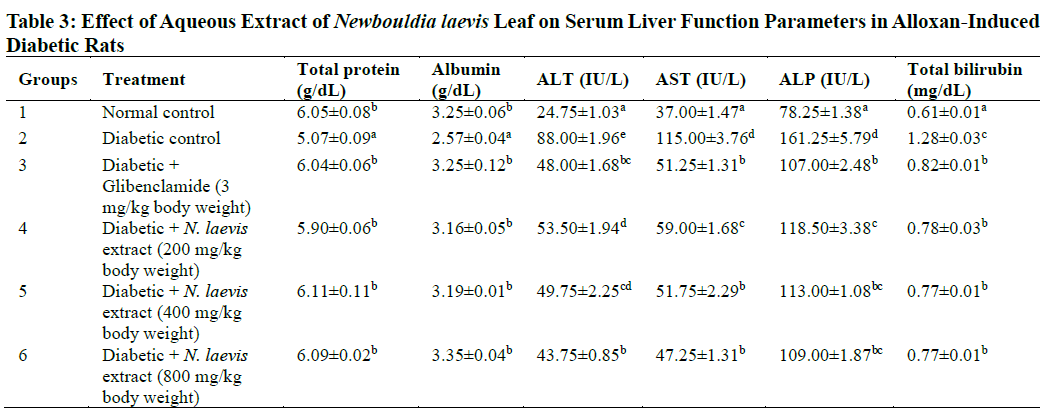
Newbouldia laevis possesses several scientifically reported medicinal properties with potential therapeutic relevance in diabetes management. This study investigated the protective effects of aqueous leaf extract of Newbouldia laevis against diabetes-induced biochemical and oxidative alterations in experimental rats. Type 2 diabetes was induced in male rats, followed by treatment with extract at varying doses of 200, 400, and 800 mg/kg body weight, while glibenclamide (3 mg/kg) served as the standard drug. Renal, hepatic, lipid, haematological, and antioxidant parameters were evaluated. Diabetic rats showed significant (p < 0.05) elevations in urea, creatinine, liver enzymes, lipid profile parameters, and malondialdehyde levels, alongside reductions in antioxidant enzyme activities and haematological indices. Administration of N. laevis extract significantly (p < 0.05) ameliorated these alterations in a dose-dependent manner, with effects comparable to glibenclamide. The extract demonstrated potent antioxidant, antidiabetic, and organ-protective activities, particularly in the liver and kidneys. These findings suggest that aqueous leaf extract of Newbouldia laevis may serve as a promising natural therapeutic agent for the management of type 2 diabetes and its associated complications.
References
Allain, C. C., Poon, L. S., Chan, C. S., Richmond, W., & Fu, P. C. (1974). Enzymatic determination of total serum cholesterol. Clinical Chemistry, 20(4), 470–475.
Antar, S. A., Ashour, N. A., Sharaky, M., Khattab, M., Zaid, R. T., Roh, E. J., Elkamhawy, A., & Al-Karmalawy, A. A. (2023). Diabetes mellitus: classification, mediators, and complications; a gate to identify potential targets for the development of new effective treatments. Biomedicine & Pharmacotherapy, 168, 115734. https://doi.org/10.1016/j.biopha.2023.115734
Arunachalam, K., & Sasidharan, S. P. (2021). General considerations and collection of animal blood. In K. Arunachalam & S. P. Sasidharan (Eds.), Bioassays in experimental and preclinical pharmacology. Humana Press. https://doi.org/10.1007/978-1-0716-1246-0
Bartels, H., & Böhmer, M. (1972). Quantitative determination of creatinine. Clinica Chimica Acta, 37, 193–197.
Bhatti, J. S., Sehrawat, A., Mishra, J., Sidhu, I. S., Navik, U., Khullar, N., Kumar, S., Bhatti, G. K., & Reddy, P. H. (2022). Oxidative stress in the pathophysiology of type 2 diabetes and related complications: Current therapeutic strategies and future perspectives. Free Radical Biology and Medicine, 184, 114–134. https://doi.org/10.1016/j.freeradbiomed.2022.03.019.
Burgeiro, A., Cerqueira, M. G., Varela-Rodríguez, B. M., Nunes, S., Neto, P., Pereira, F. C., Reis, F., & Carvalho, E. (2017). Glucose and Lipid Dysmetabolism in a Rat Model of Prediabetes Induced by a High-Sucrose Diet. Nutrients, 9(6), 638. https://doi.org/10.3390/nu9060638.
Burstein, M., Scholnick, H. R., & Morfin, R. (1980). Rapid method for the isolation of lipoproteins from serum by precipitation with polyanions. Scandinavian Journal of Clinical and Laboratory Investigation, 40(7), 583–595.
Caturano, A., D'Angelo, M., Mormone, A., Russo, V., Mollica, M. P., Salvatore, T., Galiero, R., Rinaldi, L., Vetrano, E., Marfella, R., Monda, M., Giordano, A., & Sasso, F. C. (2023). Oxidative stress in type 2 diabetes: impacts from pathogenesis to lifestyle modifications. Current Issues in Molecular Biology, 45(8), 6651–6666. https://doi.org/10.3390/cimb45080420
Cohen, G., Dembiec, D., & Marcus, J. (1970). Measurement of catalase activity in tissue extracts. Analytical Biochemistry, 34(1), 30–38.
Dilworth, L., Facey, A., & Omoruyi, F. (2021). Diabetes mellitus and its metabolic complications: the role of adipose tissues. International Journal of Molecular Sciences, 22(14), 7644. https://doi.org/10.3390/ijms22147644.
Elsawy, A., Gouda, W., Afify, M., Abdelmaksoud, M. D. E., Azazy, S., & Mohamed, N. S. (2025). Alterations in renal function and serum electrolytes in diabetic patients. Aswan Science and Technology Bulletin, 3(2), 105–116. https://doi.org/10.21608/astb.2025.409269.1028.
Fawcett, J. K., & Scott, J. E. (1960). A rapid and precise method for the determination of urea. Journal of Clinical Pathology, 13(2), 156–159.
Flohé, L., & Günzler, W. A. (1984). Assays of glutathione peroxidase. Methods in Enzymology, 105, 114–121.
Fossati, P., & Prencipe, L. (1982). Serum triglycerides determined colorimetrically with an enzyme that produces hydrogen peroxide. Clinical Chemistry, 28(10), 2077–2080.
Friedewald, W. T., Levy, R. I., & Fredrickson, D. S. (1972). Estimation of the concentration of low-density lipoprotein cholesterol in plasma without the use of a preparative ultracentrifuge. Clinical Chemistry, 18(6), 499–502.
German Society for Clinical Chemistry (GSCC). (1972). Optimized standard colorimetric method for alkaline phosphatase determination. Journal of Clinical Chemistry and Clinical Biochemistry, 10, 182–184.
Gieroba, B., Kryska, A., & Sroka-Bartnicka, A. (2025). Type 2 diabetes mellitus – conventional therapies and future perspectives in innovative treatment. Biochemistry and Biophysics Reports, 42, 102037. https://doi.org/10.1016/j.bbrep.2025.102037
González, P., Lozano, P., Ros, G., & Solano, F. (2023). Hyperglycemia and Oxidative Stress: An Integral, Updated and Critical Overview of Their Metabolic Interconnections. International Journal of Molecular Sciences, 24(11), 9352. https://doi.org/10.3390/ijms24119352
Grove, T. H. (1979). Effect of reagent pH on the determination of high-density lipoprotein cholesterol by precipitation with sodium phosphotungstate-magnesium. Clinical Chemistry, 25(4), 560–564.
Harborne, J. B. (1973). Phytochemical methods: A guide to modern techniques of plant analysis. Chapman & Hall.
Harborne, J. B. (1984). Phytochemical methods: A guide to modern techniques of plant analysis (2nd ed.). Chapman & Hall.
Harborne, J. B. (1998). Phytochemical methods: A guide to modern techniques of plant analysis (2nd ed.). Chapman & Hall.
Khandker, S. S., Kundu, S., Ahmed, F., Khan, A. A., Farhin, L., Islam, F., Begum, R., Uddin, M. J., & Mamun-Or-Rashid, A. N. M. (2026). Association of Serum Creatinine, Urea, and Glomerular Filtration Rate with the Progression of Diabetic Associated Kidney Complications: A Retrospective Case-Control Study. Current Issues in Molecular Biology, 48(2), 167. https://doi.org/10.3390/cimb48020167.
Laposata, M., & McCaffrey, P. (2022). Clinical laboratory methods: Atlas of commonly performed tests. McGraw-Hill Education.
Lorke, D. (1983). A new approach to practical acute toxicity testing. Archives of Toxicology, 54(4), 275–287. https://doi.org/10.1007/BF01234480
Mahmoud, A. M. (2013). Hematological alterations in diabetic rats: Role of adipocytokines and effect of citrus flavonoids. Experimental and Clinical Sciences Journal, 12, 647–657. https://www.ncbi.nlm.nih.gov/pmc/articles/PMC4778348/
Mbagwu, I. S., Akah, P. A., & Ajaghaku, D. L. (2020). Newbouldia laevis improved glucose and fat homeostasis in a type-2 diabesity mice model. Journal of Ethnopharmacology, 251, 112555. https://doi.org/10.1016/j.jep.2020.112555
Misra, H. P., & Fridovich, I. (1972). The role of superoxide anion in the autooxidation of epinephrine and a simple assay for superoxide dismutase. Journal of Biological Chemistry, 247(10), 3170–3175.
Ohkawa, H., Ohishi, N., & Yagi, K. (1979). Assay for lipid peroxides in animal tissues by thiobarbituric acid reaction. Analytical Biochemistry, 95(2), 351–358.
Okafor, J. N., Erukainure, O. L., Ajiboye, J. A., Etoamaihe, M. O., Eboagwu, I. L., & Adenekan, S. O. (2020). Antioxidant protective effect of Newbouldia laevis on hepatotoxicity in alloxan-induced diabetes in rats. Journal of Diseases and Medicinal Plants, 6(4), 87–91. https://doi.org/10.11648/j.jdmp.20200604.14.
Osigwe, C. C., Akah, P. A., & Nworu, C. S. (2017). Biochemical and haematological effects of the leaf extract of Newbouldia laevis in alloxan-induced diabetic rats. Journal of Biosciences and Medicines, 5(6), 18–36. https://doi.org/10.4236/jbm.2017.56003
Rafaqat, S., Sattar, A., Khalid, A., & Rafaqat, S. (2023). Role of liver parameters in diabetes mellitus – A narrative review. Endocrine Regulations, 57, 200–220. https://doi.org/10.2478/enr-2023-0024
Reitman, S., & Frankel, S. (1957). A colorimetric method for the determination of serum glutamic oxaloacetic and glutamic pyruvic transaminases. American Journal of Clinical Pathology, 28(1), 56–63.
Sharma, P., Hajam, Y. A., Kumar, R., & Rai, S. (2022). Complementary and alternative medicine for the treatment of diabetes and associated complications: A review on therapeutic role of polyphenols. Phytomedicine Plus, 2(1), 100188. https://doi.org/10.1016/j.phyplu.2021.100188
Sofowora, A. (1993). Medicinal plants and traditional medicine in Africa (2nd ed.). Spectrum Books.
Tietz, N. W., Pruden, E. L., & Siggaard-Andersen, O. (1986). Electrolytes, blood gases and acid-base balance. In N. W. Tietz (Ed.), Textbook of clinical chemistry (pp. 1172–1182). W. B. Saunders.
Tietze, F. (1969). Enzymic method for quantitative determination of nanogram amounts of total and oxidized glutathione: Applications to mammalian blood and other tissues. Analytical Biochemistry, 27(3), 502–522.
Trease, G. E., & Evans, W. C. (2002). Pharmacognosy (15th ed.). Saunders Publishers.
Ujah, I. I., Ugochukwu, J. I., & Alozieuwa, U. B. (2022). Phytochemical and vitamin content of Newbouldia laevis leaf. World Journal of Advanced Research and Reviews, 15(1), 31–40. https://doi.org/10.30574/wjarr.2022.15.1.0516
Downloads
Published
Issue
Section
Categories
License
Copyright (c) 2026 Shirley Onagbonfeoana Ebhohon, Akubuiro, Paschal Chikama, Adarki, Pongri Wazakarda, Blessing O. Nwachukwu, Victory Chidera Austin, Emmanuella Chidera Oguzie, Chibuenyim Bright Aniorji, Jennifer Chidinma Ozue, Perpetua Chibuzor Mgbakogu, Ruth Ihuanyachi Ihechukwu, Favour Ngozichukwu Onyenwe, Annointing Onyinechi Nwosu, David Eze George

This work is licensed under a Creative Commons Attribution 4.0 International License.


