
Climate and Building Configuration as Determinants of Thermal Comfort in Secondary Hospitals in Kwara State, Nigeria
DOI:
https://doi.org/10.33003/fjs-2026-1014-5187Keywords:
Indoor Environmental Quality, Tropical Hospital Design, Kwara State, Adaptive Thermal Comfort, Ward Configuration, Natural Ventilation, Building Typology, Passive Design, Harmattan, NigeriaAbstract
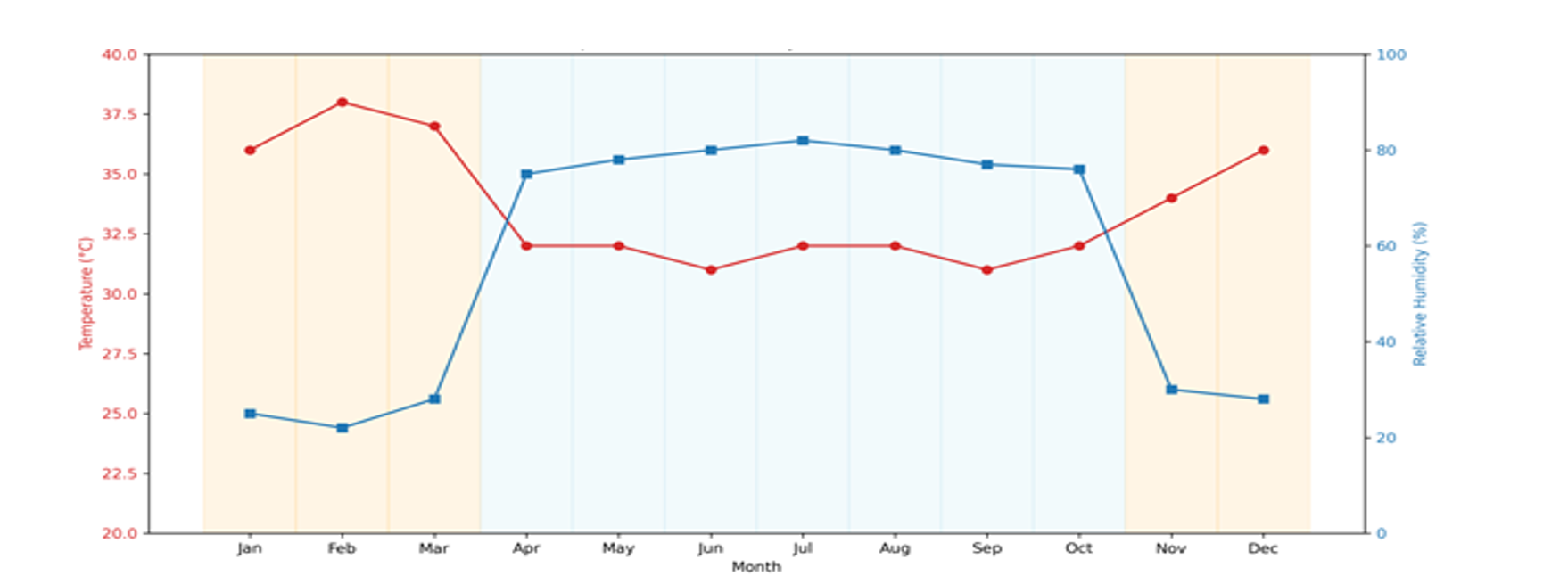
Thermal discomfort is persistent yet under-documented in Nigerian secondary hospitals. These facilities serve the largest cross-section of the population but lack systematic empirical evidence. This study investigates how outdoor climate and ward building configuration determine indoor thermal comfort across six government-owned hospitals in Kwara State. A mixed-methods design integrated ten years of climatic data with in-situ measurements of temperature, humidity, and air velocity alongside 305 user questionnaires. Mahoney table analysis classified the six hospitals into three micro-climatic zones: hot-humid (Sobi, Centre Igboro), hot-dry (Jebba), and warm-comfort transition (Omu-Aran, Offa, Share). Open wards constituted the largest ward type (48.2%). Natural ventilation served 56.4% of ward spaces. Afternoon operative temperatures averaged 31.4°C during the harmattan period, exceeding the adaptive comfort boundary of 31.8°C for spaces with functional window control. Among occupants without operable windows (48.9% of respondents), afternoon temperatures exceeded the prescriptive ASHRAE limit of 26°C by 5.6°C. Chi-square analysis found no statistically significant association between ward layout and ventilation type (χ²(9) = 14.725, p = 0.099). One-way ANOVA confirmed no statistically significant difference in comfort satisfaction across hospitals (F(5,299) = 1.49, p = 0.193, η² = 0.024), indicating shared design or operational characteristics rather than facility-specific deficiencies. Effective remediation requires a climate-responsive design framework calibrated to the three identified zones and revision of national standards to mandate performance-based thermal comfort outcomes.
References
Ackley, A., Olanrewaju, O. I., Oyefusi, O. N., Enegbuma, W. I., Olaoye, T. S., Ehimatie, A. E., Ukpong, E., & Akpan-Idiok, P. (2024). Indoor environmental quality (IEQ) in healthcare facilities: A systematic literature review and gap analysis. Journal of Building Engineering, 86, 108787. https://doi.org/10.1016/j.jobe.2024.108787
Alzahrani, A., Li, Y., Zhang, H., Sun, B., & Shen, X. (2024). Evaluating building performance and patient well-being in healthcare facilities: A literature review of environmental quality and design strategies. Journal of Building Engineering, 98, 111031. https://doi.org/10.1016/j.jobe.2024.111031
American Society of Heating, Refrigerating and Air-Conditioning Engineers. (2017). ANSI/ASHRAE Standard 55-2017: Thermal environmental conditions for human occupancy. ASHRAE. https://www.ashrae.org/technical-resources/bookstore/standard-55-thermal-environmental-conditions-for-human-occupancy
Armstrong, J. S., & Overton, T. S. (1977). Estimating nonresponse bias in mail surveys. Journal of Marketing Research, 14(3), 396–402. https://doi.org/10.1177/002224377701400320
Creswell, J. W., & Plano Clark, V. L. (2018). Designing and conducting mixed methods research (3rd ed.). SAGE Publications.
De Dear, R., & Brager, G. S. (2002). Thermal comfort in naturally ventilated buildings: Revisions to ASHRAE Standard 55. Energy and Buildings, 34(6), 549–561. https://doi.org/10.1016/S0378-7788(02)00005-1
Field, A. (2018). Discovering statistics using IBM SPSS Statistics (5th ed.). SAGE Publications.
Humphreys, M. A. (1978). Outdoor temperatures and comfort indoors. Building Research and Practice, 6(2), 92–105. https://doi.org/10.1080/09613217808550656
Jamshidi, S., Parker, J., & Hashemi, A. (2020). Effects of indoor environmental quality on occupant wellbeing and comfort in healthcare buildings. Journal of Building Engineering, 32, 101713. https://doi.org/10.1016/j.jobe.2020.101713
Kwara State Hospital Management Bureau. (2024). Inventory of state-owned hospitals and staffing statistics. Kwara State Government.
Mardaljevic, J., Heschong, L., & Lee, E. S. (2009). Daylight metrics and energy savings. Lighting Research & Technology, 41(3), 261–283. https://doi.org/10.1177/1477153509339703
Nicol, F., Humphreys, M., & Roaf, S. (2012). Adaptive thermal comfort: Principles and practice. Routledge. https://doi.org/10.4324/9780203123010
Nimlyat, P. S., Salihu, B. M., & Wang, J. (2024). Indoor environmental quality of public hospitals in Nigeria: Systematic evidence and policy gaps. Building and Environment, 248, 111048. https://doi.org/10.1016/j.buildenv.2023.111048
Nyembwe, A., Ogundiran, A., Chenari, B., Simões, N., & Gameiro da Silva, M. (2023). Indoor thermal comfort in healthcare buildings in sub-Saharan Africa: A bibliometric and systematic review. Energies, 16(4), 1765. https://doi.org/10.3390/en16041765
Pereira, L. D., Raimondo, D., Corgnati, S. P., & da Silva, M. G. (2020). Indoor environmental quality and thermal comfort in healthcare buildings: A systematic review. Applied Sciences, 10(20), 7030. https://doi.org/10.3390/app10207030
Shen, X., Zhang, H., Li, Y., Qu, K., Zhao, L., Kong, G., & Jia, W. (2023). Building a satisfactory indoor environment for healthcare facility occupants: A literature review. Building and Environment, 228, 109861. https://doi.org/10.1016/j.buildenv.2022.109861
Szokolay, S. V. (2008). Introduction to architectural science: The basis of sustainable design (2nd ed.). Architectural Press.
Tejada, J. J., & Punzalan, J. R. B. (2012). On the misuse of Slovin’s formula. The Philippine Statistician, 61(1), 129–136.
Ulrich, R. S., Zimring, C., Zhu, X., DuBose, J., Seo, H., Choi, Y., Quan, X., & Joseph, A. (2008). A review of the research literature on evidence-based healthcare design. HERD: Health Environments Research & Design Journal, 1(3), 61–125. https://doi.org/10.1177/193758670800100306
Verderber, S. (2010). Innovations in hospital architecture. Routledge. https://doi.org/10.4324/9780203855751
Wurma, G. B., & Muhammad, A. A. (2024). Parametric analysis of energy efficiency in double skin façades for hot and dry climates: A case study of Kebbi State, Nigeria. FUDMA Journal of Sciences, 8(6), 77–86. https://fjs.fudutsinma.edu.ng/index.php/fjs/article/view/2735
Downloads
Published
Issue
Section
Categories
License
Copyright (c) 2026 Ayangbemi Segun Ayankola, Martins Ndashiru, Abigail Oro Ogunwola

This work is licensed under a Creative Commons Attribution 4.0 International License.


