
PERFORMANCE-BASED CARBON FOOTPRINT ASSESSMENT OF CONCRETE INCORPORATED POWDERED CRUSHED TILE AS PARTIAL CEMENT REPLACEMENT
DOI:
https://doi.org/10.33003/fjs-2026-1007-5178Keywords:
Carbon footprint, Life Cycle Assessment, Powdered Crushed Tile, Sustainable concrete, Cement emissionsAbstract
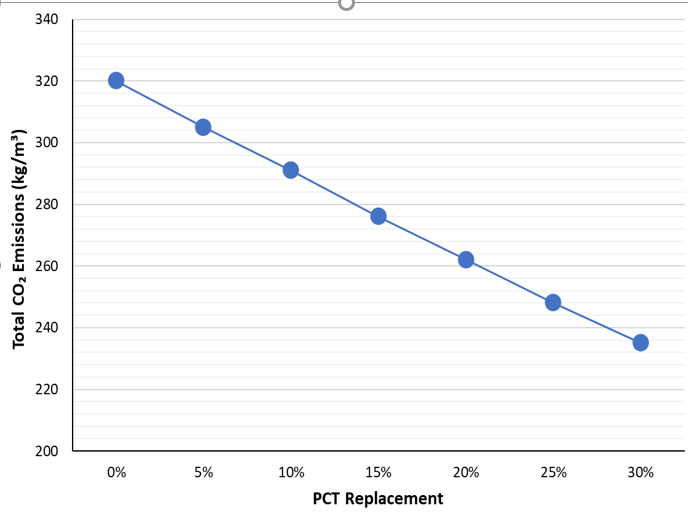
This study evaluates the environmental and mechanical performance of concrete incorporated Powdered Crushed Tile (PCT) as a partial replacement for Ordinary Portland Cement (OPC) using a performance-based Life Cycle Assessment (LCA) approach. A cradle-to-gate analysis compliant with ISO 14040 and ISO 14044 standards was conducted, considering raw material extraction, cement production, PCT processing, transportation, and concrete batching. Global Warming Potential (GWP100) was assessed per cubic meter of concrete for replacement levels between 0% and 30%. Results indicate a near-linear reduction in embodied carbon, achieving up to 26.6% reduction at 30% PCT substitution. However, compressive strength decreased with increasing replacement levels. Performance-normalised carbon analysis identified an optimal sustainability range of 5–10% PCT, where carbon savings outweigh strength reductions. Sensitivity analysis revealed that cement emission factors dominate uncertainty, while transportation and PCT processing have minimal influence. The findings demonstrate that moderate clinker substitution using recycled ceramic waste can significantly reduce concrete’s carbon footprint without compromising structural performance, supporting sustainable and circular construction practices.
References
Ahmed, A. (2024). Sustainable concrete with zero carbon footprint. Recent Progress in Materials, 6(3), 019. https://doi.org/10.21926/rpm.2403019.
Andrew, R. M. (2018). Global CO₂ emissions from cement production. Earth System Science Data, 10(1), 195–217. https://doi.org/10.5194/essd-10-195-2018.
Anum, I., Williams, F. N., & Zakka, W. P. (2025). Effects of treated high-density polyethylene admixtures on the compressive strength of concrete in sulphates and acids environments. Discover Civil Engineering, 2, 38. https://doi.org/10.1007/s44290-025-00202-2.
ASTM International. (2022). Standard specification for chemical admixtures for concrete (ASTM C494/C494M–22). ASTM International. https://doi.org/10.1520/C0494_C0494M-22.
ASTM International. (2022a). Standard specification for chemical admixtures for concrete (ASTM C494/C494M–22). ASTM International. https://doi.org/10.1520/C0494_C0494M-22.
ASTM International. (2022b). Standard specification for mixing water used in the production of hydraulic cement concrete (ASTM C1602/C1602M–22). ASTM International. https://doi.org/10.1520/C1602_C1602M-22.
ASTM International. (2022c). Standard specification for Portland cement (ASTM C150/C150M–22). ASTM International. https://doi.org/10.1520/C0150_C0150M-22.
British Standards Institution. (2013). Aggregates for concrete (BS EN 12620:2013). BSI Standards Limited.
British Standards Institution. (2020). Testing hardened concrete—Compressive strength of test specimens (BS EN 12390-3:2020). BSI Standards Limited.
Chen, C., Habert, G., Bouzidi, Y., & Jullien, A. (2010). Environmental impact of cement production: Detail of the different processes and cement plant variability evaluation. Journal of Cleaner Production, 18(5), 478–485. https://doi.org/10.1016/j.jclepro.2009.12.010.
Ecoinvent Association. (2022). Ecoinvent database v3.9: Life cycle inventory data. Zurich, Switzerland.
Flower, D. J. M., & Sanjayan, J. G. (2007). Greenhouse gas emissions due to concrete manufacture. International Journal of Life Cycle Assessment, 12(5), 282–288. https://doi.org/10.1065/lca2007.05.327.
Generowicz-Caba, N., & Kulczycka, J. (2025). LCA of cement with alternative additives: Pathways to sustainable production. Materials (Basel), 18(13), 3057. https://doi.org/10.3390/ma18133057.
Habert, G., Miller, S. A., John, V. M., Provis, J. L., Favier, A., Horvath, A., & Scrivener, K. L. (2020). Environmental impacts and decarbonization strategies in the cement and concrete industries. Nature Reviews Earth & Environment, 1(11), 559–573. https://doi.org/10.1038/s43017-020-0093-3.
Ikotun, J. O., Adedeji, P. O., & Babafemi, A. J. (2025). A comprehensive review on the performance of low-carbon ceramic waste powder as cement replacement material in concrete. Applied Sciences, 15(11), 6037. https://doi.org/10.3390/app15116037.
International Energy Agency. (2023). Cement sector emissions and mitigation pathways. IEA.
Lu, X. K., Zhang, W., Ruggiero, B. N., Seitz, L. C., & Li, J. (2024). Scalable electrified cementitious materials production and recycling. Energy & Environmental Science, 17, 9566–9579. https://doi.org/10.1039/D4EE03529A.
Zhang, Z., Lei, Y., Liew, J. Y. R., Liu, M., & Wong, G. (2024). Embodied carbon saving potential of using recycled materials as a cement substitute in Singapore’s buildings. npj Materials Sustainability, 2, 27. https://doi.org/10.1038/s44296-024-00032-w.
Published
Issue
Section
Categories
License
Copyright (c) 2026 Frank Ndanusa Williams, Kazzi Gaius Avre, Daniel Nnaemeka Nwaigwe, Adedeji Paul Adeleye

This work is licensed under a Creative Commons Attribution 4.0 International License.


