
Investigation on Date Seed Utilization as a pH Enhancer in Drilling Mud Process
DOI:
https://doi.org/10.33003/fjs-2026-1009-5166Keywords:
Date seed ash, pH enhancer, Water-based drilling mud, Rheological propertiesAbstract
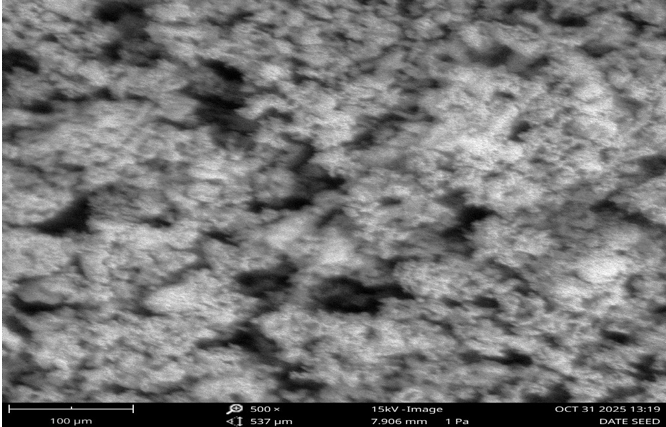
This research explores the utilisation of Date seed ash (DSA) derived from dates as a sustainable, eco-friendly substitute for conventional chemical pH enhancers in water-based drilling mud. pH enhancers controls corrosion by increasing the drilling mud pH which prevents the corrosion of drill pipes and casing. The process involved date seed collection, dehydration of date seed, carbonisation and calcination of date seed to produce DSA. SEM and XRF analysis of DSA revealed porous morphology and a rich inorganic composition of different elements having Potassium in abundance (45.29%) making DSA alkaline in nature. Mud properties such as pH and rheology were measured and compared against a baseline mud and water-based drilling mud containing 0.4 g, 0.6 g, 0.8 g and 1 g of NaOH per 35 ml of mud. The results demonstrated that DSA effectively enhanced mud pH from 9.81 to 10.02 maintaining the pH within the optimal alkaline range (8.5-10.5). DSA also enhanced the rheological properties of the drilling mud by reducing the plastic viscosity (11.0 cP-6.0-6.8 cP) and apparent viscosity indicating an improved pumpability while increasing the yield point (4.4 Pa-5.5-7.2 Pa) enhancing hole cleaning capacity. DSA transformed a high progressive gel strength of 2.2 Pa to 45.6 Pa into a better gel strength (6.0 Pa to 12.2 Pa). This research provides a pathway for the petroleum industry to repurpose agricultural waste into a cost effective drilling fluid additive that not only improves mud pH but also improves the rheology enhancing wellbore stability.
References
Adams, O. V, Adeleye, D. E., Okoro, E. A., George, J. P., & Akpoguma, V. A. (2015). Examination concerning the rheological and filtration properties of boring mud constructed with Clay from Northern Nigeria. 2(2), 71–82.
Al-zahrani, K. S., Faqeeh, A. A., Abdulghani, Z. R., & Thomas, S. P. (2022). A review on the physicochemical properties and utilization of date seeds in value ‑ added engineering products. In Polymer Bulletin (Vol. 79, Issue 12). Springer Berlin Heidelberg. https://doi.org/10.1007/s00289-021-04048-3
An, E. O. F. (2014). D e -f d f u d s g m w.
Biwott, T. C., Kiprop, A. K., & Akaranta, O. (2019). Terminalia mantaly leaves as a novel additive in water-based drilling MUD. 7(6), 2173–2181.
Clay, I. N. T. E. R. N. A. L. M. U. T. U. A. L. F. L. O. C. C. U. L. A. T. I. O. N. I. N. (1964). 19, 313-322 (1964). 322(360), 313–322.
Edition, F. (2009). Recommended Practice for Field Testing Water-based Drilling Fluids. 2008(March).
Engineering, G., & Campus, O. (2018). Plantain Peels Powder , Burnt Palm Head Powder and Commercial Sodium Hydroxide as Additives for Water Based Drilling Mud.
Gamal, H., Elkatatny, S., & Basfar, S. (2019). E ff ect of pH on Rheological and Filtration Properties of Water-Based Drilling Fluid Based on Bentonite. 1–13.
Inemugha, O., Chukwuma, F., & Uyigue, L. (2019). The Effect of pH and Salinity on the Rheological Properties of Drilling Mud Formulation from Natural Polymers. 5(October), 126–134.
Mahmoud, A., & Saleh, K. (2013). THE EFFECT OF USING DIFFERENT WEIGHTS OF CAUSTIC SODA ON THE WATER-BASE MUD DRILLING FLUID By The effect of using different weights of caustic soda on the water-base mud drilling fluid. September.
Mamyrbayev, A., Bermagambetova, S., Baytenov, K., Komekbay, Z., Sakebayeva, L., Satybaldiyeva, U., Yerimbetova, G., & Zhilisbayeva, K. (2024). Drilling Mud.
Muds, W., Al-hameedi, A. T. T., Alkinani, H. H., Dunn-norman, S., Salem, E., & Knickerbocker, M. D. (2020). Laboratory Study of Environmentally Friendly Drilling Fluid Additives.
Nzerem, P., Jakada, K., Salihu, A., & Ibrahim, K. S. (2024). Influence of Local Additives on Water Based Drilling Mud : A Review. January. https://doi.org/10.5455/NJEAS.161742
Ramasamy, J., Al-arfaj, M. K., & Aramco, S. (2016). Journal of Petroleum Science and Engineering Application of an indigenous eco-friendly raw material as fl uid loss additive. Journal of Petroleum Science and Engineering, 139, 191–197. https://doi.org/10.1016/j.petrol.2015.12.023
Sindic, M. (2020). Date Seeds : A Promising Source of Oil with Functional Properties. 1–14.
Taleb, A., Hameedi, T. Al, Alkinani, H. H., Alkhamis, M. M., & Dunn, S. (2020). Utilizing a new eco ‑ friendly drilling mud additive generated from wastes to minimize the use of the conventional chemical additives. Journal of Petroleum Exploration and Production Technology, 10(8), 3467–3481. https://doi.org/10.1007/s13202-020-00974-6
Technology, E. R., & May, R. (2017). Ac ce pt nu sc rip ot Co py ite d Ac ce pt Ma t N ot Co The ability of drilling fluids to perform their fundamental functions is measured by certain ed d. c, 1–35. https://doi.org/10.1115/1.4038382
Teniola, O. S., Bello, S. O., Odekanle, E. L., & Iyala, F. A. (2025). Comparative studies of the effects of date plant seed and palm kernel shell powder with metal oxide particles on the rheological properties of water-based mud.
Udoh, F. D., & Okon, A. N. (2012). FORMULATION OF WATER-BASED DRILLING FLUID USING LOCAL MATERIALS. 14(2), 167–174.
Wajheeuddin, M., & Hossain, M. E. (2020). Development of an Environmentally-Friendly Water-Based Mud System Using Natural Materials. Arabian Journal for Science and Engineering. https://doi.org/10.1007/s13369-017-2583-2
Downloads
Published
Issue
Section
Categories
License
Copyright (c) 2026 Gbenga Oseke, Precious Pereowei, Abiodun Falowo

This work is licensed under a Creative Commons Attribution 4.0 International License.


