
INTEGRATED NMR, FTIR, AND MASS SPECTROMETRIC APPROACH TO THE STRUCTURAL ELUCIDATION OF A HEPTACYCLIC METHOXY- AND METHYLPEROXY-SUBSTITUTED COMPOUND FROM Lactuca taraxacifolia
DOI:
https://doi.org/10.33003/fjs-2026-1007-5154Keywords:
NMR, FTIR, MASS SPECTROMETRIC APPROACH, HEPTACYCLIC METHOXY, METHYLPEROXY-SUBSTITUTED COMPOUND, LACTUCA TARAXACIFOLIAAbstract
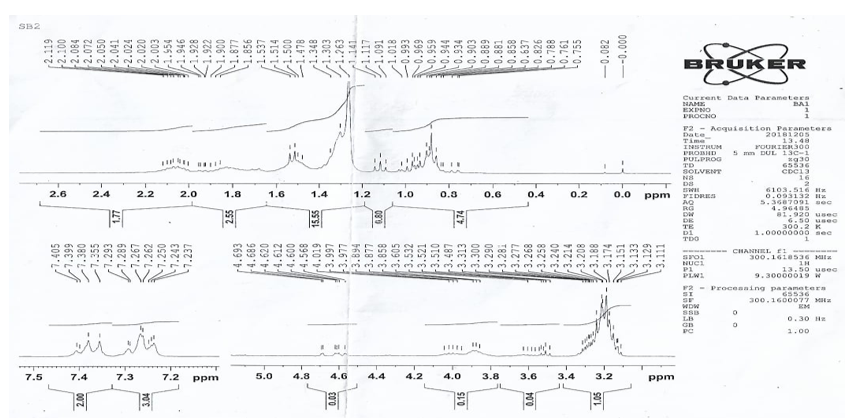
This study reports the extraction, isolation, and spectroscopic characterization of compound SB2 from the aerial parts of Lactuca taraxacifolia. Pulverized plant material was extracted with chloroform and successively partitioned using n-hexane, trichloromethane, ethyl ethanoate, and methanol. The trichloromethane fraction was subjected to silica gel column chromatography using a gradient solvent system of n-hexane and ethyl ethanoate (100:0–0:100, v/v). Fractions were monitored by thin-layer chromatography using n-hexane/ethyl ethanoate (9:1, v/v) as the mobile phase, yielding SB2 as a green oily liquid with a single spot (Rf = 0.42). Structural characterization was carried out using FTIR, ¹H NMR, ¹³C NMR, COSY, and GC–MS analyses. GC–MS revealed a molecular ion peak at m/z 530.7804 corresponding to the molecular formula C₃₆H₅₀O₃. Spectroscopic data indicated the presence of aromatic and aliphatic domains together with oxygenated functionalities including methoxy and methylperoxy groups. Although overlapping NMR signals limited definitive structural assignment, the combined GC–MS, FTIR, and NMR data support a structurally complex oxygenated aromatic–aliphatic compound with possible polycyclic features. The findings contribute to the phytochemical knowledge of Lactuca taraxacifolia.
References
Abdullahi, M. M., Nkemakonam, O. M., Garba, U., & Mustapha, M. A. (2025). Identification and characterization of bioactive compound in Croton nigritanus using FTIR and GC–MS spectroscopy. FUDMA Journal of Sciences. https://doi.org/10.33003/fjs-2025-09(AHBSI)-1279.
Adinortey M.B., Sarfo J.K., Kwarteng J., Adinortey C.A., Ekloh W., Kuatsienu L.E., Kwadwo Nyarko A. (2018). The Ethnopharmacological and Nutraceutical Relevance of Launaea taraxacifolia (Willd.) Amin ex C. Jeffrey. Evidence-Based Complementary and Alternative Medicine. 7259146. https://doi.org/10.1155/2018/7259146.
Agatha, O., Mutwil-Anderwald, D., Tan, J. Y., & Mutwil, M. (2024). Plant sesquiterpene lactones. Philosophical Transactions of the Royal Society B: Biological Sciences, 379(1914). https://doi.org/10.1098/rstb.2023.0350.
Anyanwu, B. C., Akoh, O. U., & Otuokere, I. E. (2022). Phytochemical screening and proximate analysis of the leaves of Launaea (Lactuca) taraxacifolia. Journal of Chemical Society of Nigeria, 47(2), 421–432. https://doi.org/10.46602/jcsn.v47i2.737.
Anyanwu, B. C., Otuokere, I. E., Echeme, J. O., Akoh, O. U., Njoku, C. P., Ohenhen, O. N., & Ikeadim, O. C. (2021). Isolation and characterization of a secondary metabolite from the aerial parts of Launaea (Lactuca) taraxacifolia. Journal of Chemical Society of Nigeria, 46(4), 661–672. https://doi.org/10.46602/jcsn.v46i4.644.
Ardrey, R. E. (2003). Liquid chromatography–mass spectrometry: An introduction. John Wiley & Sons. https://doi.org/10.1002/0470867299.
Azwanida, N. N. (2015). A review on the extraction methods uses in medicinal plants, principle, strength and limitation. Medicinal & Aromatic Plants, 4(3), 196. https://doi.org/10.4172/2167-0412.1000196.
Bax, A., & Summers, M. F. (1986). ¹H and ¹³C assignments from sensitivity-enhanced detection of heteronuclear multiple-bond connectivity by 2D NMR. Journal of the American Chemical Society, 108(8), 2093–2094. https://doi.org/10.1021/ja00268a057.
Borges, R. M., Teixeira, A. M., & Farias, M. A. S. (2024). On the role of NMR in metabolomics and natural product structural analysis. Frontiers in Natural Products, 3, 1359151. https://doi.org/10.3389/fntpr.2024.1359151.
Breton, R. C., & Reynolds, W. F. (2013). Using NMR to identify and characterize natural products. Natural Product Reports, 30(4), 501–524. https://doi.org/10.1039/c2np20104f.
Chen, L., Pan, H., Zhai, G., Luo, Q., Li, Y., Fang, C., & Shi, F. (2023). Widespread occurrence of in-source fragmentation in the analysis of natural compounds by liquid chromatography–electrospray ionization mass spectrometry. Rapid Communications in Mass Spectrometry, 37(12), e9519. https://doi.org/10.1002/rcm.9519.
Claridge, T. D. W. (2016). High-resolution NMR techniques in organic chemistry (3rd ed.). Elsevier. https://doi.org/10.1016/C2015-0-04654-8.
D'Atri, V., Fekete, S., Clarke, A., Veuthey, J.-L., & Guillarme, D. (2019). Recent advances in chromatography for pharmaceutical analysis. Analytical Chemistry, 91(1), 210–239. https://doi.org/10.1021/acs.analchem.8b05026.
Davies, E., Morris, G. A., Roy, S. S., & Adams, R. W. (2026). Spin-system-selective 2D J-spectroscopy. Chemistry Methods, 6(5), e70115. https://doi.org/10.1002/cmtd.70115.
Desmet, S., Morreel, K., & Dauwe, R. (2021). Origin and function of structural diversity in the plant specialized metabolome. Plants, 10(11), 2393. https://doi.org/10.3390/plants10112393.
Fulmer, G. R., Miller, A. J. M., Sherden, N. H., Gottlieb, H. E., Nudelman, A., Stoltz, B. M., Bercaw, J. E., & Goldberg, K. I. (2010). NMR chemical shifts of trace impurities: Common laboratory solvents, organics, and gases in deuterated solvents relevant to the NMR spectroscopist. Organometallics, 29(9), 2176–2179. https://doi.org/10.1021/om100106e.
Giraudeau, P. (2023). Quantitative NMR spectroscopy of complex mixtures. Chemical Communications, 59, 6627–6642. https://doi.org/10.1039/D3CC01455J.
Gottlieb, H. E., Kotlyar, V., & Nudelman, A. (1997). NMR chemical shifts of common laboratory solvents as trace impurities. The Journal of Organic Chemistry, 62(21), 7512–7515. https://doi.org/10.1021/jo971176v.
Grootveld, M., Percival, B., Gibson, M., Osman, Y., Edgar, M., Molinari, M., Mather, M. L., Casanova, F., & Wilson, P. B. (2019). Progress in low-field benchtop NMR spectroscopy in chemical and biochemical analysis. Analytica Chimica Acta, 1067, 11–30. https://doi.org/10.1016/j.aca.2019.02.026.
Gunawan, R., & Nandiyanto, A. B. D. (2021). How to read and interpret ¹H-NMR and ¹³C-NMR spectrums. Indonesian Journal of Science and Technology, 6(2), 267–298. https://doi.org/10.17509/ijost.v6i2.34189.
Harborne, J. B. (1998). Phytochemical methods: A guide to modern techniques of plant analysis (3rd ed.). Springer.
Hu, F., Chen, M. S., Rotskoff, G. M., Kanan, M. W., & Markland, T. E. (2024). Accurate and efficient structure elucidation from routine one-dimensional NMR spectra using multitask machine learning. arXiv. https://arxiv.org/abs/2408.08284.
Koukoui, O., Agbangnan, P., Boucherie, S., Yovo, M., Nusse, O., Combettes, L., & Sohounhloué, D. (2015). Phytochemical study and evaluation of cytotoxicity, antioxidant and hypolipidemic properties of Launaea taraxacifolia leaves extracts on cell lines HepG2 and PLB985. American Journal of Plant Sciences, 6(11), 1768–1779. https://doi.org/10.4236/ajps.2015.611177.
Lebeda, A., Doležalová, I., Feráková, V., & Astley, D. (2004). Geographical distribution of wild Lactuca species (Asteraceae, Lactuceae). The Botanical Review, 70(3), 328–356. https://doi.org/10.1663/0006-8101(2004)070[0328:gdowls]2.0.Co;2.
Lovestead, T., & Urness, K. (2019). Gas chromatography–mass spectrometry (GC–MS). In ASM handbook (Vol. 10, Materials characterization). ASM International. https://tsapps.nist.gov/publication/get_pdf.cfm?pub_id=926655.
Ma, X. (2022). Recent advances in mass spectrometry-based structural elucidation techniques. Molecules, 27(19), 6466. https://doi.org/10.3390/molecules27196466.
Martínez-Ramírez, J. A., González, M. A., López, J. P., & Fernández, R. (2022). Novel nuclear magnetic resonance method for position-specific carbon isotope analysis of organic molecules with significant impurities. Analytical Chemistry, 94(43), 15124–15131. https://doi.org/10.1021/acs.analchem.2c03356.
Mika'Ilu, H., Sani, A., Suleiman, S., Sani, I., Abdullahi, K. B., Hamisu, A., & Wad, K. H. (2025). Extraction, isolation, characterization and phytochemical screening of Euphorbia balsamifera leaf extract for pesticidal activity against Callosobruchus maculatus. FUDMA Journal of Sciences, 9(AHBSI), 160–170. https://doi.org/10.33003/fjs-2025-09(AHBSI)-3411.
Miller, L. M., & Coates, J. P. (2026). Interpretation of infrared spectra: A practical and systematic approach. In R. A. Meyers (Ed.), Encyclopedia of analytical chemistry (pp. 10815–10837). Wiley. https://doi.org/10.1002/9780470027318.a5606.pub2.
Nakamoto, K. (2009). Infrared and Raman spectra of inorganic and coordination compounds: Part A: Theory and applications in inorganic chemistry (6th ed.). John Wiley & Sons. https://doi.org/10.1002/9780470405840.
Nazarski, R. B. (2023). On the use of deuterated organic solvents without TMS to report 1H/13C NMR spectral data of organic compounds: Current state of the method, its pitfalls and benefits, and related issues. Molecules, 28(11), 4369 https://doi.org/10.3390/molecules28114369.
Newman, D. J., & Cragg, G. M. (2020). Natural products as sources of new drugs over the nearly four decades from 01/1981 to 09/2019. Journal of Natural Products, 83(3), 770–803. https://doi.org/10.1021/acs.jnatprod.9b01285.
Nikolin, B., Imamović, B., Medanhodzić-Vuk, S., & Sober, M. (2004). High performance liquid chromatography in pharmaceutical analyses. Bosnian Journal of Basic Medical Sciences, 4(2), 5–9. https://doi.org/10.17305/bjbms.2004.3405.
Pauli, G. F., Chen, S. N., Simmler, C., Lankin, D. C., Gödecke, T., Jaki, B. U., Friesen, J. B., McAlpine, J. B., & Napolitano, J. G. (2014). Importance of purity evaluation and the potential of quantitative 1H NMR as a purity assay. Journal of Medicinal Chemistry, 57(22), 9220–9231. https://doi.org/10.1021/jm500734a.
Pavia, D. L., Lampman, G. M., Kriz, G. S., & Vyvyan, J. R. (2015). Introduction to spectroscopy (5th ed.). Cengage Learning.
Pretsch, E., Bühlmann, P., & Badertscher, M. (2009). Structure determination of organic compounds: Tables of spectral data (4th ed.). Springer. https://doi.org/10.1007/978-3-540-93810-1.
Salazar-Gómez, A., Ontiveros-Rodríguez, J. C., Pablo-Pérez, S. S., Vargas-Díaz, M. E., & Garduño-Siciliano, L. (2020). The potential role of sesquiterpene lactones isolated from medicinal plants in the treatment of the metabolic syndrome – A review. South African Journal of Botany, 135, 240–251. https://doi.org/10.1016/j.sajb.2020.08.020.
Schüler, J. A., Kramell, A. E., Schmidt, A., Walesch, P. D., & Csuk, R. (2025). Prediction of fragmentation pathway of natural products, antibiotics, and pesticides by ChemFrag. Journal of Mass Spectrometry, 60(5), e5129. https://doi.org/10.1002/jms.5129.
Scott, T. A., & Piel, J. (2019). The hidden enzymology of bacterial natural product biosynthesis. Nature Reviews Chemistry, 3(7), 404–425. https://doi.org/10.1038/s41570-019-0107-1.
Sherma, J. (2019). Thin-layer chromatography in the determination of synthetic and natural colorants in foods. In Advances in Chromatography (pp. 109–135). https://doi.org/10.1201/9780429026171-4.
Silverstein, R. M., Webster, F. X., Kiemle, D. J., & Bryce, D. L. (2014). Spectrometric identification of organic compounds (8th ed.). Wiley. https://doi.org/10.1002/9781119134637.
Sirin O. (2025). Preparative chromatography: Fundamentals, applications, and differences from analytical chromatography. Amasya Üniversitesi, Suluova Meslek Yüksekokulu, Gıda İşleme Bölümü. https://orcid.org/0000-0002-4620-7483.
Sneddon, J., Masuram, S., & Richert, J. C. (2007). Gas chromatography–mass spectrometry—Basic principles, instrumentation and selected applications for detection of organic compounds. Analytical Letters, 40(6), 1003–1012. https://doi.org/10.1080/00032710701300648.
Stuart, B. H. (2004). Infrared spectroscopy: Fundamentals and applications. John Wiley & Sons. https://doi.org/10.1002/0470011149.
Urbain, A., & Avello Simões-P, C. (2020). Thin-layer chromatography for the detection and analysis of bioactive natural products. In Encyclopedia of Analytical Chemistry. John Wiley & Sons. https://doi.org/10.1002/9780470027318.a9907.pub2.
Valentino, G., Graziani, V., D’Abrosca, B., Pacifico, S., Fiorentino, A., & Scognamiglio, M. (2020). NMR-based plant metabolomics in nutraceutical research: An overview. Molecules, 25(6), 1444. https://doi.org/10.3390/molecules25061444.
Williamson, K. L., & Masters, K. M. (2016). Macroscale and microscale organic experiments (7th ed.). Cengage Learning.
Downloads
Published
Issue
Section
Categories
License
Copyright (c) 2026 Benedict C. Anyanwu, Chidi P. Njoku, Canice U. Silas, Onyinyechi U. Akoh, Bright C. Onyekwere, Gogo C. Anyanwu

This work is licensed under a Creative Commons Attribution 4.0 International License.


