
Kinetics and Mechanism of the Redox Reaction of Orange II with Sulphite Ion in Aqueous Acid
DOI:
https://doi.org/10.33003/fjs-2026-1019-5149Keywords:
Redox, Free Radical, Ions, OutersphereAbstract
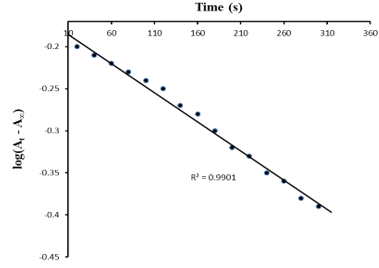
The redox reaction of orange (OR-) with sulphite ion in aqueous hydrochloric acid has been studied at an ionic strength of I = 0.50 mol dm-3 (NaCl), [H+] = 5.0 × 10⁻² mol dm-3 (HCl), T = 21 ± 1oC and λ = 484 nm. The redox reaction showed that one mole of OR- reacted with two moles of SO32-. The reaction showed a first order dependence on [OR-] and [SO32-]. Changes in ionic strength of the reaction medium indicated that the rate constant increases with increase in ionic strength. The reaction was found to be independent of [H+] in the range investigated, indicating that the reaction occurs through an acid-independent pathway. Spectroscopic evidence and Michaelis - Mentens plot of 1/k1 versus 1/SO32- suggest the possible absence of an intermediate in the rate determine step. Free radical test did not yield gel formation during the course of the reaction. Added cations and anions accelerated the rate of the reaction. This effect exerted by the ions suggested that the reaction might be operating via the outersphere mechanism.
References
Babatunde, O. (2009). Kinetics and mechanism of reduction of parafushin by nitrite ions in aqueous medium. Worid Journal of Chemistry, 4(1): 39-44.
Edokpayi, J, N (2011). Kinetics and mechanism of redox reaction of disodium 3,3’-dioxobi-indoline-2, 2’-ylidene-5, 5’ disulphonate with some oxy-anions in aqueous acidic solution, Unpublished M.Sc thesis, Ahmadu Bello University, Zaria.
Idris, S. O, Bako, B, Iyun J. F and Myek, B (2014). Kinetics and Mechanism of the Oxidation of Bromopyrogallol Red by Bromate Ion in Aqueous Hydrochloric Acid Medium. International Journal of modern chemistry, 6(2): 87-95.
Idris, S. O. Samson V. O and Myek, B. (2015). Kinetics of the Oxidation of Bromopyrogallol Red by Nitrite Ion in Aqueous Acidic Medium. International Frontier Science Letters, 3 : 32-38
Imam, M., Idris, S. O and Onu, A. D (2018). Kinetics and mechanism of the electron transfer reaction of malachite green with sulphite ion in acidic medium. FUW Trends in Science & Technology Journal, 3(2B): 778 – 782.
Iyun, J. F. Ayoko G. A and Lohdip, Y.N. (1992). The oxidation of sulphite by diaquotetrakis(2,2’-bipyridine)-µ-oxodiruthenium(III) ion in perchloric acid Bull Chemical Society Ethiopia, 6: 1-3.
Jeffery, G. H., Bassett, J., Mendham, J. and Denny, R.C. (1991). Vogel’s textbook of qualitative chemical analysis, 5th edition, Longman, England, pp. 391.
Jonnalgadda, S. B and Gollapalli N. R (2000). Kinetics of reduction of toluidine blue with sulphite –kinetic salt effect in elucidation of mechanism. Journal of Chemistry and Society, Perkin, Trans II,1111.
Mayer, T.J. and Taube, H. (1987).Comprehensive coordination chemistry: The synthesis, reaction, properties and application of coordination compounds Pergamon Press U.K, pp. 384.
Onu, A.D., Iyun, J. F. and Idris, S.O. (2009). The kinetics of the reduction of oxidation of Thiosulphates Ions by Copper Ions in Aqueous Ammonia Solution. Journal of Chemical Society, Dalton Transactions. 8: 889 – 893.
Stephanie (2008). Practical organic chemistry. Student’s handout, Department of Chemistry, Jazan University, Pp 38
Svehla, G. and Sivasankar’s, B. (2012). Vogel’s Qualitative Inorganic Analysis. Pearson, London, 254: 341-342.
Uttra, C, Aditya P and Raj, N. M (1995). Kinetics and Mechanism of the oxidation of the sulphite ion by the Mn(III)-cydta complex ion. Canadian Journal of Chemistry, 1531-1537.
Downloads
Published
Issue
Section
Categories
License
Copyright (c) 2026 Bako Myek, Suleiman Ola Idris, Ameh David Onu, Mohammed Kabir Yakubu

This work is licensed under a Creative Commons Attribution 4.0 International License.