
Crisis in the Streams: Urgent Comparative Water Quality Probe in Sabon Gari Nangere, Yobe State, Nigeria
DOI:
https://doi.org/10.33003/Keywords:
WHO, Nangere, Water Quality, Environmental Sustainability, Comparative AnalysisAbstract
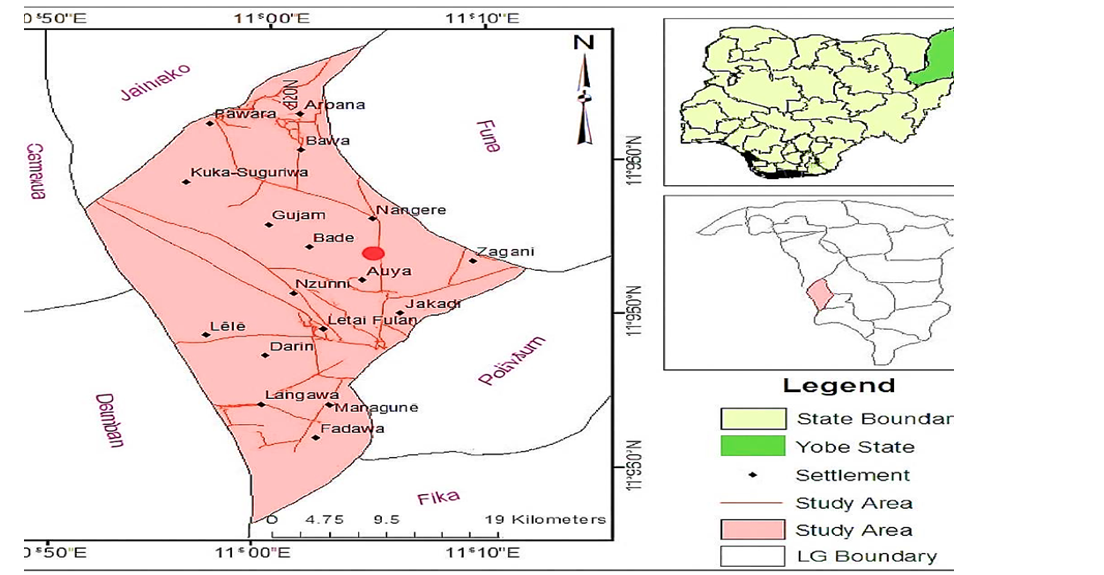
Sabon Gari Nangere, located in Nangere Local Government Area of Yobe State, depends largely on boreholes and hand-dug wells for domestic and agricultural use. This study presents a comparative analysis of water quality from selected sampling points within Sabon Gari Nangere. The analysis focused on key physicochemical parameters such as pH, temperature, hardness, turbidity, electrical conductivity, total dissolved solids (TDS), total suspended solids (TSS), and selected heavy metals, including carcinogenic heavy metals like Lead (Pb), Iron (Fe), Arsenic (As), Cadmium (Cd), and Chromium (Cr). While some parameters like Temperature, Hardness, and TSS met WHO standards, others like turbidity and conductivity were significantly high and exceeded permissible limits in almost all the samples. Likewise, TDS and pH are also above the WHO limit in the majority of the analyzed samples. Surprisingly, Fe is significantly above the set limit in only four samples. However, the analyzed carcinogenic heavy metals like Pb, Cr, As, and Cd are alarmingly very high in almost all the analyzed samples, exceeding all the regulatory bodies' limits. Factors that may contribute to such disasters include shallow groundwater tables, agricultural runoff, poor waste disposal practices, and inadequate protection of wells and boreholes. The study concludes that almost all the water sources in Sabon Gari Nangere are not safe for direct domestic use. However, regular monitoring, improved sanitation practices, proper well protection, and community awareness will greatly enhance the water quality. The findings provide a useful reference for policymakers, researchers, and stakeholders committed to improving water safety in Yobe State.
References
Abdul, I. H., & Faragai, B. A. (2026). Comparative Assessment of Soil Physicochemic… Comparative Assessment of Soil Physicochemical Properties, Heavy Metal Uptake, and Health Risk Associated with Sorghum Cultivated under Inorganic Fertilizer and Animal Manure Amendments in Kano State, Nigeria. FJS FUDMA Journal of Sciences (FJS, 10(10), 111–117. https://doi.org/10.33003/fjs-2026-1010-5206
Adjovu, G. E., Stephen, H., James, D., & Ahmad, S. (2023). Measurement of Total Dissolved Solids and Total Suspended Solids in Water Systems: A Review of the Issues, Conventional, and Remote Sensing Techniques. Remote Sensing 2023, Vol. 15, Page 3534, 15(14), 3534. https://doi.org/10.3390/rs15143534
Ali, H., Khan, E., & Ilahi, I. (2019). Environmental chemistry and ecotoxicology of hazardous heavy metals: Environmental persistence, toxicity, and bioaccumulation. Journal of Chemistry, 2019, 100094. https://doi.org/10.1155/2019/6730305
Alvarez, C. C., Bravo Gómez, M. E., & Hernández Zavala, A. (2021). Hexavalent chromium: Regulation and health effects. Journal of Trace Elements in Medicine and Biology, 65, 126729. https://doi.org/10.1016/j.jtemb.2021.126729
Audu, I. A., Ahmed, H. A., & Lawan, T. B. (2021). Assessment of Community Participation in Rural Development Projects in Nangere Local Government Area of Yobe State. International Journal of Trend in Scientific Research and Development (IJTSRD).
Bandh, S. A., & Mushtaq, B. (2025). Drinking Water Treatment Process. 165–227. https://doi.org/10.1007/978-3-031-86684-5_3
Boyd, C. E. (2020). Suspended Solids, Color, Turbidity, and Light. Water Quality, 119–133. https://doi.org/10.1007/978-3-030-23335-8_6
Butler, B. A., & Ford, R. G. (2017). Evaluating Relationships between Total Dissolved Solids (TDS) and Total Suspended Solids (TSS) in a Mining-Influenced Watershed. Mine Water and the Environment 2017 37:1, 37(1), 18–30. https://doi.org/10.1007/s10230-017-0484-y
Charkiewicz, A. E., Omeljaniuk, W. J., Nowak, K., Garley, M., & Nikliński, J. (2023). Cadmium Toxicity and Health Effects—A Brief Summary. Molecules 2023, Vol. 28, Page 6620, 28(18), 6620. https://doi.org/10.3390/molecules28186620
Collin, M. S., Venkatraman, S. K., Vijayakumar, N., Kanimozhi, V., Arbaaz, S. M., Stacey, R. G. S., Anusha, J., Choudhary, R., Lvov, V., Tovar, G. I., Senatov, F., Koppala, S., & Swamiappan, S. (2022). Bioaccumulation of lead (Pb) and its effects on human: A review. Journal of Hazardous Materials Advances, 7, 100094. https://doi.org/10.1016/j.hazadv.2022.100094
Genchi, G., Lauria, G., Catalano, A., Carocci, A., & Sinicropi, M. S. (2022). Arsenic: A Review on a Great Health Issue Worldwide. Applied Sciences 2022, Vol. 12, Page 6184, 12(12), 6184. https://doi.org/10.3390/APP12126184
Kim, E. J., Herrera, J. E., Huggins, D., Braam, J., & Koshowski, S. (2011). Effect of pH on the concentrations of lead and trace contaminants in drinking water: A combined batch, pipe loop and sentinel home study. Water Research, 45(9), 2763–2774. https://doi.org/10.1016/J.WATRES.2011.02.023
Lawan, T. B. (2021). Analysis of Spatio-Physical Accessibility to Rural Healthcare Facilities in Nangere Local Government Area of Yobe State, Nigeria. IOSR Journal of Humanities and Social Science (IOSR-JHSS, 26. https://doi.org/10.9790/0837-2606040817
Li, M., Liu, Z., Chen, Y., & Hai, Y. (2016). Characteristics of iron corrosion scales and water quality variations in drinking water distribution systems of different pipe materials. Water Research, 106, 593–603. https://doi.org/10.1016/J.WATRES.2016.10.044
Pointet, T. (2022). The United Nations World Water Development Report 2022 on groundwater, a synthesis [Le rapport mondial 2022 des Nations Unies sur les eaux souterraines synthèse]. LHB: Hydroscience Journal, 108(1). https://doi.org/10.1080/27678490.2022.2090867
Rahman, I., Wahab, M. A., Akter, M., & Mahanta, T. R. (2024). Iron in Drinking Water and its Impact on Human Health –A Study in Selected Units of Jalalabad Cantonment. Bangladesh Armed Forces Medical Journal, 56(2), 58–64. https://doi.org/10.3329/BAFMJ.V56I2.73013
Rakib, M. A., Quraishi, S. B., Newaz, M. A., Sultana, J., Bodrud-Doza, M., Rahman, M. A., Patwary, M. A., & Bhuiyan, M. A. H. (2022). Groundwater quality and human health risk assessment in selected coastal and floodplain areas of Bangladesh. Journal of Contaminant Hydrology, 249. https://doi.org/10.1016/j.jconhyd.2022.104041
PUKUMA, M. S., & IBRAHIM, T. (2023). Distribution, Possession and Utilization of Insecticide Treated Nets in Relation to Malaria Prevalence in Nangere Local Government Area, Yobe State, Nigeria. In Animal Research International (Vol. 20, Number 3). www.zoo-unn.org
Sutadian, A., Muttil, N., & Yilmaz, A. (2018). Development of a water quality index for rivers in West Java Province, Indonesia. ElsevierAD Sutadian, N Muttil, AG Yilmaz, BJC PereraEcological Indicators, 2018•Elsevier. https://www.sciencedirect.com/science/article/pii/S1470160X17307616
Tang, L., Skovhus, T. L., Søborg, D. A., Musovic, S., Kristensen, K. B., Høst-Madsen, T., & Vesterlund, C. (2024). Effect of organic compounds migrating from PE pipes on drinking water biofilms. https://www.ucviden.dk/en/publications/effect-of-organic-compounds-migrating-from-pe-pipes-on-drinking-w/
Tomczyk, P., Tymcio, M., Kuriqi, A., Santos, J. M., Wdowczyk, A., & Wiatkowski, M. (2026). Integrated water quality indices as tools for evaluating small hydropower impacts. Water Resources and Industry, 35, 100342. https://doi.org/10.1016/j.wri.2026.100342
Valskys, V., Hassan, H. R., Wołkowicz, S., Satkūnas, J., Kibirkštis, G., & Ignatavičius, G. (2022). A Review on Detection Techniques, Health Hazards and Human Health Risk Assessment of Arsenic Pollution in Soil and Groundwater. Minerals 2022, Vol. 12, Page 1326, 12(10), 1326. https://doi.org/10.3390/MIN12101326
Wang, B. B. (2021). Research on drinking water purification technologies for household use by reducing total dissolved solids (TDS). PLOS ONE, 16(9), e0257865. https://doi.org/10.1371/JOURNAL.PONE.0257865
Yavuz, V. S., Kartal, V., & Sambito, M. (2024). Comparative Analysis of Water Quality in Major Rivers of Türkiye Using Hydrochemical and Pollution Indices. Water 2024, Vol. 16, Page 2676, 16(18), 2676. https://doi.org/10.3390/w16182676
Zairullah, A., Hamzani, S., & A, S. (2025). Iron Contamination in Dug Well Water and Its Impact on Household Use in an Urban Indonesian Residential Area. Global Health & Environmental Perspectives, 2(1), 187=196. https://doi.org/10.61848/ghep.v2i1.127
Downloads
Published
Issue
Section
Categories
License
Copyright (c) 2026 Abdussamad Mukhtar Mohammed, Deghinmotei Alfred-Ughenbo

This work is licensed under a Creative Commons Attribution 4.0 International License.


