
Assessment of physicochemical and heavy metals analysis of Erinle Dam Reservoir Water, Osun State, Nigeria
DOI:
https://doi.org/10.33003/fjs-2026-10(ANB-K)-5108Keywords:
Freshwater, Reservoir, Quality, Heavy metal, Monitoring, Public HealthAbstract
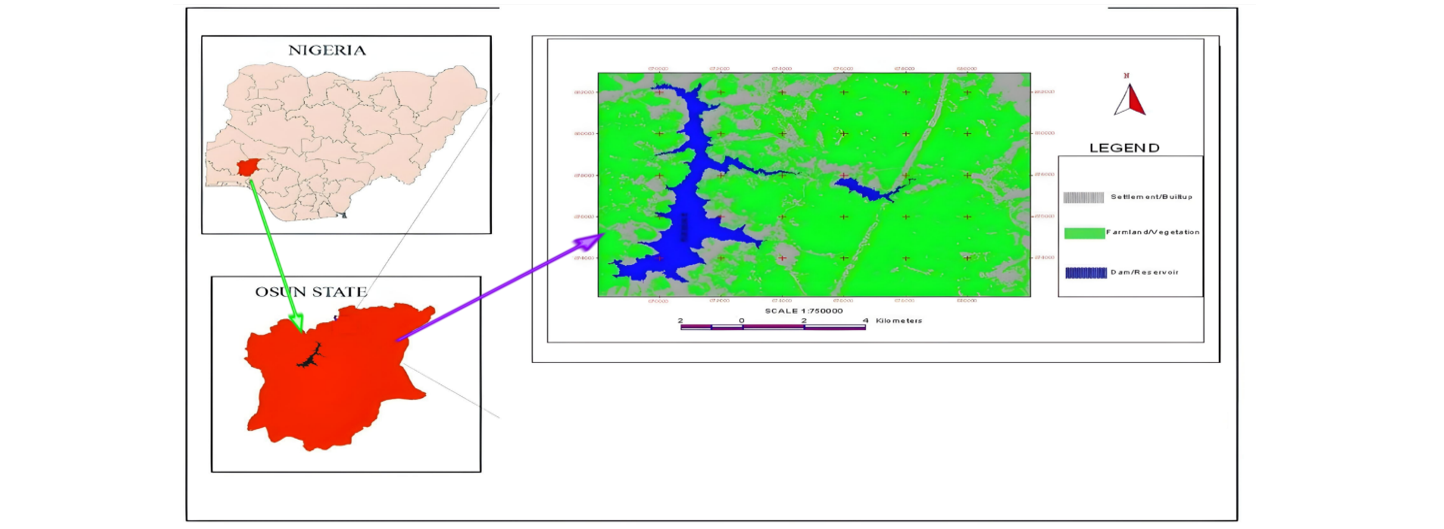
A dam reservoir plays a vital role in the global freshwater supply. This study evaluates the water quality of Erinle Dam Reservoir in Osun State, Nigeria, recognizing the essential importance of clean water for human health and well-being, agriculture, industry, and overall environmental sustainability, especially amid increasing pollution threats. The research aims to assess physicochemical parameters such as pH, temperature, turbidity, dissolved oxygen (DO), biochemical oxygen demand (BOD), total dissolved solids (TDS), and electrical conductivity (EC), examine bacteriological indicators like Escherichia coli, analyze heavy metal concentrations including zinc, cadmium, copper, lead, manganese, arsenic, iron, and chromium, and compare findings with WHO standards. It also seeks to identify pollution sources and recommend strategies for improving water quality. Twelve (12) water samples were systematically collected from different points across the reservoir and analyzed using the WHO and APHA standard laboratory procedures. Descriptive statistical analysis showed that parameters such as pH, temperature, and EC generally remained within acceptable limits; however, levels of cadmium, arsenic, and lead significantly exceeded WHO permissible limits, with calculated high heavy-metal health index risks for the users. Additionally, microbiological tests consistently detected high levels of E. coli in all samples, indicating widespread fecal contamination likely from agricultural runoff, industrial discharges, and domestic waste. Principal Component Analysis (PCA) highlighted spatial variations and pollution trends across sampling sites. The findings emphasize the urgent need for improved water quality monitoring, pollution control measures, and informed policy making to ensure sustainable water resource management in the region.
References
Adeleke, A. J., Olabode, B. G., & Toyin, O. (2024). Assessment of Shallow Wells of Public Importance in Selected Areas of Ekiti State Capital City, Ado Ekiti, Nigeria. Environmental Quality Management, 34(2), e22323.
Adeyeye, J. A, Akintan, O. B, & Afun, T. (2018). Assessment of Sanitary Risk and Water Quality of Public Hand Dug Wells in Ado Ekiti Local Government Area of Ekiti State. Journal of Agriculture and Human Ecology, 3(2):33-42.
Adeyeye, J. A, Akinyemi, O. D, Awomeso, J. A, Bada, B. S, & Akintan, O. B. (2021). Geochemical investigation of groundwater salinity status in selected coastal areas of south-western Nigeria. Sustainable Water Resources Management, 7, 1-15.
Adewoye, S. O. (2011). "Industrial effluents and their impact on water quality in Nigeria." Water and Environmental Journal, 25(2), 255-262.
APHA (2005). Federation WE. American Public Health, Standard methods for the examination of water and wastewater. Washington, DC: American Public Health Association
Awogbami, S. O. (2023). Assessment of Water Quality and Its Associated Health Effects Among Residents of Gold Mining Areas in Osun State, Southwest Nigeria (Doctoral dissertation, Kwara State University (Nigeria)).
Chakraborty, T. K., Ghosh, G. C., Ghosh, P., Jahan, I., Zaman, S., Islam, Md. S., Hossain, M. R., Habib, A., Biswas, B., Sultana, N., & Khan, A. S. (2022). Arsenic, iron, and manganese in groundwater and its associated human health risk assessment in the rural area of Jashore, Bangladesh. Journal of Water and Health, 20(6), 888–902. https://doi.org/10.2166/wh.2022.284
Daughton, C. G., & Ternes, T. A. (1999). "Pharmaceuticals and personal care products in the environment: Agents of subtle change?" Environmental Health Perspectives, 107(Suppl 6), 907-938.
European Commission (2020). "Directive 98/83/EC on the quality of water intended for human consumption." Official Journal of the European Communities.
Eslami, H., Esmaeili, A., Razaeian, M., Salari, M., Hosseini, A. N., Mobini, M., & Barani, A. (2022). Potentially toxic metal concentration, spatial distribution, and health risk assessment in drinking groundwater resources of southeast Iran. Geoscience Frontiers, 13(1), 101276. https://doi.org/10.1016/j.gsf. 2021.101276
Ghosh, G. C., Khan, Md. J. H., Chakraborty, T. K., Zaman, S., Kabir, A. H. M. E., & Tanaka, H. (2020). Human health risk assessment of elevated and variable iron and manganese intake with arsenic-safe groundwater in Jashore, Bangladesh. Scientific Reports, 10(1), 5206. https://doi.org/10.1038/s41598-020-62187-5
Gleick, P. H. (2000). "The changing water paradigm: A look at twenty-first century water resources development." Water International, 25(1), 127-138.
González, S., López-Roldán, R., & Cortina, J. L. (2013). Presence of metals in drinking water distribution networks due to pipe material leaching: a review. Toxicological and Environmental Chemistry, 95(6), 870-889.
Han, J., Cao, R., Li, K., Wang, S., Ji, G., Xu, H., ... & Wen, G. (2022). Change of algal organic matter under different dissolved oxygen and pressure conditions and its related disinfection by-products formation potential in the metalimnetic oxygen minimum. Water Research, 226, 119216.
Ighalo, J. O, Adeniyi, A.G., Adeniran, J.A., & Ogunniyi, S. (2021). A systematic literature analysis of the nature and regional distribution of water pollution sources in Nigeria. Journal of Cleaner Production, 283, 124566.
Kapoor, K., Kumar, S., Vishwakarma, D. K., Obaidullah, A. J., & Yadav, K. K. (2024). Health risk assessment of heavy metals in groundwater sources: Carcinogenic and non-carcinogenic evaluation. Journal of Water and Health, 22(10), 1972–1987. https://doi.org/10.2166/wh.2024.243
Kubier, A., Wilkin, R. T., & Pichler, T. (2019). Cadmium in soils and groundwater: A review. Applied Geochemistry, 108, 104388. https://doi.org/10.1016/j.apgeochem.2019.104388
Kümmerer, K. (2009). "The presence of pharmaceuticals in the environment due to human use – Present knowledge and future challenges." Journal of Environmental Management, 90(8), 2354-2366.
Martínez, J. L. (2009). "Environmental pollution by antibiotics and antibiotic resistance determinants." Environmental Microbiology, 11(12), 2970-2988.
NSDWQ (2007). Nigerian Standard for Drinking Water Quality, Standard Organization of Nigeria. Wuse. Abuja.
NESREA (2011). "National Environmental Standards and Regulations Enforcement Agency Act." Government of Nigeria.
Noll, P., Lilge L., Hausmann, R., & Henkel, M. (2020). Modeling and exploiting microbial temperature response. Processes, 8(1), 121.
Odonkor, S. T., & Mahami, T. (2020). Escherichia coli as a tool for disease risk assessment of drinking water sources. International Journal of Microbiology, 2020(1), 2534130.
Oketola, A. A., Adekolurejo, S. M., & Osibanjo, O. (2013). Water quality assessment of River Ogun using multivariate statistical techniques.
Richardson, S. D., & Kimura, S.Y. (2020). "Emerging contaminants in water: A new era of research." Environmental Science and Technology, 54(14), 8462-8468.
Richardson, S. D., & Ternes, T. A. (2018). "Water analysis: Emerging contaminants and current issues." Analytical Chemistry, 90(1), 398-428.
Rochester, J.R. (2013). "Bisphenol A and human health: A review of the literature." Reproductive Toxicology, 42, 132-155.
Sangoremi, A., Godwin, J., & Uzoukwu, B. A. (2013). Effect of SO42- Concentration on Ni (Ii) Extractions from Aqueous Solution Using 1-Phenyl-3-Methyl-4-Trichloroacetyl Pyrazol-5-One in Chloroform. Eur. Chem. Bull, 2, 68-71.
Sarkar, S., Bhatia, G., & Dhawan, A. (2023). Clinical practice guidelines for assessment and management of patients with substance intoxication presenting to the emergency department. Indian journal of psychiatry, 65(2), 196-211.
Singh, P. K., Kumar, U., Kumar, I., Dwivedi, A., Singh, P., Mishra, S., ... & Sharma, R. K. (2024). Critical review on toxic contaminants in surface water ecosystem: sources, monitoring, and its impact on human health. Environmental Science and Pollution Research, 31(45), 56428-56462.
SON (2015) "Nigerian Standard for Drinking Water Quality (NSDWQ)." Standards Organisation of Nigeria.
Sonone, S. S, Jadhav, S, Sankhla, M.S., & Kumar, R. (2020). Water contamination by heavy metals and their toxic effect on aquaculture and human health through the food Chain. Lett. Appl. NanoBioScience, 10(2), 2148-2166.
Srivastava, R. K., Shetti, N. P., Reddy, K. R., & Aminabhavi, T. M. (2020). Sustainable energy from waste organic matter via efficient microbial processes. Science of the Total Environment, 722, 137927.
Tavakoli Pirzaman, A., Ebrahimi, P., Niknezhad, S., Vahidi, T., Hosseinzadeh, D., Akrami, S., ... & Kazemi, S. (2023). Toxic mechanisms of cadmium and exposure as a risk factor for oral and gastrointestinal carcinomas. Human and Experimental Toxicology, 42, 09603271231210262.
Too, J. K. (2023). Characterization of Thermotolerant Escherichia Coli and Associated Risk Factors with Contamination of Source and Household Drinking Water in Kericho District, Kenya (Doctoral dissertation).
USEPA (2012). "Safe Drinking Water Act and regulations." United States Environmental Protection Agency.
U.S. EPA (1989). Risk Assessment Guidance for Superfund, Volume I: Human Health Evaluation Manual (Part A). EPA/540/1-89/002. Office of Emergency and Remedial Response, Washington, DC.
U.S. EPA (2004). Risk Assessment Guidance for Superfund Volume I: Human Health Evaluation Manual (Part E, Supplemental Guidance for Dermal Risk Assessment). EPA/540/R/99/005. Office of Superfund Remediation and Technology Innovation, Washington, DC.
U.S. EPA (2011). Exposure Factors Handbook: 2011 Edition. EPA/600/R-090/052F. U.S. Environmental Protection Agency, Washington, DC.
U.S. Environmental Protection Agency. (n.d.). National primary drinking water regulations (F-72-F-77).
Vetrimurugan, E., Brindha, K., Elango, L., & Ndwandwe, O. M. (2017). Human exposure risk to heavy metals through groundwater used for drinking in an intensively irrigated river delta. Applied Water Science, 7(6), 3267–3280. https://doi.org/10.1007/s13201-016-0472-6
Van der Bruggen, B., and Vandecasteele, C. (2003). "Removal of pollutants from surface water and groundwater by nanofiltration: Overview of possible applications in the drinking water industry. Environmental Pollution, 122(3), 435-445.
WHO (2017). "Guidelines for drinking-water quality." World Health Organization. WHO https://www.who.int/gho/malaria/en/
Inuwa, H. S., Apagu, A., Chaka, B., Mbilari, M. B., Mohammed, M., & Filibus, N. (2026). Study on physicochemical parameters and plankton composition of lake Ribadu in Fufore Local Government Area of Adamawa State, Nigeria. FUDMA Journal of Sciences, 10 (3), 160-172.
Yuan, Z., Luo, T., Liu, X., Hua, H., Zhuang, Y., Zhang, X., & Ren, J. (2019). Tracing anthropogenic cadmium emissions: From sources to pollution. Science of the total environment, 676, 87-96.
Ziarati, P., Hochwimmer, B., Cruz-Rodriguez, L., Tanideh, N., Iraji, A., & Kamyab-Moghadas, B. (2021). Lung cancer disease and arsenic: the medical geology as key, Journal of Medical Discovery, 6(1), 1-16.
Downloads
Published
Issue
Section
Categories
License
Copyright (c) 2026 Abidemi Sangoremi, Joseph Adeleke Adeyeye, Adebayo Emmanuel Adeleke, John Omodara Akinremi, Oluwakemi Bolanle Akintan, Temitope Oluwaseun Faloye

This work is licensed under a Creative Commons Attribution 4.0 International License.


