
MEASURING NIGERIA DATA PROTECTION ACT (NDPA) 2023 COMPLIANCE IN NIGERIAN UNIVERSITIES: A GENERAL COMPLIANCE INDEX AND EVIDENCE OF INSTITUTIONAL DECOUPLING
DOI:
https://doi.org/10.33003/fjs-2026-1006-5085Keywords:
NDPA 2023, data protection compliance, Nigerian universities, institutional decoupling, General Compliance Index, data governanceAbstract
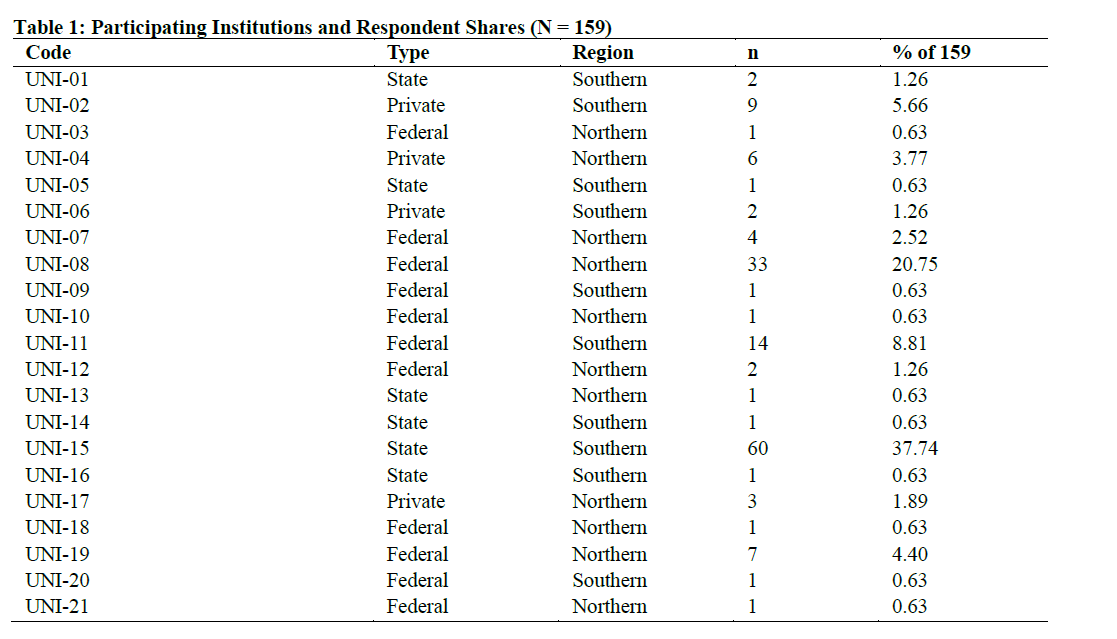
Nigerian universities are amidst the most data-intensive actors in the public sector, yet no structured measurement exists of how the higher education sector performs with respect to Nigeria Data Protection Act (NDPA) 2023. This study addresses the gap by applying the concept of General Compliance Index (GCI) spanning 13 NDPA-defined domains to measure NDPA 2023 compliance in Nigerian Universities. Stratified purposive sampling across 24 universities in northern and southern Nigeria yielded 159 valid responses; GCI scores revealed compliance levels, inter-institutional differences, and decoupling. The mean GCI of 35.79% (SD = 13.56%) positions the higher education sector in the awareness maturity band. At this level, universities recognize regulatory requirements but have not taken that recognition into daily operational practice. Only 1.7% of the 298 accredited universities filed the mandatory 2024 compliance returns with the Nigeria Data Protection Commission (NDPC). A decoupling gap of 50.9 percentage points separates privacy policy adoption (74.2%) from Data Protection Officer (DPO) appointment (23.3%), pointing to a deep structural disconnect between symbolic conformity and genuine governance investment. GCI scores differed significantly by university type (Kruskal–Wallis H(2) = 7.719, p = .021) and geopolitical region (Mann–Whitney U = 2287.5, p = .009). Role-based analysis further showed that awareness of the DPO requirement is heavily concentrated by job function (χ² = 29.314, p < .001, Cramér’s V = 0.429). Findings are interpreted through Meyer and Rowan’s institutional decoupling framework, with direct implications for the NDPC, the National Universities Commission (NUC), and university data governance practitioners.
References
DiMaggio, P., & Powell, W. (1983). The iron cage revisited: Institutional isomorphism and collective rationality in organizational fields. American Sociological Review, 48(2), 147–160. https://doi.org/10.2307/2095101
Erima, J. A., & Maseh, E. (2024). Attaining compliance for digital archiving through effectual implementation of legislative and regulatory frameworks in selected Kenyan universities. KLISC Journal of Information Science and Knowledge Management, 2(2), 49–57. https://doi.org/10.61735/2jr98p51
European Parliament. (2016). Regulation (EU) 2016/679 of the European Parliament and of the Council — General Data Protection Regulation (GDPR). Official Journal of the European Union.
Federal Republic of Nigeria. (2023). Nigeria Data Protection Act (NDPA) 2023. Federal Government of Nigeria.
Femi, A. G., Adenomon, M. O., Aimufua, G. I. O., & Ibrahim, U. (2025). Evaluating the level of compliance with the Nigeria Data Protection Regulation (NDPR): Insights from organizations across key sectors. Journal of Cyber Security, 7, 377–394. https://doi.org/10.32604/jcs.2025.069185
Ghorashi, S. R., Zia, T., Bewong, M., & Jiang, Y. (2023). An analytical review of industrial privacy frameworks and regulations for organisational data sharing. Applied Sciences, 13(23), 12727. https://doi.org/10.3390/app132312727
Juma, I., & Faturoti, B. (2025). Enforcing data privacy in Kenya and Nigeria: Towards an African approach to regulatory practice. International Review of Law, Computers & Technology. Advance online publication. https://doi.org/10.1080/13600869.2025.2506918
Li, S., Cram, R., & Rupasinghe, T. (2025). Mapping the empirical literature on the GDPR’s (in-)effectiveness: A systematic literature review. Computer Law & Security Review, 57, 106129. https://doi.org/10.1016/j.clsr.2025.106129
Meyer, J. W., & Rowan, B. (1977). Institutionalized organizations: Formal structure as myth and ceremony. American Journal of Sociology, 83(2), 340–363. https://doi.org/10.1086/226550
Munot, A., Afroz, I., & Choffnes, D. (2025). Compliance by design or by disguise? GDPR’s reshaping of universities’ privacy policies. Proceedings of the Workshop on Privacy in the Electronic Society (WPES ’25). ACM. https://doi.org/10.1145/3733802.3764047
National Information Technology Development Agency (NITDA). (2019). Nigeria Data Protection Regulation (NDPR). NITDA.
Nigeria Data Protection Commission (NDPC). (2024). Annual Report 2024. NDPC. https://ndpc.gov.ng/Files/AnnualReport2024.pdf
Nuruddeen, U., Aimufua, G. I. O., Maijamaa, B., & Bassey, S. (2025). Assessment of data protection and privacy implementation in financial institutions in Nigeria. International Journal of Innovative Information Systems & Technology Research, 13(4), 125–134. https://doi.org/10.5281/zenodo.17490504
Okikiola, F. M., Arogundade, T. S., Onadokun, I., Oladiboye, O. E., & Adetunji, S. K. (2026). Strengthening financial integrity: The role of cybersecurity in mitigating financial fraud in Nigeria's banking sector. FUDMA Journal of Sciences, 10(2), 175–183. https://doi.org/10.33003/fjs-2026-1002-4491
Republic of Ghana. (2012). Data Protection Act, Act 843 of 2012. Ghana Publishing Corporation.
Republic of Kenya. (2019). Data Protection Act, No. 24 of 2019. Kenya Gazette Supplement.
Republic of South Africa. (2013). Protection of Personal Information Act (POPIA), Act No. 4 of 2013. Government Gazette.
Smirnova, Y., & Travieso-Morales, V. (2025). Tech startups and general data protection regulation: An empirical exploration of compliance challenges. Journal of Small Business and Enterprise Development, 32(8), 54–82. https://doi.org/10.1108/JSBED-09-2024-0495
Downloads
Published
Issue
Section
Categories
License
Copyright (c) 2026 Opeyemi Shokunbi, Prof. Michael Agbaje, Dr. Emmanuel C. OGU

This work is licensed under a Creative Commons Attribution 4.0 International License.


