
Computational Thermal Analysis of AISI 1018 Low-Carbon Steel during Gas Tungsten Arc Welding
DOI:
https://doi.org/10.33003/fjs-2026-1008-5079Keywords:
Gas Tungsten Arc Welding, AISI 1018 Low-Carbon Steel, Thermal Behaviour, Computational Fluid Dynamics, Finite Volume Method, Weld Pool DynamicsAbstract
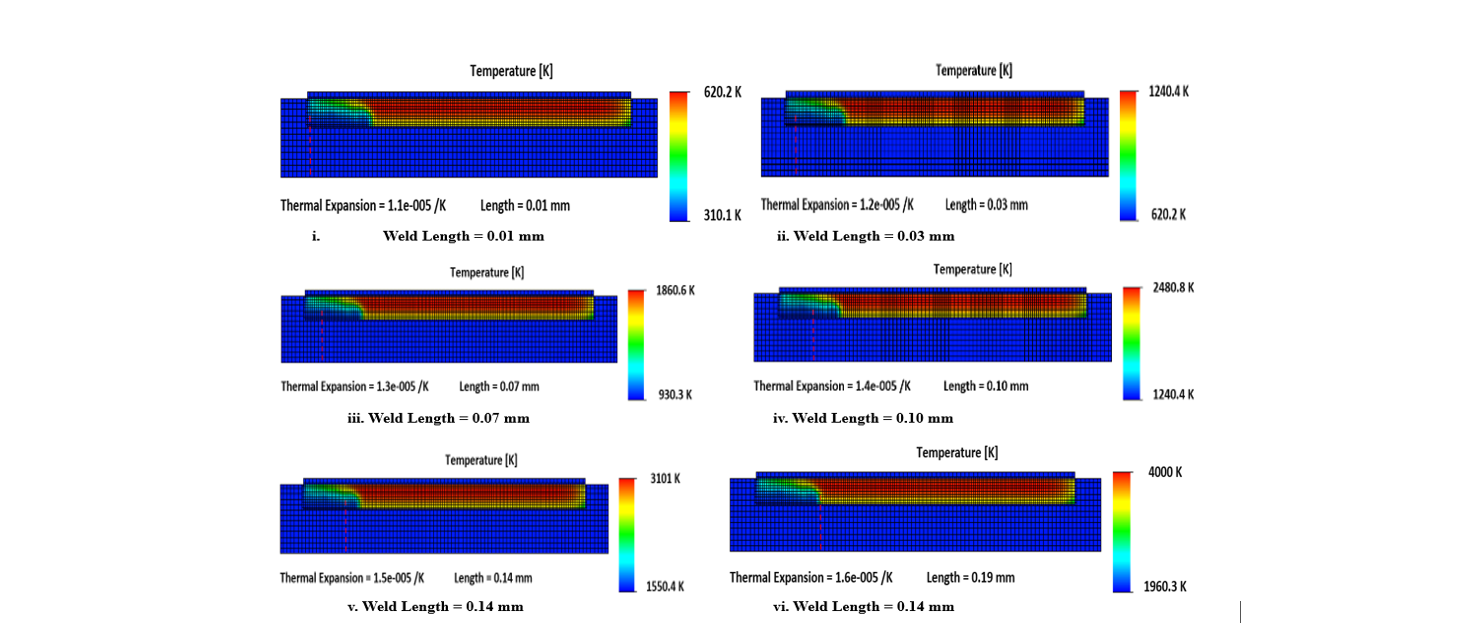
The thermal behaviour of AISI 1018 low-carbon steel during Gas Tungsten Arc Welding (GTAW) is thoroughly investigated computationally in this work utilising computational fluid dynamics and finite volume methods. The study assesses how heat input affects the welded region's temperature distribution, thermal conductivity, dynamic viscosity, specific heat capacity, weld pool behaviour, and heat flux properties. To replicate actual welding conditions, a three dimensional transient thermal model with temperature dependent thermophysical characteristics and a Gaussian moving heat source was created. The findings show that GTAW offers localised heating, controlled thermal penetration, reduced heat affected zone, and improved weld quality. The study provides important insight for optimising GTAW parameters and improving thermal management in steel fabrication industries. The simulation results showed peak temperatures exceeding 4000 K within the fusion zone, confirming stable weld pool formation and effective heat penetration. Thermal conductivity and dynamic viscosity decreased with increasing temperature, while specific heat capacity increased significantly, influencing heat diffusion and molten metal flow. As the temperature rose, specific heat capacity dramatically increased, affecting heat diffusion and the flow of molten metal, but thermal conductivity and dynamic viscosity decreased. The results show that GTAW offers enhanced weld quality, reduced heat affected zone, regulated thermal penetration, and localised heating. The study offers important information for enhancing heat management in steel manufacturing businesses and optimising GTAW parameters.
References
Ahmad, S., Khan, M. A., & Yusuf, M. (2022). Numerical investigation of thermal distribution during GTAW of low carbon steel using finite volume method. Journal of Manufacturing Processes, 74, 512–523. https://doi.org/10.1016/j.jmapro.2022.01.045
Ali, H., Ibrahim, R., & Noor, M. M. (2023). Thermal-fluid analysis of weld pool behaviour in TIG welding of mild steel. Materials Today: Proceedings, 72, 1150–1158. https://doi.org/10.1016/j.matpr.2022.11.214
Arora, P., Singh, R., & Sharma, A. (2022). CFD modeling of heat transfer in gas tungsten arc welding of AISI steels. Case Studies in Thermal Engineering, 36, 102145. https://doi.org/10.1016/j.csite.2022.102145
Babu, K., Kumar, S., & Rajesh, N. (2023). Effect of welding heat input on thermal gradients and residual stress in GTAW joints. Journal of Materials Engineering and Performance, 32(4), 2789–2802. https://doi.org/10.1007/s11665-022-07411-2
Chen, Y., Liu, H., & Wang, Z. (2022). Three-dimensional numerical simulation of heat transfer and fluid flow in TIG welding. Welding in the World, 66(8), 1579–1592. https://doi.org/10.1007/s40194-022-01312-4
Das, P., Roy, S., & Mukherjee, M. (2023). Thermal analysis of low carbon steel during gas tungsten arc welding using finite element approach. Engineering Science and Technology, an International Journal, 39, 101328. https://doi.org/10.1016/j.jestch.2023.101328
Elangovan, S., & Balasubramanian, V. (2022). Heat affected zone characterization in GTAW welded low carbon steel joints. Materials Research Express, 9(5), 056519. https://doi.org/10.1088/2053-1591/ac6d82
Farahani, M., Hosseini, S., & Azad, M. (2023). Influence of temperature-dependent material properties on weld pool dynamics during TIG welding. Metals, 13(2), 341. https://doi.org/10.3390/met13020341
Ghosh, A., & DebRoy, T. (2022). Advanced computational modeling of arc welding processes: A review. International Materials Reviews, 67(6), 455–489. https://doi.org/10.1080/09506608.2021.1975678
Gupta, R., Verma, A., & Singh, D. (2023). Numerical study of thermal conductivity variation during GTAW of carbon steels. Journal of Thermal Analysis and Calorimetry, 148(3), 1455–1468. https://doi.org/10.1007/s10973-022-11876-4
Hassan, M., Ali, L., & Rehman, A. (2022). Computational investigation of weld pool convection in TIG welding. Applied Thermal Engineering, 210, 118364. https://doi.org/10.1016/j.applthermaleng.2022.118364
He, X., Zhang, Y., & Sun, J. (2023). Numerical simulation of transient temperature fields during arc welding of steels. Journal of Materials Processing Technology, 314, 117912. https://doi.org/10.1016/j.jmatprotec.2022.117912
Jha, P., Kumar, R., & Soni, V. (2022). Heat transfer analysis in gas tungsten arc welding using moving Gaussian heat source model. Journal of Manufacturing and Materials Processing, 6(4), 89. https://doi.org/10.3390/jmmp6040089
Kannan, T., & Murugan, N. (2023). Experimental and numerical investigation of thermal behaviour in TIG welded low carbon steel plates. Materials Today Communications, 34, 105012. https://doi.org/10.1016/j.mtcomm.2022.105012
Kumar, A., Singh, P., & Mehta, Y. (2022). Finite volume simulation of heat flux distribution in GTAW process. Heat Transfer Engineering, 43(18), 1612–1624. https://doi.org/10.1080/01457632.2021.2012334
Li, J., Zhao, H., & Wu, T. (2023). Effect of welding parameters on molten pool morphology in TIG welding of steel alloys. Metallurgical and Materials Transactions B, 54(2), 965–978. https://doi.org/10.1007/s11663-022-02708-9
Mahmood, T., Khan, A., & Saeed, M. (2022). Thermal-fluid behavior of weld pool during GTAW process using CFD analysis. Engineering Applications of Computational Fluid Mechanics, 16(1), 1756–1771. https://doi.org/10.1080/19942060.2022.2083410
Mohanty, S., & Biswas, P. (2023). Influence of arc heat source parameters on weld penetration in TIG welding. Journal of Mechanical Science and Technology, 37(6), 2811–2821. https://doi.org/10.1007/s12206-023-0510-2
Natarajan, K., & Ravi, G. (2022). Thermal characterization of AISI steels during gas tungsten arc welding. Materials Performance and Characterization, 11(5), 742–756. https://doi.org/10.1520/MPC20220031
Oladimeji, T., & Akinlabi, E. (2023). Numerical prediction of temperature distribution and residual stresses in welded steel structures. Results in Engineering, 18, 101045. https://doi.org/10.1016/j.rineng.2023.101045
Patel, H., Shah, P., & Joshi, M. (2022). Modeling of molten pool dynamics in GTAW using computational fluid dynamics. Proceedings of the Institution of Mechanical Engineers, Part B: Journal of Engineering Manufacture, 236(11), 1830–1842. https://doi.org/10.1177/09544054221076543
Qiu, C., Huang, Y., & Lin, S. (2023). Numerical investigation of thermal cycles and cooling rates in TIG welding. Journal of Materials Research and Technology, 23, 4021–4035. https://doi.org/10.1016/j.jmrt.2023.02.154
Ramesh, T., Kumar, V., & Prasad, R. (2022). Influence of thermal gradients on microstructural evolution during GTAW of mild steel. Materials Characterization, 188, 111892. https://doi.org/10.1016/j.matchar.2022.111892
Sharma, D., & Singh, K. (2023). Heat transfer and phase transformation analysis in GTAW welded steels. Steel Research International, 94(7), 2200615. https://doi.org/10.1002/srin.202200615
Siva, R., & Balaji, N. (2022). Computational analysis of heat affected zone development during TIG welding of low carbon steel. Journal of Advanced Joining Processes, 5, 100089. https://doi.org/10.1016/j.jajp.2022.100089
Sun, L., Chen, Q., & Yang, Z. (2023). Thermo-fluid simulation of molten metal flow in arc welding applications. Fusion Engineering and Design, 191, 113679. https://doi.org/10.1016/j.fusengdes.2023.113679
Tiwari, M., & Dubey, A. (2022). Numerical modeling of transient heat transfer during gas tungsten arc welding of steels. International Journal of Pressure Vessels and Piping, 196, 104627. https://doi.org/10.1016/j.ijpvp.2022.104627
Wang, X., Li, F., & Zhou, Y. (2023). Influence of thermo-physical properties on weld pool stability during TIG welding. Materials Science and Engineering A, 869, 144805. https://doi.org/10.1016/j.msea.2023.144805
Yadav, P., & Chauhan, R. (2022). Thermal performance analysis of AISI 1018 steel during GTAW process. Journal of Engineering Research, 10(4), 215–229. https://doi.org/10.36909/jer.15439
Zhang, H., Liu, Y., & Feng, J. (2023). Coupled thermal-fluid simulation of arc welding process considering temperature-dependent material properties. Computational Materials Science, 222, 112066. https://doi.org/10.1016/j.commatsci.2023.112066
Downloads
Published
Issue
Section
Categories
License
Copyright (c) 2026 Ejiroghene Kelly Orhorhoro, Oghenekevwe Oghoghorie

This work is licensed under a Creative Commons Attribution 4.0 International License.


