
A DECENTRALIZED CERTIFICATE VERIFICATION SYSTEM LEVERAGING BLOCKCHAIN AND NON-FUNGIBLE TOKENS
DOI:
https://doi.org/10.33003/fjs-2026-1006-5064Keywords:
Blockchain Technology, NFT, Web3, Certificate VerificationAbstract
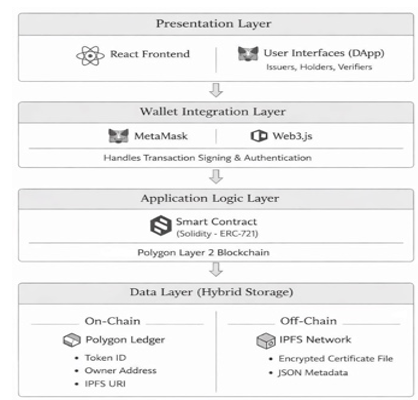
Academic certificate verification in many institutions is still carried out using centralized and manual systems, which are prone to forgery, data manipulation, high administrative costs, and delays in verification. These challenges reduce the reliability and efficiency of credential validation. This research work focuses on the development of a Decentralized Certificate Verification System (DCVS) that improves security, transparency, and trust in academic credential verification. The proposed system uses blockchain technology to represent academic certificates as Non-Fungible Tokens (NFTs) based on the ERC-721 standard deployed on the Polygon blockchain. Certificate documents and metadata are stored off-chain using the Interplanetary File System (IPFS), while cryptographic references are recorded on the blockchain to ensure data integrity and prevent tampering. The system adopts Self-Sovereign Identity (SSI) principles, allowing students to own and share their credentials while enabling employers and institutions to verify certificates without relying on a central authority. Evaluation of the system on the Polygon test network showed a reliable result with a minting confirmation time of 3.2 seconds, less than the 10-second standard benchmark, verification latency of 0.8 seconds, less than the 2-second benchmark, and a transaction cost of 0.00021 MATIC, less than the 0.01 MATIC standard cost. The study demonstrates that blockchain-based solutions can effectively address the challenges of traditional academic certificate verification systems.
References
Abayomi-Zannu, T.P., Odon-Ayo, I, Tatama, B.F., & Misra, S. (2020). Implementing a Mobile Voting System Utilizing Blockchain Technology and Two-Factor Authentication in Nigeria. Lecture Notes in Networks and Systems. https://doi.org/10.1007/978-981-15-3369-3_63
Abed, S.I., Albeltaji, O.S., & Alnabriss, H. (2024). Decentralized Storage Using Inter Planetary File System, In: AI in Business: Opportunities and Limitations. https://doi.org/10.1007/978-3-031-49544-1_19
Aghware, F., Okpor, M.D., Adigwe, W., & Odiakose, C.C. (2024). BloFoPASS: A Blockchain Food Palliatives Tracer Support System for Resolving Welfare Distribution Crisis in Nigeria. International Journal of Information and Communication Technology https://doi.org/10.11591/ijict.v13i2.pp178-187
Atzori, M. (2017). Blockchain technology and decentralized governance: Is the state still necessary? Journal of Governance and Regulation, 6(1), 45–62. https://doi.org/10.22495/jgr_v6_i1_p5
Azogu, I, Norta, A., Papper, I., Longo, J., & Draheim, D. (2019). A Framework for the Adoption of Blockchain Technology in Healthcare Information Management Systems: A Case Study of Nigeria. Proceedings of the 12th International Conference on Theory and Practice of Electronic Governance (ICEGOV2019), Melbourne, VIC, Australia. https://doi.org/10.1145/3326365.3326405
Buterin, V. (2014). A next-generation smart contract and decentralized application platform. Ethereum White Paper.
Carmichael, J., & Eaton, S. E. (2020). Understanding the landscape of counterfeit credentials and university admissions fraud. Academic Integrity Webinar Series: Urgent and Emerging Topics - Taylor Institute for Teaching and Learning, University of Calgary.
Dordevic, J., Stojanovi, L., & Markovi, T. (2025). Blockchain-Based Academic Records for Hybrid Education: Securing Digital Credentials in Global Crisis Contexts. Journal Neosantara Hybrid Learning 3(1): 20 – 28.
Guo, H. & Yu, X. (2022). A Survey on Blockchain Technology and Its Security. Blockchain: Research and Applications. 3(2). https://doi.org/10.1016/j.bcra.2022.100067.
Ibrahim, M. Y., Musa, K.I., Yarima, A., & Ahmad, A. (2022). A Proposed Secured Health Monitoring System for the Elderly Using Blockchain Technology in Nigeria. Journal of Electronics, Computer Networking and Applied Mathematics. 2(4). https://doi.org/10.55529/jecnam.24.31.53
Ikuero, F. E., Germanos, V., Brooks, L., & Zeng, W. (2021). Is E-voting Systems based on Blockchain Technology Efficient in Nigeria General Elections?. EAI Endorsed Transactions on Security and Safety. 7(25). https://doi.org/10.4108/eai.10-3-2021.168964
Kaisto, J., Juutilainen, T., & Kauranen, J. (2024). Non-fungible Tokens, Tokenization, and Ownership. Computer Law & Security Review (54). https://doi.org/10.1016/j.clsr.2024.105996
Motepalli, S. & Jacobsen, H. (2025). Decentralization in PoS Blockchain Consensus: Quantification and Advancement. arXiv preprint, arXiv:2504.14351v1
Nweje, U. (2024). Blockchain Technology for Secure Data Integrity and Transparent Audit Trails in Cybersecurity. International Journal of Research Publication and Reviews, 5(12): 4902 – 4916.
Ojobor, R. C., Ojobor, C. I., & Oluranti, J. (2022). Blockchain and Organizational Practices: The Case of Nigerian Academic Libraries. Blockchain Applications in the Smart Era – Springer Innovations in Communication and Computing. https://doi.org/10.1007/978-3-030-89546-4_9
Polygon Technology. (2023). Polygon documentation. https://polygon.technology
Sadar, L. (2025). Fake Me If You Can: Unforgeable Digi-Physical Academic Certificates with Instant Verifiability. IEEE Access 99 (1). https://doi.org/10.1109/ACCESS.2025.3583184
Schardong, F., & Custodio, R. (2022). Self-Sovereign Identity: A Systematic Review, Mapping and Taxonomy. Sensors 22(15):5641. https://doi.org/10.3390/s22155641
Seun, O. A., Khodadadi, T., & Palaniappan, S. (2020). Blockchain Technology for Managing land Titles in Nigeria. International Journal of Advanced Trends in Computer Science and Engineering 9(4). https://doi.org/10.30534/ijatcse/2020/178942020
Tripathi, G., Ahad, M. A., & Casalino, G. (2023). A Comprehensive Review of Blockchain Technology: Underlying Principles and Historical Background With Future Challenges. Decision Analytics Journal. https://doi.org/10.1016/j.dajour.2023.100344
Wang, X., Younas, M., Jiang, Y., Imran, M., & Almusharraf, N.M. (2025). Transforming Education Through Blockchain: A Systematic Review of Applications, Projects, and Challenges. IEEE Access 13(13264-13284), https://doi.org/10.1109/ACCESS.2024.3519350
Yahya, S., Muhammad-Bello, B., & Salihu, I. A, Imran, M., & Almusharraf, N.M. (2026). A Scoping Review on the Viability of Blockchain For Land Registry Systems in Nigeria. FUDMA Journal of Science 10(3), 266 – 272. https://doi.org/10.33003/fjs-2026-1003-4419
Yang, J., Li, Y., Lai, Y., Liu, M. (2023). Non-Fungible Tokens (NFTs): Tokens of Digital assets on the Blockchain. International Conference on Electronics, Computers and Communication Technology, Guilin, China. https://doi.org/10.1145/3637494.3638725
Downloads
Published
Issue
Section
Categories
License
Copyright (c) 2026 Tivlumun Ge, Joel Aondofa Udoji, Isaac Terngu Adom

This work is licensed under a Creative Commons Attribution 4.0 International License.


