
Development of Network Learning Management System (Net-LMS ) to Support Effective Teaching and Learning of Network Devices
DOI:
https://doi.org/10.33003/fjs-2026-1009-5058Keywords:
E-learning, Network Simulation, Network Device Training, Learning Management System, Virtual Labs,Abstract
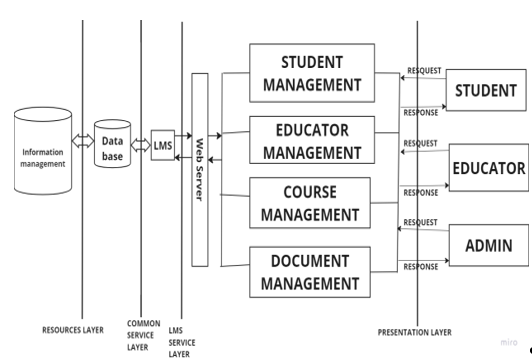
The current project was implemented in response to a challenge in network devices education which is characterized by the discrepancy between theoretical knowledge and practical skills. Traditionally, learners find it hard to apply the acquired knowledge to real networking tasks since teaching has always been focused more on theoretical rather than practical aspects.Net-LMS – an interactive learning platform integrating video tutorials, quizzes, practical tasks and performance analysis tools – was designed to solve this issue. Design Network Learning Management System (Net-LMS) has been developed using the WordPress website development platform, providing numerous advantages such as flexibility and the capability to integrate any required plugins for a better performance of the system. Development of Network Learning Management System involved several important stages aimed at creating a scalable learning platform with easy-to-navigate interfaces. First, web hosting and domain services were purchased to make it possible to develop the project on the Internet.Then, WordPress was installed to serve as the basis for further development. Additional protection of the website was ensured due to installation of SSL certificates, and Tutor LMS Plugin enabled the development of courses, management of users, delivering of assessments and learning performance tracking. Advantages Network Learning Management System possesses several major advantages including the opportunity for repeated network configuration practice without the need for physical networking devices.Such an advantage contributes to improved engagement among the learners, enhances practical skills, and provides chances for building confidence through constant practice. Finally, all test cases concerning the project performance have been successfully completed.
References
Almarashdeh, I. (2016). Sharing instructors’ experience of learning management system: A technology perspective of user satisfaction in distance learning course. Computers in Human Behavior, 63, 249–255. https://doi.org/10.1016/j.chb.2016.05.013
Al-Fuqaha, A., Guizani, M., Mohammadi, M., Aledhari, M., & Ayyash, M. (2015). Internet of things: A survey on enabling technologies, protocols, and applications. IEEE Communications Surveys & Tutorials, 17(4), 2347–2376. https://doi.org/10.1109/COMST.2015.2444095
Brinson, J. R. (2015). Learning outcome achievement in non-traditional (virtual and remote) versus traditional (hands-on) laboratories: A review of the empirical research. Computers & Education, 87, 218–237. https://doi.org/10.1016/j.compedu.2015.07.003
Cisco. (2021). Cisco annual internet report (2018–2023) white paper. Cisco Systems. https://doi.org/10.48550/arXiv.2101.00001
Coutinho, G. S., Magana, A. J., & do Rego Dias, V. (2023, June). A framework for the development of online virtual labs for engineering education. In Proceedings of the 2023 ASEE Annual Conference & Exposition, Baltimore, Maryland. https://doi.org/10.18260/1-2--42396
Dicheva, D., Dichev, C., Agre, G., & Angelova, G. (2015). Gamification in education: A systematic mapping study. Educational Technology & Society, 18(3), 75–88. https://doi.org/10.2307/jeductechsoci.18.3.75
Dabbagh, N., & Kitsantas, A. (2012). Personal learning environments, social media, and self-regulated learning: A natural formula for connecting formal and informal learning. The Internet and Higher Education, 15(1), 3–8. https://doi.org/10.1016/j.iheduc.2011.06.002
Dillenbourg, P. (2015). Orchestration graphs: Modeling scalable education. Lausanne, Switzerland: EPFL Press. ISBN: 978-2832316900
García-Peñalvo, F. J., Hernández-García, Á., & Conde-González, M. Á. (2021). Learning ecosystems: An approach for the integration of educational tools and technologies. Educational Technology & Society, 24(3), 35–45. https://doi.org/10.30191/ETS.202107_24(3).0004
Heradio, R., de la Torre, L., Galán, D., Cabrerizo, F. J., Herrera-Viedma, E., & Dormido, S. (2016). Virtual and remote labs in education: A bibliometric analysis. Computers & Education, 98, 14–38. https://doi.org/10.1016/j.compedu.2016.03.010
Kebande, V. R. (2024). The impact of virtual laboratories on active learning and engagement in cybersecurity distance education. arXiv. https://doi.org/10.48550/arXiv.2404.04952
Kirkwood, A., & Price, L. (2014).Technology-enhanced learning and teaching in higher education: What is ‘enhanced’ and how do we know? Learning, Media and Technology, 39(1), 6–36. https://doi.org/10.1080/17439884.2013.770404
Kurose, J. F., & Ross, K. W. (2021). Computer networking: A top-down approach (8th ed.). Pearson. https://doi.org/10.5555/3486562
Makransky, G., & Petersen, G. B. (2019). Immersive virtual reality and learning: A meta- analysis. Educational Psychology Review, 31, 817–847. https://doi.org/10.1007/s10648-019-09486-2
Means, B., Toyama, Y., Murphy, R., Bakia, M., & Jones, K. (2010). Evaluation of evidence- based practices in online learning: A meta-analysis. U.S. Department of Education. https://doi.org/10.1037/e675882010-001
Mwansa, G., Ngandu, M. R., & Dasi, Z. S. (2024). Enhancing practical skills in computer networking: Evaluating the unique impact of simulation tools, particularly Cisco Packet Tracer, in resource-constrained higher education settings. Education Sciences, 14(10), 1099. https://doi.org/10.3390/educsci14101099
Navarro, C., Arias-Calderón, M., Henríquez, C. A., & Riquelme, P. (2024).
Assessment of student and teacher perceptions on the use of virtual simulation in cell biology laboratory education. Education Sciences, 14(3), 243. https://doi.org/10.3390/educsci14030243
Object Management Group. (2017). Unified Modeling Language (UML) specification version 2.5.1. https://www.omg.org/spec/UML/2.5.1
Potkonjak, V., Gardner, M., Callaghan, V., Mattila, P., Guetl, C., Petrović, V. M., &
Jovanović, K. (2016). Virtual laboratories for education in science, technology, and engineering: A review. Computers & Education, 95, 309–327. https://doi.org/10.1016/j.compedu.2016.02.002
Radianti, J., Majchrzak, T. A., Fromm, J., & Wohlgenannt, I. (2020). A systematic review of immersive virtual reality applications for higher education. Computers & Education, 147, 103778. https://doi.org/10.1016/j.compedu.2019.103778
Rahman, A., Nayem, A., & Siddik, S. (2023). Non functional requirements classification using machine learning algorithms. International Journal of Intelligent Systems and Applications (IJISA), 15(3), 56–69. https://doi.org/10.5815/ijisa.2023.03.05
Rashid, N. bin A., Othman, M. Z., Johan, R., & Sidek, S. F. bin H. J. (2019). Cisco Packet Tracer simulation as effective pedagogy in computer networking course. International Journal of Interactive Mobile Technologies (iJIM), 13(10), 4–18. https://doi.org/10.3991/ijim.v13i10.11283
Saleh, E. M., & ElShahrani, F. B. (2023). Extracting functional and non functional requirements for e learning systems. International Journal of Educational Sciences and Arts, 2(5), 3. https://doi.org/10.59992/IJESA.2023.v2n5p3
Ugwunna, C. O.., Ugo, D.., Chukwuogo, O. E. ., Alabi, O. A. ., & Folorunso, J. . (2023). Improving instructional technology using augmented and virtual reality. Journal of Science and Sustainable Development, 11(2), 79-93. Retrieved from https://aujssd.ethernet.edu.et/index.php/jssd/article/view/466
Zawacki-Richter, O., Marín, V. I., Bond, M., & Gouverneur, F. (2019). Systematic review of research on artificial intelligence applications in higher education. International Journal of Educational Technology in Higher Education, 16(39). https://doi.org/10.1186/s41239-019-0171-0
Zuo, X., Zhang, Y., Li, X., & Wang, L. (2025). The impact of ICT on learning outcomes: A meta-analysis. Frontiers in Psychology, 16, 1540169. https://doi.org/10.3389/fpsyg.2025.1540169
Downloads
Published
Issue
Section
Categories
License
Copyright (c) 2026 Ifanyi Godspower Akawuku, Charles Okechukwu UGWUNNA, Charles Ikenna Uchefuna, Daniel Ugoh, Joshua Oluwasegun Oluwaniyi

This work is licensed under a Creative Commons Attribution 4.0 International License.


