
COMPARATIVE EVALUATION OF THE In Vitro ANTIMICROBIAL AND ANTIOXIDANT POTENTIAL OF Telfairia occidentalis SEED ESSENTIAL OIL AND CRUDE EXTRACT
DOI:
https://doi.org/10.33003/fjs-2026-1007-5054Keywords:
Telfairia occidentalis, Antimicrobial, Antioxidant, GC-MS, Crude extract, Essential oilAbstract
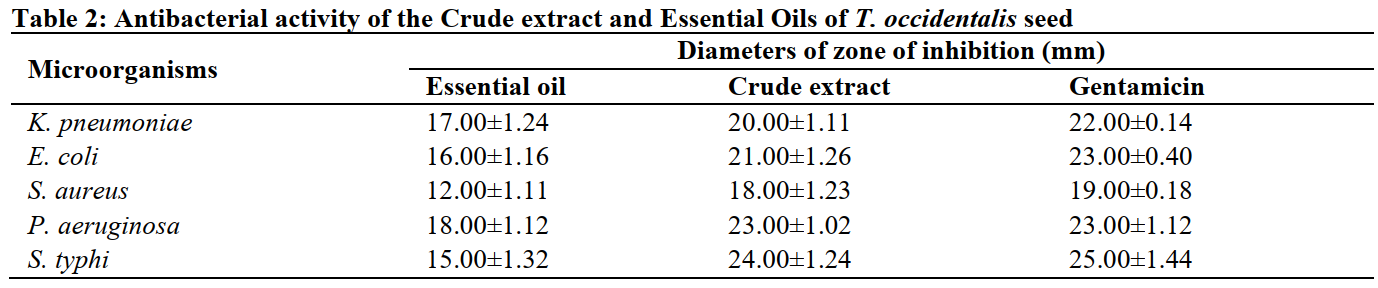
Antimicrobial resistance is a prevalent health challenge affecting human, animal, and environmental health, while oxidative stress contributes to an increased susceptibility of humans to infections due to an increased free radical activity, thus requiring urgent alternative solutions. The present work, therefore, compares the therapeutic potential of the crude extract (CE) and essential oil (EO) of Telfaria occidentalis seed. Oil extraction was achieved by steam distillation, and crude extract by maceration. GC-MS analysis revealed the chemical composition of the oil. Agar-well diffusion was used for bioassay screening, while FRAP, DPPH and NO scavenging were used for antioxidant activity. Antimicrobial evaluation against five bacterial strains demonstrated that the CE exhibited stronger antimicrobial activity than the oil, with inhibition zones (IZ) (mm) of 20.00±1.11: K. pneumonia, 21.00±1.26: E. coli, 18.00±1.23: S. aureus, 23.00±1.02 P. aeruginosa, and 24.00±1.24: S. typhi, while the essential oil had IZ of 17.00±1.24, 16.00±1.16, 12.00±1.11, 18.00±1.12, and 15.00±1.32 against K. pneumoniae, E. coli, S. aureus, P. aeruginosa, and S. typhi, respectively. However, the EO demonstrated superior NO scavenging (IC50: CE: 28.32 % vs EO: 30.25), DPPH scavenging (EO: 62.22 μg/mL vs. CE: 66.22 μg/mL) and FRAP activities (EO: 3.42 μg/mL vs CE: 2.10 μg/mL) than the CE. These findings indicate that the CE has better antimicrobial potential than the volatile oils, while the oil displayed better antioxidant activity across all assays employed. To conclude, the crude extract showed promise as a potential source of lead compounds for developing treatments against multidrug-resistant pathogens. In addition, the strong antioxidant activity of...
References
Akinsipo, O. B., Osinubi, A. D., & Adebayo, B. P. (2026). Green Synthesis and Characterization of Zinc Oxide Nanoparticles Using Euphorbia Lateriflora Leaf Extract: Evaluation of Antimicrobial and Antioxidant Activities. Fudma Journal of Sciences, 10(2), 45-54. https://doi.org/10.33003/fjs-2026-1002-4456
Ali, A. I, Dandago, M. A., & Ali, F. I. (2024). Food Applications of Telfairia occidentalis as a Functional Ingredient and Nanoencapsulation as a Promising Approach toward Enhancing Food Fortification. IntechOpen. doi: 10.5772/intechopen.111716 (Eds) Soto-Hernández, M., Aguirre-Hernández, E. and Palma-Tenango, M In: Phytochemicals in Agriculture and Food https://doi.org/10.5772/intechopen.111716
Bai, Z., Yao, C., Zhu, J., Xie, Y., Ye, X-Y., Bai, R., & Xie, T. (2021). Anti-tumor drug discovery based on natural product β-elemene: anti-tumor mechanisms and structural modification. Molecules, 26(6), 1499. https://doi.org/10.3390/molecules26061499
Ćujić N., Šavikin K., Janković T., Pljevljakušić D., Zdunić G. & Ibrić S. (2016). Optimization of polyphenols extraction from dried chokeberry using maceration as traditional technique. Food Chem. 194, 135–142. https://doi.org/10.1016/j.foodchem.2015.08.008
Daramola O. O., Oyeyemi W. A., Odiase L. O., Olorunfemi A. A. (2016). Effects of methanol extract of Telfairia occidentalis seed on ovary antioxidant enzymes, serum hormone concentration and histology in wistar rats. International Journal of Pharmacognosy and Phytochemical Research 8:1245 9.
Eseyin, O. A., Daniel, A., Paul, T. S., Attih, E., Emmanuel, E., Ekarika, J., Munavvar Zubaid, A. S., Ashfaq, A., Afzal, S. & Ukeme, A. (2018). Phytochemical analysis and antioxidant activity of the seed of Telfairia occidentalis Hook (Cucurbitaceae). Natural Product Research. 32(4):444-447. https://doi.org/10.1080/14786419.2017.1308366
Fatunmibi O. O, Saint Njoku I, Asekun O. T. & Ogah J. O. (2023). Chemical composition, antioxidant and antimicrobial activity of the essential oil from the rhizome of Curcuma longa L. Journal of Pharmacy and Allied Medicine.; 1(1):27-33. https://doi.org/10.58985/jpam.2023.v01i01.04
Fernandes, R. P., Trindade, M. A., Tonin, F. G., Lima, C. G., Pugine, S. M., Munekata, P. E., Lorenzo, J. M., & de Melo, M. P. (2016). Evaluation of antioxidant capacity of 13 plant extracts by three different methods: cluster analyses applied for selection of the natural extracts with higher antioxidant capacity to replace synthetic antioxidant in lamb burgers. Journal of Food Science and Technology, 53(1), 451–460. https://doi.org/10.1007/s13197-015-1994-x
Garcia-Llorens, G., El Ouardi, M., & Valls-Belles, V. (2025). Oxidative stress fundamentals: Unraveling the pathophysiological role of redox imbalance in non-communicable diseases. Applied Sciences, 15(18), 10191. https://doi.org/10.3390/app151810191
Giovagnorio, F., De Vito, A., Madeddu, G., Parisi, S. G., & Geremia, N. (2023). Resistance in Pseudomonas aeruginosa: A Narrative Review of Antibiogram Interpretation and Emerging Treatments. Antibiotics (Basel, Switzerland), 12(11), 1621. https://doi.org/10.3390/antibiotics12111621
Kang, Y., Wang, X., Wei, X., Li, D., Gan, L., Jin, J.,Wu, R., Wu, P., Sheng, Z. Zhang, K., Goodin, S., Xu, X. & Zheng, X. (2022). Synergistic inhibitory effect of α-humulene and sclareol on human pancreatic cancer cells. Journal of Functional Foods, 89, 104958. https://doi.org/10.1016/j.jff.2022.104958
Koenig, W. A., Hochmuth D. H. & Joulain, D. (1998). Mass Finder 2.1 (Including the library) of terpenoids and related constituents of essential oils, E-B Verlag: Hamburg.
Machado, C. A., Oliveira, F. O., de Andrade, M. A., Hodel, K. V. S., Lepikson, H., & Machado, B. A. S. (2022). Steam Distillation for Essential Oil Extraction: An Evaluation of Technological Advances Based on an Analysis of Patent Documents. Sustainability, 14(12), 7119. https://doi.org/10.3390/su14127119
Makhija, I. K., Aswatha Ram, H. N., Shreedhara, C. S., Vijay Kumar, S. & Devkar, R. (2011). In vitro antioxidant studies of Sitopaladi Churna, a polyherbal Ayurvedic formulation. Free Radicals and Antioxidants, 1(2), 37–41. https://doi.org/10.5530/ax.2011.2.8
Njoku I. S., Ichide M. U., Rahman N., Khan A.M., Otunomo I., Asekun, O. T. & Familoni O.B. (2021). Variation in the sesquiternoid composition of the volatile oils of Annona muricata Linn. from South Western Nigeria, caused by different drying methods. Journal of Chemical Society of Nigeria 46(4). https://doi.org/10.46602/jcsn.v46i4.656
Odusina, B. O., Oyeyemi, T. B., Fatoki, R. A., Ajikobi, W. A., Akinsunmbo, T. H., Ajimosun, I. E. & Osinubi, A. D. (2023). Chemical Constituents and Antioxidant Activities of the Essential Oil from Stem of Olax Manii Mountain Top University Journal of Applied Science and Technology (MUJAST) 3(2) 33-38 https://mujast.mtu.edu.ng/storage/issues/Year_2023_Vol_3/Number_2/1712569535_Odusina%20et%20al.%20%202023.pdf
Ojimelukwe, P. C. (2022). Telfairia occidentalis: A blood booster, an antioxidant and an antihyperglycaemic agent. International Journal of Food Sciences and Nutrition 7(3):1-19 https://www.foodsciencejournal.com/assets/archives/2022/vol7issue3/7-3-13-398.pdf
Osibote, E. A., Adesida, S. A., Nwafor, S., & Iluobe, H. (2021). Chemical Composition and Antimicrobial Activities of Essential Oil from the Leaves of Acalypha wilkesiana on Pathogenic Microorganisms. Egyptian Academic Journal of Biological Sciences, G. Microbiology, 13(1), 19-28. https://doi.org/10.21608/eajbsg.2021.172882
Osinubi, A. D., Asekun, O. T., & Familoni, O. B. (2023) N-Aryl Amino Acids as Potential Antibacterial Agents. Reactions. 4(2):286-294. https://doi.org/10.3390/reactions4020017
Osinubi, A. D., Aberuagba, M. O., Gbadamosi, M. R. & Banjoko O. O. (2024). Exploring the Biological Potential of the Methanolic Crude Extract of Capsicum Frutescens Root. Journal of Science and Information Technology (JOSIT), 18 (1), 129-136. https://journals.tasued.edu.ng/index.php/josit/article/view/92
Osinubi A. D., Njoku, I. S. & Roleola B. T. (2025). Comparative Analysis of Hydro-Distillation and Steam-Distillation Techniques on the Chemical Composition of Turmeric (Curcuma longa Linn) Rhizomes. International Journal of Basic Science and Technology 11 (2), 170 - 176 https://ijbst.fuotuoke.edu.ng//issue/Apr-Jun-2025/Comparative-Analysis-of-Hydro-Distillation-and-Steam-Distillation-Techniques-on-the-Chemical-Composition-of-Turmeric-(Curcuma-longa-Linn)-Rhizomes/
Platzer, M., Kiese, S., Tybussek, T., Herfellner, T., Schneider, F., Schweiggert-Weisz, U., & Eisner, P. (2022). Radical scavenging mechanisms of phenolic compounds: A quantitative structure-property relationship (QSPR) study. Frontiers in Nutrition, 9, 882458. https://doi.org/10.3389/fnut.2022.882458
Povh, N. P., Garcia, C. A., Marques, M. O. & Meireles, M. A. A. (2001). Extraction of essential oil and oleoresin from chamomile (Chamomila recutita [L.] Rauschert) by steam distillation and extraction with organic solvents: a process design approach. Revista Brasileira de Plantas Medicinais, 4, 1-8. https://doi.org/10.70151/19g3g918
Ruth, O. O., Idowu, A. R., Bamikole, A. O., & Olusanya, A. R. (2023). Free radical scavenging-related antioxidant properties and inhibitory activities of Telfairia occidentalis seed protein hydrolysates and peptide fractions against two key enzymes implicated in diabetes mellitus. International Journal of Peptide Research and Therapeutics, 29(5), 82. https://doi.org/10.1007/s10989-023-10555-w?urlappend=%3Futm_source%3Dresearchgate.net%26utm_medium%3Darticle
Sarkic, A. & Stappen, I. (2018). Essential oils and their single compounds in cosmetics—A critical review. Cosmetics, 5(1), 11. https://doi.org/10.3390/cosmetics5010011
Schwartz, B., Klamer, K., Zimmerman, J., Kale-Pradhan, P. B., & Bhargava, A. (2024). Multidrug Resistant Pseudomonas aeruginosa in Clinical Settings: A Review of Resistance Mechanisms and Treatment Strategies. Pathogens (Basel, Switzerland), 13(11), 975. https://doi.org/10.3390/pathogens13110975
Sun, S., Yu, Y., Jo, Y., Han, J. H., Xue, Y., Cho, M., Bae, S. J., Ryu, D., Park, W., Ha, K. T., & Zhuang, S. (2025). Impact of extraction techniques on phytochemical composition and bioactivity of natural product mixtures. Frontiers in Pharmacology, 16, 1615338. https://doi.org/10.3389/fphar.2025.1615338
Teugwa C. M., Boudjeko T., Tugnoua T. B., Mejiato P. C. & Zofou D. (2013). Anti hyperglycaemic globulins from selected Cucurbitaceae seeds used as antidiabetic medicinal plants in Africa. BMC Complementary and Alternative Medicine 2013, 13:63. https://doi.org/10.1186/1472-6882-13-63
van Beek, T. A., & Joulain, D. (2018). The essential oil of patchouli, Pogostemon cablin: A review. Flavour and Fragrance Journal, 33(1), 6-51. https://doi.org/10.1002/ffj.3418
World Health Organization. (2022). Global antimicrobial resistance and use surveillance system (GLASS) report 2022. World Health Organization. https://www.who.int/publications/i/item/9789240062702
Downloads
Published
Issue
Section
Categories
License
Copyright (c) 2026 Adejoke Deborah Osinubi, Issac Saint Njoku, Azeez Opeyemi Abdullahi, Olubusayo Funmilola Semire, Ademola Emmanuel Sangosanya

This work is licensed under a Creative Commons Attribution 4.0 International License.


