
SPATIAL AND TEMPORAL DISTRIBUTION OF Culex, Aedes AND Anopheles MOSQUITOES IN EGBEDA LGA, NIGERIA
DOI:
https://doi.org/10.33003/fjs-2026-1007-5007Keywords:
Mosquito Diversity, Vector-Borne Diseases, Culex pipiens Complex, Anopheles gambiae Sensu Lato, Peri-Urban, Egbeda, NigeriaAbstract
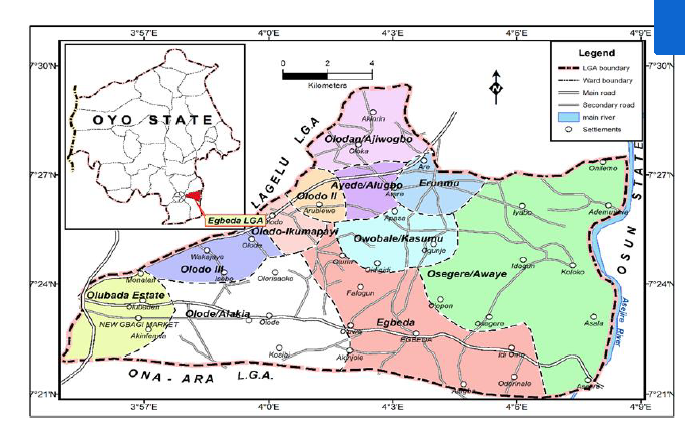
Locally resolved mosquito entomological baselines remain scarce in peri-urban southwestern Nigeria. This study quantified mosquito vector diversity, seasonal dynamics and the spatial signature of land use across eleven communities of Egbeda Local Government Area (LGA), Oyo State, over twelve months (May 2024 to April 2025). Larvae were sampled monthly using the standard dipping technique and reared to adulthood for morphological identification using the Afrotropical Anopheles key of Coetzee (2020) and the Walter Reed Biosystematics Unit culicine keys. A total of 6,135 adult mosquitoes was recovered, comprising five operational taxonomic units in three genera: Culex quinquefasciatus (39.10%), the Culex pipiens complex sensu lato (9.85%), Anopheles gambiae sensu lato (23.94%), Aedes aegypti (22.54%) and Aedes albopictus (4.56%). Sibling species within the An. gambiae and Cx. pipiens complexes are reported at complex level pending molecular confirmation. Diversity was moderate (Shannon-Wiener H′ = 1.414; Pielou's J′ = 0.879) and deviated from evenness (χ² = 2,234.25; df = 4; p < 0.001). Species composition differed across sites (χ² = 168.4; df = 40; p < 0.001), with peri-urban communities supporting higher Culex and Aedes abundances and rural communities relatively higher Anopheles catches. Negative binomial regression identified August as the seasonal peak (1,208 individuals). Females accounted for 68.2% of the catch. Co-occurrence of competent vectors of malaria, lymphatic filariasis and Aedes-borne arboviruses indicates exposure to multiple disease risks. The findings establish a community-level entomological baseline and motivate season-aware integrated vector management, with molecular resolution and pathogen screening as priority next steps.
References
Adamu, H., Isaac, C., Hussaini, R., Inegbenosun, C., Obasuyi, C., & Solomon, E. (2020). The burden of bancroftian filariasis in Nigeria: A review. Ethiopian Journal of Health Sciences, 30(2), 309-318. https://doi.org/10.4314/ejhs.v30i2.18
Adejoh, V. A., Pam, V. A., Ombugadu, A., Maikenti, J. I., & Ashigar, M. A. (2025). Habitat characterisation of culicine mosquitoes in two Local Government Areas of Nasarawa State, Nigeria. FULafia Journal of Science and Technology, 9(1), 72-80. https://doi.org/10.62050/fjst2025.v9n1.505
Adoha, C. J., Sovi, A., Padonou, G. G., Yovogan, B., Akinro, B., Accrombessi, M., Dangbenon, E., Sidick, A., Osse, R., Tokponon, T. F., Odjo, E. M., Koukpo, C. Z., Fassinou, A., Missihoun, A. A., Sominanhouin, A., Messenger, L. A., Agboho, P. A., Akpodji, S., Ngufor, C., & Akogbeto, M. C. (2024). Diversity and ecological niche model of malaria vector and non-vector mosquito species in Cove, Ouinhi and Zangnanado, southern Benin. Scientific Reports, 14(1), 16944. https://doi.org/10.1038/s41598-024-67919-5
Afolabi, O. J., Akinneye, J. O., & Igiekhume, A. M. A. (2019). Identification, abundance and diversity of mosquitoes in Akure South Local Government Area, Ondo State, Nigeria. The Journal of Basic and Applied Zoology, 80(1), 39. https://doi.org/10.1186/s41936-019-0112-4
Animasaun, O. S., Shaibu, J. O., Akomolafe, B. K., Animasaun, O. P., Niyang, P. M., Olugbade, O. T., Akinyode, A. O., Omisakin, I. A., Adeogun, A. O., & Audu, R. A. (2025). Enhancing surveillance for dengue fever in Oyo State, Nigeria: A One Health approach. One Health Outlook, 7(1), 5. https://doi.org/10.1186/s42522-024-00121-9
Bagbe, A. S. (2019). Assessment of physico-chemical and ecological variables in selected natural breeding sites of mosquitoes in Ibadan, Oyo State, Nigeria. Archives of Pharmacy and Pharmacology Research, 1(5), 1-8. https://doi.org/10.33552/APPR.2019.01.000521
Bamidele, O. (2025). Revisiting dengue in Nigeria: Epidemiological analysis, current trends and recommendations. Asian Journal of Research in Infectious Diseases, 16(1), 48-61. https://doi.org/10.9734/ajrid/2025/v16i1418
Bassey, B. E., Braka, F., Onyibe, R., Kolude, O. O., Oluwadare, M., Oluwabukola, A., Omotunde, O., Iyanda, O. A., Tella, A. A., & Olanike, O. S. (2022). Changing epidemiology of yellow fever virus in Oyo State, Nigeria. BMC Public Health, 22(1), 467. https://doi.org/10.1186/s12889-022-12871-0
Bello, A. B., Hassan, A. A., Oladejo, S. O., Awoniran, D. R., & Popoola, K. O. K. (2025). Influence of meteorological variables on the abundance and distribution patterns of Anopheles mosquitoes in Epe and Orimedu, Lagos, Nigeria. Discover Animals, 2(1), 28. https://doi.org/10.1007/s44338-025-00076-9
Chen, L., Tan, Z., Kong, P., Zhou, Y., & Zhou, L. (2024). Impact of vector richness on the risk of vector-borne disease: The role of vector competence. Ecology and Evolution, 14(3), e11082. https://doi.org/10.1002/ece3.11082
Coetzee, M. (2020). Key to the females of Afrotropical Anopheles mosquitoes (Diptera: Culicidae). Malaria Journal, 19(1), 70. https://doi.org/10.1186/s12936-020-3144-9
Datta Mudi, S., Das, D., Banerjee, S., Roy, M., Brahma, S., Pramanik, S., Saha, G. K., & Aditya, G. (2024). Mosquito diversity and mosquito-borne diseases. In Omkar (Ed.), Mosquitoes (pp. 105-140). Springer Nature Singapore. https://doi.org/10.1007/978-981-97-4163-2_4
Egid, B. R., Coulibaly, M., Dadzie, S. K., Kamgang, B., McCall, P. J., Sedda, L., Toe, K. H., & Wilson, A. L. (2022). Review of the ecology and behaviour of Aedes aegypti and Aedes albopictus in western Africa and implications for vector control. Current Research in Parasitology and Vector-Borne Diseases, 2, 100074. https://doi.org/10.1016/j.crpvbd.2021.100074
Ezihe, E. K., Chikezie, F. M., Egbuche, C. M., Nwankwo, E. N., Onyido, A. E., Aribodor, D., & Samdi, M. L. (2017). Seasonal distribution and microclimatic factors influencing the abundance of the malaria vectors in southeast Nigeria. Journal of Mosquito Research, 7(3), 1-12. https://doi.org/10.5376/jmr.2017.07.0003
Fagbohun, I. K., Idowu, E. T., Awolola, T. S., & Otubanjo, O. A. (2020). Seasonal abundance and larval habitats characterisation of mosquito species in Lagos State, Nigeria. Scientific African, 10, e00656. https://doi.org/10.1016/j.sciaf.2020.e00656
Medlock, J., Balenghien, T., Alten, B., Versteirt, V., & Schaffner, F. (2018). Field sampling methods for mosquitoes, sandflies, biting midges and ticks. EFSA Supporting Publications, 15(6), EN-1435. https://doi.org/10.2903/sp.efsa.2018.EN-1435
Mohammed, B. R., Yayo, A. M., Ajanusi, O. J., & Lawal, I. A. (2021). Relative abundance and molecular identification of Culex pipiens complex (Diptera: Culicidae) in Kura Local Government Area, northwestern Nigeria. Parasite Epidemiology and Control, 14, e00213. https://doi.org/10.1016/j.parepi.2021.e00213
Nigerian Meteorological Agency. (2023). Climatological data summary for Ibadan station: 1991-2020 normals. Abuja: Nigerian Meteorological Agency.
Okeke, O. (2024). Mosquito species composition, diversity and relative abundance in Science Village, Nnamdi Azikiwe University, Awka, Anambra State, Nigeria. Journal of Current Biomedical Research, 4(3), 1644-1659. https://doi.org/10.54117/jcbr.v4i3.4
Opayele, A. V., Adekunle, A. J., Ibrahim, K. T., & Olaleye, D. O. (2017). Influence of meteorological variables on diversity and abundance of mosquito vectors in two livestock farms in Ibadan, Nigeria: Public health implications. Journal of Mosquito Research, 7(9), 60-71. https://doi.org/10.5376/jmr.2017.07.0009
Padonou, G. G., Konkon, A. K., Salako, A. S., Zoungbedji, D. M., Osse, R., Sovi, A., Azondekon, R., Sidick, A., Ahouandjinou, J. M., Adoha, C. J., Sominahouin, A. A., Tokponnon, F. T., Akinro, B., Sina, H., Baba-Moussa, L., & Akogbeto, M. C. (2023). Distribution and abundance of Aedes aegypti and Aedes albopictus (Diptera: Culicidae) in Benin, west Africa. Tropical Medicine and Infectious Disease, 8(9), 439. https://doi.org/10.3390/tropicalmed8090439
R Core Team. (2023). R: A language and environment for statistical computing. R Foundation for Statistical Computing. https://www.R-project.org/
Santolamazza, F., Mancini, E., Simard, F., Qi, Y., Tu, Z., & della Torre, A. (2008). Insertion polymorphisms of SINE200 retrotransposons within speciation islands of Anopheles gambiae molecular forms. Malaria Journal, 7, 163. https://doi.org/10.1186/1475-2875-7-163
Shekhar, M., & Illendula, S. (2022). Composition of mosquito species in three selected villages in Mahabubnagar District, Telangana. Indian Journal of Entomology, 84(4), 924-927. https://doi.org/10.55446/IJE.2022.527
Smith, J. L., & Fonseca, D. M. (2004). Rapid assays for identification of members of the Culex pipiens (Diptera: Culicidae) complex, their hybrids, and other sibling species. American Journal of Tropical Medicine and Hygiene, 70(4), 339-345. https://doi.org/10.4269/ajtmh.2004.70.339
St. Laurent, B. (2025). Mosquito vector diversity and malaria transmission. Frontiers in Malaria, 3, 1600850. https://doi.org/10.3389/fmala.2025.1600850
Villena, O. C., McClure, K. M., Camp, R. J., LaPointe, D. A., Atkinson, C. T., Sofaer, H. R., & Berio Fortini, L. (2024). Environmental and geographical factors influence the occurrence and abundance of the southern house mosquito, Culex quinquefasciatus, in Hawai'i. Scientific Reports, 14(1), 604. https://doi.org/10.1038/s41598-023-49793-9
World Health Organization. (2017). Global vector control response 2017-2030. Geneva: World Health Organization.
World Health Organization. (2024). World malaria report 2024. Geneva: World Health Organization.
Downloads
Published
Issue
Section
Categories
License
Copyright (c) 2026 Ademola E. Alaba, Adekunle O. Adepoju, John O. Olayiwola, Moses S. Afariogun

This work is licensed under a Creative Commons Attribution 4.0 International License.


