
Bactericidal Potentials of Garlic (Allium sativum) and Onion (Allium cepa) Paste on Microbial Quality and Shelf Life of Nile Tilapia (Oreochromis niloticus)
DOI:
https://doi.org/10.33003/fjs-2026-1017-4991Keywords:
Nile tilapia, natural preservatives, Antimicrobial ActivityAbstract
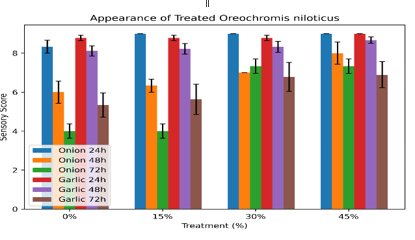
Fish remains a critical protein source globally, particularly in developing countries where it contributes significantly to food security and livelihoods. Nile tilapia (Oreochromis niloticus) is one of the most widely cultured fish species due to its adaptability, rapid growth, and high nutritional value. However, its high perishability poses significant challenges, especially in regions with limited cold storage infrastructure. This study evaluated the bactericidal potentials of garlic (Allium sativum) and onion (Allium cepa) paste on the microbial quality and shelf life of fresh Nile tilapia. Fish samples were treated with graded amounts of garlic paste and onion paste (15%, 30%, and 45%) while untreated samples served as control. Microbial analyses were conducted to determine total viable count and the presence of spoilage organisms over a defined storage period. Results indicated that treated samples exhibited significantly reduced microbial loads compared to control, with garlic showing the highest inhibitory effect. The 45% (9.00± 0.66ᶜ) garlic treatment showed the strongest antibacterial effect, indicating potent bacteriocidal activity as compared to onion paste (14.70± 1.33ᶜ) at the same application rate. These findings suggest that garlic and onion paste can serve as effective, low-cost natural preservatives, offering a sustainable solution to reduce post-harvest losses and enhance food safety in fish processing systems.
References
Abd El-Aty, A. M., Hamed, M. B., & Mohamed, A. A. (2022). Antibacterial activity of plant extracts against foodborne pathogens. Journal of Food Safety, 42(3), e12945.
https://doi.org/10.1111/jfs.12945
Adaka, G. S., Okeke, J. J., & Nwabueze, T. U. (2021). Effect of natural plant extracts on the quality and shelf life of Clarias gariepinus. Nigerian Journal of Fisheries, 18(2), 112–121. https://doi.org/10.4314/njf.v18i2.12
Akpotu, O. J., Udi, J. M., & Eze, C. (2025). Effects of garlic and onion paste on microbial and sensory quality of smoke-dried Oreochromis niloticus. African Journal of Food Science, 19(1), 45–56. https://doi.org/10.5897/AJFS2025.2256
Alqah, H. A. (2022). Advances in physicochemical methods of food preservation. Food Chemistry Advances, 1, 100012. https://doi.org/10.1016/j.focha.2022.100012
Borlinghaus, J., Albrecht, F., Gruhlke, M. C. H., Nwachukwu, I. D., & Slusarenko, A. J. (2018). Allicin: chemistry and biological properties. Molecules, 23(4), 1–23.
https://doi.org/10.3390/molecules23040791
Boziaris, I. S. (2018). Seafood processing: Technology, quality and safety. Wiley-Blackwell.
https://doi.org/10.1002/9781118346174
FAO (Food and Agriculture Organization). (2022). The State of World Fisheries and Aquaculture 2022. Rome. https://doi.org/10.4060/cc0461en
Fredotović, Ž., Puizina, J., Nazlić, M., & Ljubenkov, I. (2017). Antimicrobial activity of onion (Allium cepa) extracts. Croatian Journal of Food Science and Technology, 9(1), 9–16. https://doi.org/10.17508/CJFST.2017.9.1.02
Ghaly, A. E., Dave, D., Budge, S., & Brooks, M. S. (2020). Fish spoilage mechanisms and preservation techniques: Review. American Journal of Applied Sciences, 17(3), 94–120. https://doi.org/10.3844/ajassp.2020.94.120
Griffiths, G., Trueman, L., Crowther, T., Thomas, B., & Smith, B. (2022). Onions: A global benefit to health. Phytotherapy Research, 36(5), 2055–2070.
https://doi.org/10.1002/ptr.7435
Huang, X., Liu, L., & Zhou, L. (2019). Natural plant extracts as preservatives in aquatic food products. Food Control, 95, 145–152. https://doi.org/10.1016/j.foodcont.2018.07.044
Li, T., Li, J., Hu, W., & Zhang, X. (2020). Quality deterioration and microbial spoilage of fish: A review. Food Microbiology, 87, 103385. https://doi.org/10.1016/j.fm.2019.103385
Merati, S., & Boudra, H. (2024). Antimicrobial activity of garlic extract against resistant Escherichia coli. Journal of Applied Microbiology, 136(2), lxad234.
https://doi.org/10.1093/jambio/lxad234
Nile, S. H., & Park, S. W. (2021). Edible coatings and natural preservatives in food systems. Food Chemistry, 334, 127612. https://doi.org/10.1016/j.foodchem.2020.127612
Omotola, O. D., Akinyele, B. J., & Oladejo, B. O. (2018). Antibacterial effects of aqueous extracts of garlic and onion. Journal of Microbiology Research, 8(2), 45–52.
https://doi.org/10.5923/j.microbiology.20180802.03
Parlapani, F. F., Boziaris, I. S., & Kormas, K. A. (2018). Microbiological spoilage of seafood. Current Opinion in Food Science, 20, 13–18. https://doi.org/10.1016/j.cofs.2018.02.001
Sanchez, J. A. (2023). Global food systems and fisheries sustainability. Sustainability, 15(4), 3456. https://doi.org/10.3390/su15043456
Sivertsvik, M., Jeksrud, W. K., & Rosnes, J. T. (2020). Modified atmosphere packaging and fish preservation. Food Engineering Reviews, 12, 1–20.
https://doi.org/10.1007/s12393-019-09210-8
Tran, N., Chu, L., Chan, C. Y., Genschick, S., Phillips, M. J., & Kefi, A. S. (2022). Fish supply and demand for food security. Nature Food, 3, 1–10.
https://doi.org/10.1038/s43016-022-00587-3
Upadhyay, A., Upadhyaya, I., Kollanoor-Johny, A., & Venkitanarayanan, K. (2019). Plant-derived antimicrobials in food safety. Microbial Pathogenesis, 133, 103573.
Downloads
Published
Issue
Section
Categories
License
Copyright (c) 2026 Joseph Onoriode Akpotu, Miracle Udi

This work is licensed under a Creative Commons Attribution 4.0 International License.


