
PRODUCTION AND CHARACTERIZATION OF ALKALI EXTRACTS FROM PLANTAIN PEEL, COCOA POD HUSK, AND CASSAVA PEEL ASH FOR INDUSTRIAL APPLICATIONS
DOI:
https://doi.org/10.33003/fjs-2026-1007-4979Keywords:
Agricultural wastes, plantain peel, cocoa pod husk, cassava peel, alkali production, potassium hydroxides, FTIR, AAS, FES.Abstract
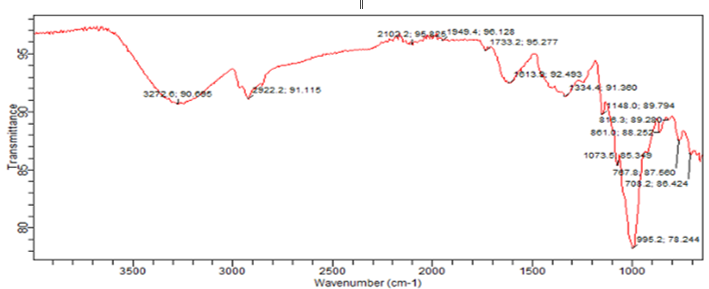
Growing demand for low-cost, eco-friendly substitutes for inorganic alkalis have driven interest in agricultural wastes as feedstocks. This study produced and characterized alkali extracts from three agricultural residues: plantain peel, cocoa pod husk and cassava peel. The aim was to produce substitutes for inorganic alkalis while adding value to agro-industrial residues. The biomass samples were subjected to proximate analysis to determine moisture content and ash content, while their alkali extracts were analyzed for pH, molarity, and elemental composition using standard analytical techniques. Statistical relationships among alkali properties were examined using one-way ANOVA and regression analysis. Results showed significant variability in moisture content (70.3±0.78c -79.8±0.49d %) and ash content (5.1±0.23d -8.8±0.20d %) across the biomass. The alkali extracts also varied widely molarity (0.01±0.00b -0.80± 0.01f mol/dm⁻³), and pH (9.77-11.46). Among the samples, plantain peel and cocoa pod husk produced the most effective alkali extract, largely due to its high potassium and sodium content. FTIR results showed that all the volatile organic component like cellulose, hemicellulose, lignins and protein are largely burnt off, and what remains is predominantly inorganic ash, typically composed of metal oxides, carbonates phosphates and silicates. The results demonstrate that agricultural waste-derived alkali, particularly from plantain peel and cocoa pod husk, offers a low-cost, environmentally sustainable alternative to commercial alkalis for soap making and decomposition nitrocellulose-based propellants.
References
Ajayi, J. A., Ikumapayi, C. M., Oyedepo, O. J. & Olalemi, A. O. (2026). Effectiveness of Agro-wastes Materials in minimizing Alkali-Silica Reactions in Concrete Pavement. FUTA Journal of Engineering and Engineering Technology 20 (1), 1-7
Amaza I. B. (2021). Determination of proximate composition, amino acids, minerals and phytochemical profile of Cassava (Manihot esculenta) peel from sweet cassava variety grown in Yobe State of North Eastern Nigeria. Nig. J. Anim. Prod., 48(1): 124-134. doi.org/10.51791/njap.v48i1.2894
AOAC (2020). Official Methods of Analysis, 25th ed. Washington: Association of Official Analytical Chemists.
Azhar, N.H., Zaidan, U.H., Shamsi, S., Gani, S.G., & Yusof, A.H. (2023). Nutritional Composition and Optimization of Extraction Conditions of Cocoa Pod Husk using Response Surface Methodology. Malaysian Applied Biology 52(6): 127-135
Chamorro, F., Luna, S. P., & Palencia, M. (2024). Unripe plantain peel biohydrogel for methylene blue removal from aqueous solution. Polymers, 16(21), 3135. https://doi.org/10.3390/polym16213135
Chua, M.F., Youbee, L., Oudthachit, S., Phanthasin Khanthavong, P., Veneklaas, E.J., & Malik, A.I. (2020). Potassium Fertilisation Is Required to Sustain Cassava Yield and Soil Fertility. Agronomy 10, 1103. https://doi.org/10.3390/agronomy10081103
Eric, E.C., Cosmas, C.K., Abiodun, A.K., Olajide, B.T., Chisom, I.B., & Franklyn, E.N. (2025). Quantitative determination of cellulose content of peels of selected plants growing in Enugu Urban. World Journal of Biology Pharmacy and Health Sciences, 21(01), 250-267. DOI: https://doi.org/10.30574/wjbphs.2025.21.1.0034
Esan, Y. O., Famuwagun, A. A. & Adeleye, O. T. (2023). Quality assessment of composite flour made from wheat and plantain peel. Journal of the school of science, Vol. 5, 2714-3716. https://doi.org/10.61281/coastjss.v5i2.4
Fabricia, V., Hortência, E. P., Meirielly, J., Fernando, M., Preciosa, P., Manuela, V., Daniel, P. S., & Denise, S. R. (2024). Comparative study of pretreatments on coconut fiber for efficient isolation of lignocellulosic fractions. Sustainability, 16, 4784. https://doi.org/10.3390/su16114784
Gopal, M., Apshara, S.E., Neenu, S., Gupta, A. (2025). Cocoa pod husk wastes derived biochar for overcoming potassium deficiency in organic agriculture. International Journal of Recycling Organic Waste in Agriculture (IJROWA), Vol. 14, Issue 2, 142519 (1-7) https://doi.org/10.57647/ijrowa-tyz5-1967
Ibrahim Grema, M.H., Konan, A.T.S., Kouassi, E. K.A., Amadou Kiari, M.N., Brou, Y. C., Yao, K.B. (2023). Characterization of cassava peelings as a precursor for biochar preparation, J. Mater. Environ. Sci., 14(12), 1582-1594
Igbashio, I., & Obasuyi, O. (2022). Investigation of plantain peel for production of local soap. Journal of Local Industrial Chemistry.
Irma, R., Amiruddin, R., Jafar, N.,Wahiduddin, N., Rifai, A., Alam, G.,Agung Wibawa Mahatva Yodha, A.W.M., Sudargo, T., Nasir, S., & Moedjiono, A.I. (2024). Evaluation of the bioactive composition of cocoa pod husk from sulawesi island, indonesia, for health benefits. Acta Sci. Pol. Technol. Aliment. 23(2) 2024, 163–177.
Irmak, S. (2020). Challenges of biomass utilizationfor for biofuel. Doi:http//dx.doi.org/10.55772/intechopen.83752.
Jumare, F. I., Alhassan, M., & Abdulrahman, M. (2022). Evaluating the potentials of banana and plantain peels for biofuel production in Nigeria. Journal of Energy Research and Reviews, 10(2), 26–35. https://doi.org/10.9734/jenrr/2022/v10i230249
Kaur, B., Parmjit, P., Panesar, S., & Anil, K. A. (2022). Standardization of ultrasound-assisted extraction for the recovery of phenolic compounds from mango peels. Journal of Food Science and Technology, 59(7), 2813–2820. https://doi.org/10.1007/s13197-021-05177-5
Kayiwa, R., Kasedde, H., Lubwama, M., & Kirabira, J. B. (2021). Mesoporous activated carbon yielded from pre-leached cassava peels. Journal of Bioresources and Bioprocessing, 8, 1–12. https://doi.org/10.1186/s40643-021-00395-3
Khanolkar, A., Pawale, P., Thorat, V., Patil, B., & Samanta, G. (2024). Near-infrared spectroscopy for determination of moisture content in lyophilized formulation. Journal of Near Infrared Spectroscopy, 32(1), 18–28. https://doi.org/10.1177/09670335231208340
Komba, D.P., Lebbie, S.E., Conteh, D., Turay, I., & Yongai, I. (2025). Potassium Hydroxide in Plantain Peels ash and its Uses as a Source of Saponification. World Journal of Advanced Research and Reviews, eISSN 2581-9615. DOI: https://doi.org/10.30574/wjarr.2025.28.3.4221
Kone, K., Akueson, K., & Norval, G. (2020). On the Production of Potassium Carbonate from Cocoa Pod Husks. Recycling. http://creativecommons.org/licenses/by/4.0/
Kouadio, K.K.A., Soro, L.C., Kossonou, Y.K., Anin, A.L. (2025). Production of Potash from Green and Ripe Plantain Peels. Science Journal of Analytical Chemistry, Vol. 13, No. 4, pp. 96–103. https://doi.org/10.11648/j.sjac.20251304.13
Laverde-Albarracin, C.,Gonzalez, J.F., Ledesma, B., Roman-Suero, S. (2025). Comparative Study of Thermochemical Valorization of CCN51 Cocoa Shells: Combustion, Pyrolysis, and Gasification. Appl. Sci. 15, 2071.
Lei, J., Yang, L., Wang, Y., & Zhao, D. (2025). Pyrolysis kinetics, mechanism, and thermodynamics of peanut shell based on Gaussian function deconvolution. Heliyon, 11, e42800. https://doi.org/10.1016/j.heliyon.2025.e42800
Maliki, M., Ifijen, I. H., & Omorogbe, S. O. (2020). Cocoa husks: A sustainable resource for alkali production. International Journal of Biological and Chemical Sciences, 14(7), 2652–2658.
Mauer, L.J. (2024). Moisture and Total Solids Analysis. In: Ismail, B.P., Nielsen, S.S. (eds) Nielsen's Food Analysis. Food Science Text Series. Springer, Cham. https://doi.org/10.1007/978-3-031-50643-7_15
Odiko, A. E., Eribo, G. E., & Akenbor, M. (2024). Determination of metal content in Ethmalosa fimbiata, Pseudotolithus epipercus, Clupea harengus, and Merluccius merluccius stored in commercial cold stores.
Okunola, O. J., Siaka, A. A., & Abdulkareem, O. A. (2019). Optimization of soap production using mango peels ash as alkali source. FUDMA Journal of Sciences (FJS), Vol. 3 No. 4, pp 343 –351
Oliver-Simancas, R., Diaz-Maroto, M. C., Alvaro Fernandez-Ochoa, A., Maria Soledad Perez-Coello, M.S., & Alanon, M. E. (2025). Odor-Active Compound Stability in Mango Peel Side-Streams: Insights for Valorization and Waste Minimization. Foods https://doi.org/10.3390/15020215
Omoniyi, K. I., Nwokem, N. C., Usman, Y. O., & Idowu, O. O. (2019). An assessment of the potential of plantain peel ash as a potash biocatalyst for producing reducing sugar from Phoenix dactylifera seed pit. Pacific Journal of Science and Technology, 19. https://doi.org/10.48317/IMIST.PRSM/morjchem-v7i1.12432
Otache, M.A., Ubwa, S.T., & Godwin, A.K. (2017). Proximate Analysis and Mineral Composition of Peels of Three Sweet Cassava Cultivars. Asian Journal of Physical and Chemical Sciences 3(4): 1-10.
Pratama, M.I., Sugiman, Catur, A.D., Hilton, A. (2024). Effects of Alkali (NaOH) Treatment of Banana Bunch Fiber (Musa Paradisiaca) on the Tensile Properties of Banana Bunch Fiber/Unsaturated Polyester Composites. CHEMICA: Jurnal Teknik Kimia, Vol. 11, No.1, pp. 1-9. https://doi.org/10.26555/chemica.v11i1.222
Promraksaa, A., & Rakmak, N. (2021). Biochar production from palm oil mill residues and application of the biochar to adsorb carbon dioxide. Heliyon, 6, e04001.
Satheesh, M., Pugazhvadivu, M., Prabu, B., Gunasegaran, V., & Manikandan, A. (2019). Synthesis and characterization of coconut shell ash. Journal of Nanoscience and Nanotechnology, 19, 4123–4128.
Tajudeen, O. (2023). Optimization of alkali extraction from Musa paradisiaca for catalytic applications. Journal of Biomass Research, 15(2), 88–102.
Umoh, E. O. (2024). Evaluation of physicochemical properties of unripe plantain peels. Agriculture and Food Sciences Research, 11(2), 104–109. https://doi.org/10.20448/aesr.v11i2.6178
Uzor, O., et al. (2024). Development of sustainable alkali from agricultural wastes for industrial applications. Journal of Applied Science and Process Engineering, 11(1), 45–58.
Zainal, S., Tajuddin, R. H., & Yusof, N. F. M. (2024). Synthesis and characterization of liquid-silicate fertilizer from rice husk ash. Malaysian Journal of Analytical Sciences, 28(1), 1–9
Downloads
Published
Issue
Section
Categories
License
Copyright (c) 2026 Bosede Tosin Hussein, Jonathan Maduka Nwaedozie, Muktar Mohammed Namadi, Kabiru Ado

This work is licensed under a Creative Commons Attribution 4.0 International License.


