
EXAMINING CYBERSECURITY VULNERABILITIES IN CONSTRUCTION COMPANIES IN NIGERIA
DOI:
https://doi.org/10.33003/fjs-2026-1005-4975Keywords:
Cybersecurity, Construction industry, Cyber threats, Digital technologies, NigeriaAbstract
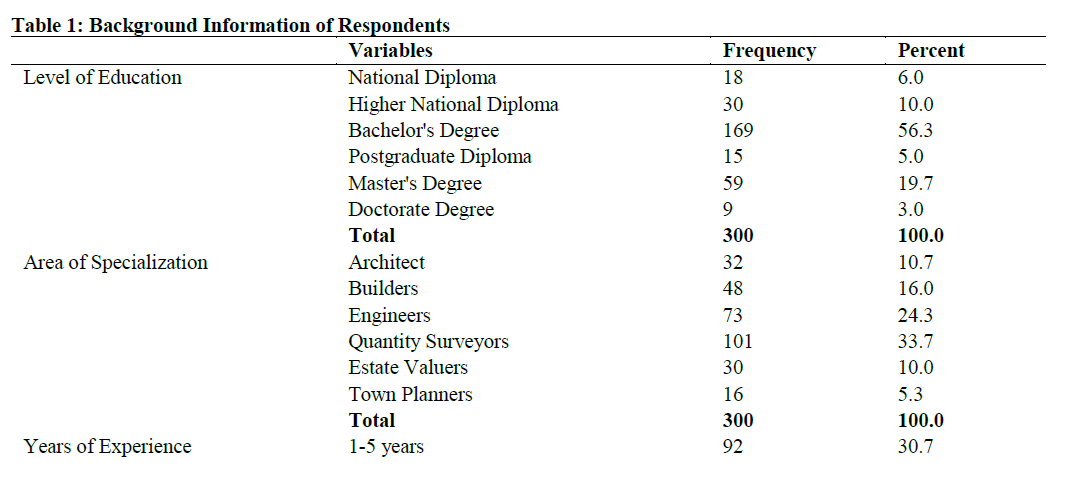
The increasing adoption of digital technologies in the construction industry has improved project coordination, communication, and efficiency. Tools such as Building Information Modeling (BIM), cloud-based platforms, and mobile communication systems are now widely used by construction firms. However, the growing reliance on these digital systems has also exposed construction companies to significant cybersecurity risks. In Nigeria, where the construction sector plays a key role in infrastructure development, many firms lack adequate cybersecurity preparedness, making them vulnerable to cyber threats. This study examines the vulnerabilities of construction companies to cybersecurity threats within Lagos State construction industry. A quantitative research approach was adopted using a cross-sectional survey design. Data were collected from 300 construction professionals, including architects, builders, engineers, quantity surveyors, estate valuers, and town planners, through a structured questionnaire. The data were analyzed using descriptive statistics, a one-sample t-test, and exploratory factor analysis with the aid of SPSS. The findings revealed several major cybersecurity vulnerabilities, including the use of unsecured networks, risks associated with remote work, limited cybersecurity resources, unpatched software vulnerabilities, insufficient data protection, and inadequate access control. The t-test results confirmed that all identified vulnerabilities were statistically significant (p < 0.05). Factor analysis further grouped the vulnerabilities into three key components: technical weaknesses, organizational and policy gaps, and human and external risks. The study concludes that strengthening cybersecurity policies, improving awareness, and investing in secure digital systems are essential for protecting construction firms from cyber threats and ensuring safer digital operations in the Nigerian construction industry.
References
Adebowale, O. J., & Agumba, J. N. (2024). A systematic review of challenges undermining the efficacy of construction health and safety regulations in major African countries. Construction Economics and Building, 24(4/5), 1–24.
Adeyinka, T., Ogunsami, D., & Hassan, R. (2024). Outdated software and vulnerabilities in African construction projects. International Journal of Built Environment and Information Technology, 12(1), 67–79.
Albert I., Osadola O.A. and Olonilebi P. (2025a). Assessment of Digital Inventory Management among Construction Firms in Lagos State. Environmental Technology & Science Journal. 16(2): 181-192. https://dx.doi.org/10.4314/etsj.v16i2.20
Albert, I., Osadola, A.O. and Nathaniel. O.B., (2025b). Investigating the relationship between technology integration and construction management efficiency in project delivery. International Journal of Environmental Design and Construction Management, 8(4), pp. 33 – 49. https://doi.org/10.70382/hijedcm.v08i4.045
Albert, I., Nathaniel. O.B. and Olonilebi, P., (2025c). Investigation of Building Information Modeling (BIM) in sustainable construction projects. FUDMA Journal of Sciences (FJS), 9(2), pp.133 – 139. DOI: https://doi.org/10.33003/fjs-2025-0902-3121
Arogundade, O. R. (2023). Network security concepts, dangers, and defense best practical. Computer Engineering and Intelligent Systems, 14(2). 25-38.
Asere, G. F., Adenomon, M. O., Aimufua, G. I., & Ibrahim, U. (2025). The Effects of Data Privacy Regulations on Cybersecurity Practices in Nigeria and Africa. Journal of Cyberspace Studies, 9(2), 313-336.
Bello, H. O., Ige, A. B., & Ameyaw, M. N. (2024). Adaptive machine learning models: Concepts for real-time financial fraud prevention in dynamic environments. World Journal of Advanced Engineering Technology and Sciences, 12(02), 021-034
Catal, C., Ozcan, A., Donmez, E., & Kasif, A. (2023). Analysis of cyber security knowledge gaps based on cyber security body of knowledge. Education and Information Technologies, 28(2), 1809-1831.
Ebelogu, C. U., Prasad, R., Bisallah, H. I., Hammawa, B. M., & Musa, I. (2025). Investigation of cybersecurity vulnerabilities and mitigation strategies in Nigeria's oil and gas industry. ABUAD Journal of Engineering Research and Development (AJERD), 8(1), 140- 150.
Eni, K., Obafemi, R., & Hassan, S. (2024). Digital risk management in Nigerian infrastructure projects. Journal of African Project Studies, 8(1), 50–63.
Ilori, O., Nwosu, N. T., & Naiho, H. N. N. (2024). Third-party vendor risks in IT security: A comprehensive audit review and mitigation strategies. World Journal of Advanced Research and Reviews, 22(3), 213-224.
Jabid, T., Rashid, M. R. A., Ferdaus, M. H., Ali, M. S., Islam, M. M., Hasan, M. & Islam, M. (2023) Ransomware prevention strategies: Building robust cyber defenses. In Ransomware Evolution (pp. 144-171). CRC Press.
Jegede, O. V., Uzoma, C. N., Oghenevavwarehro, R. A., & Shabi, M. O. (2025). Application of digital technologies for risk management in the Nigerian construction industry: a study of awareness and barriers. UNIABUJA Journal of Engineering and Technology (UJET), 2(1), 166-176.
Johns, E., & Ell, M. (2020). Cyber security breaches survey 2020. London: Department for Digital, Culture, Media & Sport, 4(1), 1-4.
Harake, M. (2025). Integrating Cybersecurity into Project Management: Best Practices, Emerging Trends, and Strategic Approaches.
Lehto, M. (2022). Cyber-attacks against critical infrastructure. In Cyber security: Critical infrastructure protection (pp. 3-42). Cham: Springer International Publishing.
Liu, Q., Gao, J., & Li, S. (2024). The innovation model and upgrade path of digitalization driven tourism industry: Longitudinal case study of OCT. Technological Forecasting and Social Change, 200, 123127.
Magnani, M. (2022). The technological revolution: The rise of machines. In Making the global economy work for everyone: Lessons of sustainability from the tech revolution and the pandemic (pp. 17-52). Cham: Springer International Publishing.
Mallick, M. A. I., & Nath, R. (2024). Navigating the cyber security landscape: A comprehensive review of cyber-attacks, emerging trends, and recent developments. World Scientific News, 190(1), 1-69.
Manoharan, K., Dissanayake, P., Pathirana, C., Deegahawature, D., & Silva, R. (2024). Investigating and determining the crucial construction site supervisory competencies influencing the effectiveness of building construction project activities. International journal of industrial engineering and operations management, 6(1), 43-63.
Maskuriy, R., Ang, C. K., & Nordin, N. (2023). IoT-driven risks in smart construction projects. Smart and Sustainable Built Environment, 12(1), 44- 59. https://doi.org/10.1108/SASBE-03-2022-0055
Mishra, B., & Kumar, A. (2023). How does regulatory framework impact sectoral performance? A systematic literature review. International Journal of Productivity and Performance Management, 72(5), 1419-1444.
Odeh, A., Al-Haija, Q. S. A., Taleb, A. A., Salameh, W., & Alhajahjeh, T. (2024). Enhancing security and efficiency in mobile payment systems: an integrated approach utilizing advanced technologies. In 8th IET Smart Cities Symposium (SCS 2024) (Vol. 2024, pp. 723-727).
Ogunde, A., Adeyinka, T., & Oladipo, M. (2022). Digital transformation and cybersecurity challenges in Nigerian construction. Nigerian Journal of Building, 9(1), 55–70.
Ogundele, R. (2024). Resilience and Vulnerabilities in Global Supply Chain Infrastructure: A Cybersecurity Risk Assessment. Nuvern Applied Science Reviews, 8(10), 1-9.
Okpo, H., Ikediashi, D., & Dania, A. (2023). Influence of digitalisation adoption level on construction project delivery in Nigeria. Frontiers in Engineering and Built Environment, 3(4), 221-232.
Olanrewaju, A., Musa, R., & Adeyemi, T. (2023). Reputational impacts of data breaches on construction SMEs. Construction Innovation, 23(5), 687–703.
Onatuyeh, E. A., Oghorodi, D., Okpako, E. A., Ojei, E., Osakwe, G., Chinedu, N. B., ... & Nwankwo, W. (2025). Cybersecurity and business survival in Nigeria: Building customer's trust. African Journal of Applied Research, 11(1), 786-813.
Osifo, E. O., Omumu, E. S., & Alozie, M. (2025). Evolving contractual obligations in construction law: Implications of regulatory changes on project delivery. World J. Adv. Res. Rev, 25(3), 1315-1333.
Pargoo, R., Ahmad, R., & Karim, M. R. (2024). Intellectual property theft in BIM-enabled construction. International Journal of Built Environment and Information Technology, 13(1), 45–62.
Takona, J. P. (2024). Research design: qualitative, quantitative, and mixed methods approaches. Quality & Quantity, 58(1), 1011-1013.
Tuleun, W. (2022). Analysis of cybercrimes, major cyber security attacks and the overall economic impact on Nigeria. World Journal of Advanced Research and Reviews, 16(01), 1196-1221.
Söderlund, J., & Pemsel, S. (2022). Changing times for digitalization: The multiple roles of temporal shifts in enabling organizational change. human relations, 75(5), 871-902.
Swire, P., Kennedy-Mayo, D., Bagley, D., Krasser, S., Modak, A., & Bausewein, C. (2024). Risks to cybersecurity from data localization, organized by techniques, tactics and procedures. Journal of Cyber Policy, 9(1), 20-51.
Yap, J. B. H., Lee, K. P. H., Skitmore, M., Lew, Y. L., Lee, W. P., & Lester, D. (2023). Predictors to increase safety technology adoption in construction: an exploratory factor analysis for Malaysia. Journal of Civil Engineering and Management, 29(2), 157-170
Downloads
Published
Issue
Section
Categories
License
Copyright (c) 2026 Idowu Albert, Ayodeji Opeyemi Osadola

This work is licensed under a Creative Commons Attribution 4.0 International License.


