
Bacteriological and Physicochemical Quality of Bottled Water Brands in Ota, Ogun State, Nigeria: Public Health Implications
DOI:
https://doi.org/10.33003/fjs-2026-1009-4956Keywords:
Chlorides, Drinking water, Linear models, Nigeria, pHAbstract
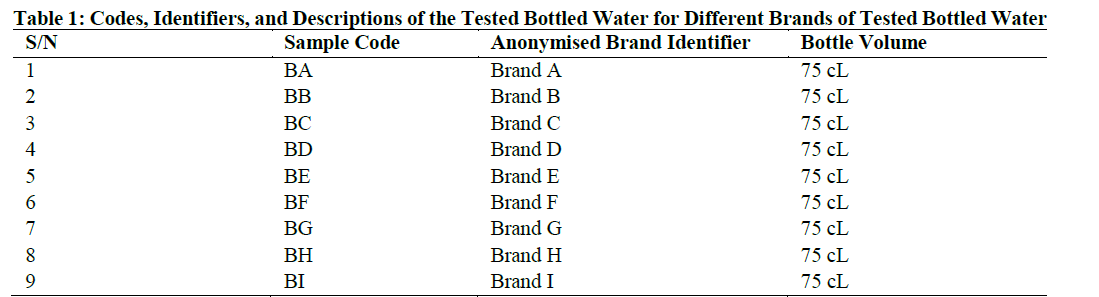
Water is essential for human survival and must be managed carefully to prevent health risks associated with industrial or bacterial contamination. Hence, this study provided a baseline assessment of the quality and microbiological safety of the most widely consumed bottled drinking water brands in Ota, Ogun State, Nigeria.Nine individual bottled water samples representing nine entirely distinct brands were analysed. Each distinct brand was processed in duplicate for viable bacterial population, pH and chloride content. Gram staining, biochemical tests, and the Analytical Profile Index (API) were used to identify the bacteria. The pH and the chloride content of the samples ranged from 5.19 to 6.96 and 6.92 to 28.58 mg/L, respectively. Six of the nine water samples were below the recommended pH range (6.5 to 8.5) for drinking water. Although a notable negative trend was observed between pH and TVC (rs = -.567, p = .112) and a minor positive trend between chloride and TVC (rs = .133, p = .732), neither relationship was statistically significant at the 0.05 level. However, causality cannot be inferred from this dataset due to the small sample size.In addition, growth of 7 isolates was observed: Aeromonas hydrophila, Klebsiella pneumoniae, Providencia rettgeri, Chromobacterium violaceum, Enterobacter intermedius, Enterobacter cloacae, and Escherichia coli. Even though bottled water was supposed to be devoid of microorganisms, various bacteria were discovered in it, according to these findings. Water distribution systems must be adequately maintained, and awareness of the potential risks of consuming unsanitary water should be improved.
References
Abd El-Tawab, A., Elhofy, F., Hasb Elnaby, G., & Refaey, M.A. (2021). Antimicrobial resistance genes of Vibrio parahaemolyticus and Aeromonas hydrophila isolated from Nile tilapia and Mugil fish farms in Kafr-Elsheikh governorate, Egypt. Benha Veterinary Medical Journal, 40(1), 16-20. https://doi.org/10.21608/bvmj.2021.54565.1318
Agbasi, J. C., Usman, A. G., Paneerselvam, B., Abba, S. I., Aralu, C. C., Uwajingba, H. C., & Egbueri, J. C. (2026). Contaminants of emerging concern in Nigerian bottled water: A critical review of occurrence, analytical foundations, and regulatory implications. Journal of Environmental Chemical Engineering, 14(3), 123075. https://doi.org/10.1016/j.jece.2026.123075
Anghileri, D., Pastori, M., Marcos-Garcia, P., Umlauf, G., Crestaz, E., Seliger, R. & Carmona-Moreno, C. (2024). Global Water Challenges in Sub-Saharan Africa and how to strengthen science-policy dialogues on transboundary governance and cooperation. Journal of Environmental Management, 365, 121417. https://doi.org/10.1016/j.jenvman.2024.121417
Aram, S. A., Saalidong, B. M., & Osei Lartey, P. (2021). Comparative assessment of the relationship between coliform bacteria and water geochemistry in surface and ground water systems. PloS One, 16(9), e0257715. https://doi.org/10.1371/journal.pone.0257715
Araújo, S., Silva, V., Quintelas, M., Martins, Â., Igrejas, G., & Poeta, P. (2025). From soil to surface water: Exploring Klebsiella’s clonal lineages and antibiotic resistance odyssey in environmental health. BMC Microbiology, 25, 97. https://doi.org/10.1186/s12866-025-03798-8
Asfaw, M. D., & Belete, A. B. (2025). Argentometric determination of chloride content in tap water at Gimba city administration, South wollo, Ethiopia. F1000Research, 14,104. https://doi.org/10.12688/f1000research.160681.1
Asoo, M. T., Aguoru, C. U., Ogbonna, I. O., & Oluma, H. O. A. (2024). Surface Water Quality Profiling Using Physicochemical Parameters in Open Defecation Free and Non-Open Defecation Free Local Government Areas in Benue State, Nigeria. Open Journal of Modern Hydrology, 14(03), 174–191. https://doi.org/10.4236/ojmh.2024.143010
Carusi, J., Kabuki, D. Y., de Seixas Pereira, P. M., & Cabral, L. (2024). Aeromonas spp. in drinking water and food: Occurrence, virulence potential and antimicrobial resistance. Food Research International, 175, 113710. https://doi.org/10.1016/j.foodres.2023.113710
Cheesbrough, M (2006). District Laboratory Practice in Tropical Countries. 2nd edition. Cambridge University Press, London. pp. 100-194.
de Paiva, M. A. A., Forte, A. G., da Cunha, J. L., de Souza Silva, P. V., de Sousa, E. B. G., & de Oliveira, A. F. B. (2026). Analysis of the Surface Morphology of Dental Enamel Exposed to Ready‐to‐Drink Alcoholic Beverages. International Journal of Dentistry, 9930736. https://doi.org/10.1155/ijod/9930736
Dewangan, S. K., Shrivastava, S., Tigga, V., Lakra, M., Namrata, & Preeti. (2007). Review paper on the role of pH in water quality implications for aquatic life, human health, and environmental sustainability. International Advanced Research Journal in Science, Engineering and Technology, 10, 215–218. https://doi.org/10.17148/IARJSET.2023.10633
Duze, S. T., Mkhize, L., Marimani, M., & Patel, M. (2025). A river in crisis: Water quality, microbial burden, and public health implications of a South African urban river. Applied and Environmental Microbiology, 91(11), e0156625. https://doi.org/10.1128/aem.01566-25
El Baroudi, H., Ouazzani, C., Moustaghfir, A., Er-Ramly, A., Essebbahi, I., El Baroudi, Y.,& Balouch, L. (2024). Evaluation of drinking water quality and potential health risks on the population in Morocco. Desalination and Water Treatment, 320, 100715. https://doi.org/10.1016/j.dwt.2024.100715
Hamad, A. A., Sharaf, M., Hamza, M. A., Selim, S., Hetta, H. F., & El-Kazzaz, W. (2022). Investigation of the Bacterial Contamination and Antibiotic Susceptibility Profile of Bacteria Isolated from Bottled Drinking Water. Microbiology Spectrum, 10(1), e0151621. https://doi.org/10.1128/spectrum.01516-21
Herath, A. T., Abayasekara, C. L., Chandrajith, R., & Adikaram, N. K. B. (2012). Temporal variation of microbiological and chemical quality of noncarbonated bottled drinking water sold in Sri Lanka. Journal of Food Science, 77(3), M160-164. https://doi.org/10.1111/j.1750-3841.2011.02588.x
Hofstra, N., Flörke, M., Jones, E. R., Ouedraogo, I., Podgorski, J., Politi, E., & Peeters, S. (2026). Water quality impacts on human health: Towards an integrated, solution-oriented global assessment. Environmental Research: Water, 2, https://doi.org/10.1088/3033-4942/ae4265
Ibrahim, N. F., Noh, N. A. H. M., Juahir, H., Kamaruddin, M. K. A., Gharaibeh, M. A., & Yaakub, N. (2025). Assessment of Escherichia coli and fecal coliform as water quality indicators in Terengganu, Besut and Setiu Rivers, Malaysia. International Journal of Energy and Water Resources, 10(1), 4. https://doi.org/10.1007/s42108-025-00432-1
Ike, V. E., Iheukwumere, I. H., Iheukwumere, C. M., Dim, C. N., Ezendianefo, J. N., Egbe, P. A. & Ochibulu, S. C. (2025). Stream Water Quality Assessment: Antibiotic Resistance of Lac-Positive Enteric Bacterial Isolates. Journal of Pollution Monitoring, Evaluation Studies and Control, 4(2), 120-125. https://doi.org/10.54117/jpmesc.v4i2.21.2025
Jeamsripong, S., Odoi, J. O., Shahi, M. K., Anuntawirun, S., Roongrojmongkhon, N., & Thiptara, A. (2025). Global spread and antimicrobial resistance of Aeromonas hydrophila in aquatic food animals: A systematic review and meta-analysis. Scientific Reports, 15, 28441. https://doi.org/10.1038/s41598-025-14498-8
Kiltu, T. S. (2025). Assessment of Physico-chemical and Bacteriological Quality of Drinking Water from Source to Household Level. American Journal of Applied Scientific Research, 11(1), 1-18. https://doi.org/10.11648/j.ajasr.20251101.12
Kuczynski, D. (2016). Occurrence of pathogenic bacteria in surface water of an urban river in Argentina (Reconquista River, Buenos Aires). International Journal of Aquatic Science, 7(1), 30-38.
Li, E., Saleem, F., Edge, T. A., & Schellhorn, H. E. (2021). Biological Indicators for Fecal Pollution Detection and Source Tracking: A Review. Processes, 9(11). https://doi.org/10.3390/pr9112058
Maduka, H.C.C., Chukwu, N.C., Ugwu, C.E., Dike, C.C., Okpogba, A.N., Ogueche, P.N., & Maduka, A.A. (2014). Assessment of Commercial Bottled Table And Sachet Water Commonly Consumed In Federal University Of Technology, Owerri (FUTO), Imo State, Nigeria. Journal of Dental and Medical Sciences, 13(1), 86-89.
Mnguchivir, T.E. (2021). Presence and Virulence Potential of Aeromonas hydrophila in Selected Water Sources for Household Consumption in Makurdi, Benue State, Microbiology Research Journal International, 31(3),31-39. https://journalmrji.com/index.php/MRJI/article/view/1168
Odeyemi, O. A. (2015). Bacteriological safety of packaged drinking water sold in Nigeria: Public health implications. SpringerPlus, 4(1), 642. https://doi.org/10.1186/s40064-015-1447-z
Oiganji, E., Emmanuel, Z.J., & Ezra, B. (2020). Evaluation of shelf life of Sachet water produced in Jos North, Plateau State. FUDMA Journal of Sciences 4(3), 178-184. https://doi.org/10.33003/fjs-2020-0403-359
Schmidt, J., & Huang, B. (2022). The pH of bottled water commercially available in Australia and its implications for oral health. Journal of Water and Health, 20(5), 871–876. https://doi.org/10.2166/wh.2022.070
Sheikh, S. W., Ali, A., Ahsan, A., Shakoor, S., Shang, F., & Xue, T. (2021). Insights into Emergence of Antibiotic Resistance in Acid-Adapted Enterohaemorrhagic Escherichia coli. Antibiotics, 10(5), 522. https://doi.org/10.3390/antibiotics10050522
Tenebe, I. T., Babatunde, E. O., Eddy-Ugorji, C. C., Etu, E.-E. E., Ogarekpe, N. M., Ekeanyanwu, C. V. & Ezeudu, O. B. (2023). TenebeWater, 15(9). https://doi.org/10.3390/w15091762
Tesfalem, N., Tesfamariam, A., Okbaslasie, A., & Tesfay, K. (2019). Physico-chemical Analysis of Groundwater Around Mai-Bela, Asmara, Eritrea. American Scientific Research Journal for Engineering, Technology, and Sciences, 57(1), 161–186. https://asrjetsjournal.org/American_Scientific_Journal/article/view/4928
Uba, B. N., & Eze, A. (2004). Incidence of Chromobacterium violaceum in borehole water in Port Harcourt metropolis, Rivers State, Nigeria. Journal of Water Supply: Research and Technology-Aqua, 53(6), 433-439. https://doi.org/10.2166/aqua.2004.0034
Udoh, A., Lawal, B. K., Akpan, M., Labaran, K. S., Ndem, E., Ohabunwa, U. & Kpokiri, E. (2021). Microbial contamination of packaged drinking water in Nigeria. Tropical Medicine & International Health: TM & IH, 26(11), 1378–1400. https://doi.org/10.1111/tmi.13672
World Health Organization (2022). Physical Guidelines for drinking-water quality: Fourth edition incorporating the first and second addenda. (n.d.). Retrieved March 13, 2026, from https://www.who.int/publications/i/item/9789240045064
Downloads
Published
Issue
Section
Categories
License
Copyright (c) 2026 Seriki Abiodun Tola, Enobong Essien, Goddey Umanu, Chioma C. Obi, Emmanuel O. Olumuyiwa, Ugonnaya L. Asomugha, Folakemi O. Adenij

This work is licensed under a Creative Commons Attribution 4.0 International License.


