
DEVELOPMENT OF A LIGHTWEIGHT DEEP LEARNING MODEL FOR REAL-TIME MASKED AND OCCLUDED FACE RECOGNITION
DOI:
https://doi.org/10.33003/fjs-2026-1007-4954Keywords:
Masked Face Recognition, Occlusion Handling, Lightweight CNN, Biometric Security, Presentation Attack DetectionAbstract
Abstract
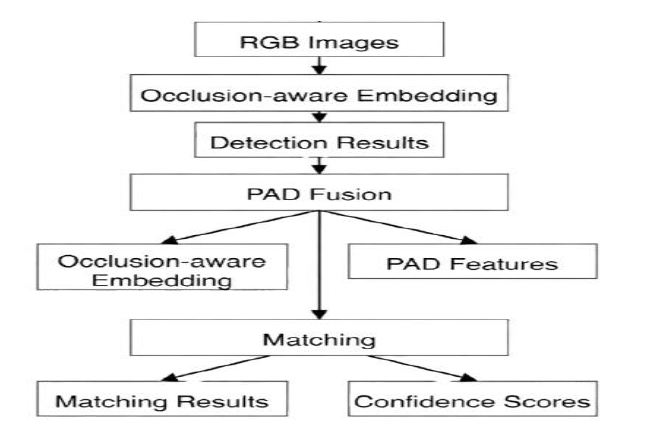
Masked and occluded face recognition remains a persistent challenge for real-time biometric systems, especially in security, healthcare, and surveillance contexts where facial coverings are either voluntary or mandated. Existing models, such as MFRNet and the occlusion-aware networks, have achieved notable benchmark accuracy; however, their high computational demands make them impractical on edge devices with limited memory and processing power. Furthermore, most state-of-the-art presentation attack detection (PAD) systems operate as isolated modules that are not integrated with recognition pipelines. This gap motivates the present study. A lightweight deep learning model is proposed that combines an occlusion-aware attention module built on a MobileNetV3 backbone with a multi-stream PAD system fusing remote photoplethysmography (rPPG), monocular depth estimation, frequency/texture analysis, and blink dynamics. Optimization through INT8 quantization and knowledge distillation enables edge deployment at latencies below 25 ms per frame. Evaluations on a custom Nigerian-diverse dataset and public benchmarks RMFRD, MAFA, masked CelebA-HQ, and Oulu-NPU show Rank-1 accuracies of 94.2–96.8% under occlusion and PAD Equal Error Rates (EER) of 2.1–3.4%, with reduced demographic bias across Fitzpatrick skin tones I–VI.
References
Adebayo, O., Adeyemi, F., Ogundimu, T., and Bakare, S. (2022). Biometric authentication systems in sub-Saharan Africa: Challenges and opportunities. African Journal of Science, Technology, Innovation and Development, 15(4), 234–248.
Atoum, Y., Liu, Y., Jourabloo, A., and Liu, X. (2018). Face anti-spoofing using patch and depth-based CNNs. IEEE Transactions on Information Forensics and Security, 13(11), 2787–2798.
Boulkenafet, Z., Komulainen, J., Li, L., Feng, X., and Hadid, A. (2017). OULU-NPU: A mobile face presentation attack database with real-world variations. In Proceedings of the IEEE International Conference on Automatic Face and Gesture Recognition (FG), pp. 612–618.
de Haan, G. and Jeanne, V. (2013). Robust pulse rate from chrominance-based rPPG. IEEE Transactions on Biomedical Engineering, 60(7), 2033–2040.
Deng, J., Guo, J., Xue, N., and Zafeiriou, S. (2019). ArcFace: Additive angular margin loss for deep face recognition. In Proceedings of the IEEE/CVF Conference on Computer Vision and Pattern Recognition (CVPR), pp. 4690–4699.
Deng, J., Guo, J., Zhou, Y., Yu, J., Kotsia, I., and Zafeiriou, S. (2020). RetinaFace: Single-shot multi-level face localisation in the wild. In CVPR Workshops, pp. 314–323.
Ge, S., Li, J., Ye, Q., and Luo, Z. (2017). Detecting masked faces in the wild with LLE-CNNs. In IEEE International Conference on Computer Vision Workshops (ICCVW), pp. 306–314.
He, K., Zhang, X., Ren, S., and Sun, J. (2016). Deep residual learning for image recognition. In CVPR, pp. 770–778.
Hinton, G., Vinyals, O., and Dean, J. (2015). Distilling the knowledge in a neural network. arXiv:1503.02531.
Howard, A., Sandler, M., Chu, G., Chen, L.C., Chen, B., Tan, M., Wang, W., Zhu, Y., Pang, R., Vasudevan, V., Le, Q., and Adam, H. (2019). Searching for MobileNetV3. In Proceedings of the IEEE/CVF International Conference on Computer Vision (ICCV), pp. 1314–1324.
Ibrahim, M., Sanchez, P., and Kumari, P. (2020). GAN-based occlusion synthesis for robust face recognition training. International Journal of Computer Vision and Image Processing, 10(2), 45–60.
Jacob, B., Kligys, S., Chen, B., Zhu, M., Tang, M., Howard, A., Adam, H., and Kalenichenko, D. (2018). Quantization and training of neural networks for efficient integer-arithmetic-only inference. In CVPR, pp. 2704–2713.
Jourabloo, A., Liu, Y., and Liu, X. (2018). Face de-spoofing: Anti-spoofing via noise modeling. In ECCV, pp. 290–306.
Karras, T., Laine, S., and Aila, T. (2019). A style-based generator architecture for generative adversarial networks. In CVPR, pp. 4401–4410.
Li, H., Lin, Z., and Li, B. (2021). Occlusion-aware face recognition using attention-guided partial feature fusion. Pattern Recognition Letters, 145, 100–108.
Liu, X., Yan, W., and Hu, S. (2016). Real-time face liveness detection with mobile hardware. IEEE Signal Processing Letters, 23(11), 1565–1569.
Nigerian Inter-Bank Settlement System (2023). Annual report on digital financial services in Nigeria. NIBSS.
NITDA (2023). Report on biometric vulnerability assessment in Nigerian financial institutions. National Information Technology Development Agency.
Nwankwo, C., Eze, T., Obi, J., and Uche, I. (2023). Multi-cue fusion for presentation attack detection in West African biometric deployments. Journal of Information Security and Applications, 74, 103456.
Ojala, T., Pietikainen, M., and Maenpaa, T. (2002). Multiresolution gray-scale and rotation invariant texture classification with local binary patterns. IEEE Transactions on Pattern Analysis and Machine Intelligence, 24(7), 971–987.
Okonkwo, N., Eze, C., and Bello, A. (2023). Algorithmic bias in facial recognition: An African perspective. Digital Policy, Regulation and Governance, 25(3), 198–215.
Oluwafemi, B., Adeyemi, R., and Ibrahim, K. (2023). Real-time multi-face recognition systems for surveillance: Optimization strategies and trade-offs. Nigerian Journal of Technology, 42(1), 88–98.
Oluwatobi, A., Faseun, T., and Adewale, O. (2023). Impact of facial occlusion on automated border control systems: Evidence from Nigeria. African Security Review, 32(2), 112–127.
ONSA (2023). Facial recognition deployment in Nigerian national security infrastructure: Policy framework and technical standards. Office of the National Security Adviser.
Park, J. and Rodriguez, M. (2023). Presentation attack detection integrated with face recognition: A survey of joint architectures. ACM Computing Surveys, 56(1), 1–38.
Soukupova, T. and Cech, J. (2016). Eye blink detection using facial landmarks. In 21st Computer Vision Winter Workshop (CVWW), pp. 1–6.
Wang, Z., Huang, X., and Yu, J. (2022). MFRNet: Mask-aware face recognition network for occluded face recognition in surveillance scenarios. IEEE Transactions on Circuits and Systems for Video Technology, 32(5), 2925–2937.
Zhang, K., Liu, H., and Chen, Y. (2020). Occlusion-robust face recognition using attention-based partial feature aggregation. Neurocomputing, 410, 1–13.
Downloads
Published
Issue
Section
Categories
License
Copyright (c) 2026 Ahmed Musa Iliyasu, Etemi Joshua Garba, Yusuf Musa Malgwi, Mamudu Francis Itanyi

This work is licensed under a Creative Commons Attribution 4.0 International License.


