
PREVALENCE OF GASTROINTESTINAL PARASITES OF CATTLE AND SHEEP IN ANIMAL PRODUCTION RESEARCH FARM, FEDERAL UNIVERSITY OF TECHNOLOGY, MINNA, NIGER STATE, NORTH CENTRAL, NIGERIA
DOI:
https://doi.org/10.33003/fjs-2026-1007-4930Keywords:
Gastrointestinal, Parasites, Cattle, Sheep, Research, PrevalenceAbstract
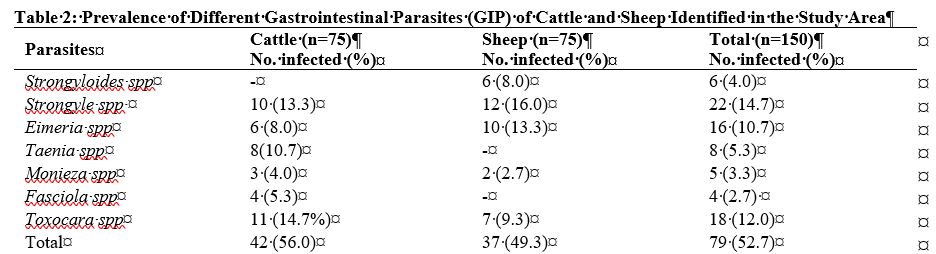
A cross sectional study was carried out to determine the prevalence of Gastrointestinal Parasites of Cattle and Sheep in animal production research farm, Federal University of Technology Minna, using centrifugal floatation and sedimentation technique. A total of one hundred and fifty (150) faecal samples were collected from cattle (75) and Sheep (75). An overall prevalence of 52.7% was recorded. Cattle (56%) had the highest prevalence than Sheep (49.3%) and the difference was non-significant (P>0.05). Seven (7) gastrointestinal parasites were encountered namely: Toxocara spp (12%), Strongyloides spp (4%), Strongyle spp (14.7%), Eimeria spp (10.7%), Taenia spp (5.3%), Monieza spp (3.3%) and Fasciola spp (2.7%). Strongyle spp (14.7%) had the highest prevalence while the least prevalence was Fasciola spp (2.7%). Male cattle (62.9%), male sheep (64%), adult cattle (60%), young sheep (58.6%) and pregnant cattle (70%) were more infected than female cattle (50%), female sheep (42%), young cattle (50%), adult sheep (43.5%) and non-pregnant cattle (33.3%) and the difference was not significant (P>0.0). Pregnant sheep (66.7%) were more infected than non-pregnant sheep (20%) and a significant difference was observed (P<0.05). The result of this study revealed that cattle and sheep in this study area were infected with different gastrointestinal parasites and effective prevention and control measures should be developed to combat the dangerous effect of gastrointestinal parasites in these animals and reduce economic losses.
References
Ahmad, M., Khan, M.N., Sajid, M.S, Muhammad, G., Qudoos, A. and Rizwan, H.M. (2017). Prevalence, economic analysis and chemotherapeutic control of small ruminant fasciolosis in the Sargodha district of Punjab, Pakistan. Vetenaria Italiana, 53 (1), 47–53. Doi: 10.12834/vetit.114.316.6.
Batool, A., Sajid, M.S., Rizwan, H.M., Iqbal, A., Rashid, I., Jan, I., Bano, F., Ahmad, F., Waqas Ahmad, W. and Khan, M.N. (2022). Association of various risk factors with the distribution of gastrointestinal, haemo and ectoparasites in small ruminant. Journal of Animal Health and Production, 10 (2), 204–213. Doi:10.17582/journal.jahp/2022/10.2.204.213.
Charlier, J., Hoglund, J., Samson-Himmelstgorna, G. and Dorny, P. (2009). Gastrointestinal nematode infections in adult dairy cattle:Impact on production, diagnosis and control. Veterinary Parasitology, 164 (1), 70–79. Doi: 10.1016/j.vetpar.2009.04.012.
Cheesbrough, M. (2009). District laboratory practice in tropical countries. 2nd ed. Cambridge University Press, New York, USA.
Cordero C.M, and Rojas F. (1999). Parasitología Veterinaria. 1st ed. España: McGraw Hill, p. 323.
Dabasa, G., Shanko, T., Zewdei, W., Jilo, K., Gurmesa, G. and Abdela, N. (2017). Prevalence of small ruminant gastrointestinal parasites infections and associated risk factors in selected districts of Bale zone, south eastern Ethiopia. Journal of Parasitology and Vector Biology, 9(6), 81–88. Doi: 10.5897/JPVB2017.0286.
Dagnachew, S., Amamute, A. and Temegen W. (2011). Epidemiology of gastrointestinal helminthiasis of small ruminants in selected sites of North Gondar zone, Northwest Ethiopia. Ethiopian Veterinary Journal, 15 (2), 57-68. Doi: 10.4314/evj.v15i2.6769.
Das, M., Deka, D., Sarmah, P.C., Islam, S. and Sarma, S. (2015). Diversity of Eimeria spp. in dairy cattle of Guwahati, Assam, India. Veterinary World, 8(8), 941. Doi: 10.14202/vetworld.2015.941-945.
Dey, A.R., Begum, N., Biswas, H. and Alam., M.Z. (2021). Prevalence and Factors influencing gastrointestinal parasitic infections in Sheep in Bangladesh. Annals of Parasitology, 67 (2), 187-194. Doi: 10.17420/ap6702.328.
Dosa, D., Mulugeta, M. and Alaro, T. (2023). Epidemiology of Gastro-Intestinal Parasites of Cattle Managed Under Extensive Production System in Arbaminch Zuria Wereda of Gamo Zone, Southern Ethiopia. Journal of Veterinary Science and Medical Diagnosis, 12, 2. DOI: 10.4172/2325-9590.100037.
Federal University of Technology Minna. (2012). Postgraduate school prospectus. Federal University of Technology, Minna, Niger State.
Foreyt, W.J. (2001).Veterinary Parasitology Reference Manual. Ames. IA: Iowa State University Press, USA.
Frandson, R.D., Wilke, W.L., & Fail, A.D. (1992). Anatomy and physiology of farm animals. Department of anatomy and neurobiology collage of veterinary medicine and biomedic sciences, 5thEdn. Colorado state University: for Collins, Colorado, 337-341.
Gadahi, J.A., Arshed, M.J., Ali, Q., Javaid, S.B. and Shah, S.I. (2009). Prevalence of gastrointestinal parasites of sheep and goat in and around Rawalpindi and Islamabad, Pakistan. Veterinary World, 2(2), 51–53. www.veterinaryworld.org.
Gofwan P. G., Gyang I. Y., Dastu A. J., Magaji S. T., Damter S. A.and Sudik, S.D. (2025). Prevalence of Gastrointestinal Parasites of Cattle and Sheep in Pankshin Local Government Area (LGA) of Plateau State Nigeria. Nigerian Journal of Animal Science and Technology, 8 (3), 91-97. https://www.njast.com.ng/index.php/home/article/view/463.
Haftu, B, and Bacha A. (2014). Prevalence of Gastrointestinal Nematodes and Coccidian Parasites Affecting Cattle in West Arsi zone, Oromia Regional State, Ethiopia. J Vet Sci Technol, 05(05). Doi10.4172/2157–7579.1000207.
Hassan, I. and Jibrin, A.N. (2022). Prevalence of gastrointestinal helminths of small ruminants subjected to traditional livestock management system in Gadau district, Bauchi State, Nigeria. Acta Entomology and Zoology, 3(2), 32–35. https://doi.org/10.33545/27080013.2022.v3.i2a.73.
Haymanot, F. and Kaba, T. (2022). Prevalence and associated factors of gastrointestinal helminthiasis in lactating cows and the effect of strategic deworming on milk quantity, fat, and protein in Kucha, Ethiopia. BMC Veterinary Research, 18, 1–12. Doi:10.1186/s12917-022-03251.
Hendrix, C. and Robinson, E. (2012). Common laboratory procedures for diagnosing parasitism. Diagnostic Parasitology for Veterinary Technicians, 4th ed. St. Louis: Elsevier, pp 316-334, 336.
Huang, C., Wang, L., Pan, C., Yang, C. and Lai, C.H. (2014). Investigation of gastrointestinal parasites in dairy cattle in Taiwan. Journal of Microbiology, Immunology and Infection, 47 (1), 70–74. Doi:10.1016/j.jmii.2012.10.004.
Hurisa, G., Yimer, L. and Amante, M. (2021). Species composition and burden of small intestinal parasitic helminths in goats and sheep slaughtered at Bishoftu Elfora export abattoir (Ethiopia). Veterinary Medicine Research and Report, 12, 235–239. doi:10.2147/VMRR.S324500.
Income, N., Tongshoob, J., Taksinoros, S., Adisakwattana, P., Rotejanaprasert, C., Maneekan, P. and Kosoltanapiwat, N. (2021). Helminth Infections in Cattle and Goats in Kanchanaburi, Thailand, with Focus on Strongyle Nematode Infections. Veterinary Science, 9, 1–17. Doi:10.3390/vetsci9010001.
Islam, M.S., Hossain, M.S, Dey, A.R., Alim, M.A., Akter, S., Alam, M.Z. (2017). Epidemiology of gastrointestinal parasites of small ruminants in Mymensingh, Bangladesh. Journal of Advanced Veterinary and Animal Research, 4(4), 356-362. http://doi.org/10.5455/javar.2017.d234 .
Johansson, L. (2017). The impact of gastrointestinal parasites on weight gain, activity patterns, and behaviors in cattle on pasture, p 688.
Jurasek, M.E., Bishop-Stewart, J.K., Storey, B.E., Kaplan, R.M. and Kent, M.L. (2010). Modification and further evaluation of a fluorescein-labeled peanut agglutinin test for identification of Haemonchus contortus eggs. Veterinary Parasitology, 169 (1-2), 209–213. Doi: 10.1016/j.vetpar.2009.12.003.
Knapp-Lawitzke, F, von Samson-Himmelstjerna, G. and Demeler, J. (2015). Elevated temperatures and long drought periods have a negative impact on survival and fitness of strongylid third stage larvae. International Journal for Parasitology, 46 (6), 229–237. Doi: 10.1016/j.ijpara.2015.10.006.
Lemy, E.E. and Egwunyenga, A.O. (2017) Prevalence of Parasitic Helminthes from Feacal Samples of Cattle at Various Abattoirs inAbraka, Delta State, Nigeria. Journal of Animal Health and Behavioural Science,1, 107.
Leon, J.C.P., Delgada, N.U. and Florez, A.A. (2019). Prevalence of gastrointestinal parasites in cattle and sheep in three municipalities in the Colombian Northeastern Mountain. Veterinary World, 12 (1), 48–54. Doi: 10.14202/vetworld.2019.48-54.
Maimadu AA, Bata SI, Olabode MP, Akinsulie OC, Waziri IA, Sabo JA (2020) Prevalence of Gastrointestinal Parasites and their Impactin Sheep in Riyom Local Government Area of Plateau State. Journal of Bacteriology and Parasitology. 11, 375. Doi: 10.35248/ 2155-9597.20.11.375.
McNeilly, T.N and Nisbet, A.J. (2014). Immune modulation by helminth parasites of ruminants: implications for vaccine development and host immune competence. Parasite, 21, 51. Doi:10.1051/parasite/2014051.
Ntonifor, H. N., Shei, S. J., Ndaleh, N. W. and Mbunkur, G. N. (2013). Epidemiological studies of GIT parasitic infections in ruminants in Jakiri, Bui Division, North West Region of Cameroon. Journal of Veterinary Medicine and Animal Health, 5(12), 344-352.DOI: 10.5897/JVMAH2013.0209.
Nwosu, C.O., Madu, P.P., Richards, W.S. (2007). Prevalence and seasonal changes in the population of gastrointestinal nematodes of small ruminants in the semi-arid zone of north-eastern Nigeria. Veterinary Parasitology, 144, 118–124. https://doi.org/10.1016/j.vetpar.2006.09.004.
Obi, C.F., Akata, M.C. and Ezubelu, O.J. (2020). Prevalence of gastrointestinal helminth parasites of trade cattle in Aguata and Orumba South Local Government Areas, Southeastern Nigeria. Journal of Parasitic Diseases, 44(3), 546-552. Doi: 10.1007/s12639-020-01227-3.
Odoi, A., Gathuma, J.M., Gachuiri, C.K. and Omore, A. (2007). Risk factors of gastrointestinal nematode parasite infections in small ruminants kept in smallholder mixed farms in Kenya. BMC Veterinary Research, 3, 1–11. Doi:10.1186/1746-6148-3-6.
Pam, V. A., Dakul, D. A., Karshima, N. S., Bata, S. I., Ogbu, K. I., Daniel, L. N.., Udokaninyene, A. D., Kemza, S. Y., Igeh, C. P. and Hassan, A. A. (2013). Survey of Cryptosporidium species among ruminants in Jos, Plateau State, north-central Nigeria. Journal of Veterinary Advances, 3(2), 49-54. DOI: 10.5455/jva.20130227112004.
Poddar, P.R., Begum, N., Alim, M.A., Dey, A.R., Hossain, M.S. and Labony, S.S. (2017). Prevalence of Gastrointesinal Helminthes of sheep in Sherpur, Bangladesh. Journal of Advanced Veterinary and Animal Research, 4, 274–280. https://doi.org/10.5455/javar.2017.d224.
Raza, M.A., Younas, M. and Schlecht, E. (2017). Prevalence of gastrointestinal helminths in pastoral sheep in Sherpur, Bangladesh. Journal of Advanced Veterinary and Animal Research, 4, 274–280. https://doi.org/10.5455/javar.2017.d224.
Said, F.A., Okurut, E., Mohamed, N.B., Byonanuwe, S.,Mulumba, R. and Kusolo, I. (2025). Prevalence,common helminths, and factors associated with helminths among pregnant women attendingantenatal clinic at a tertiary hospital in Uganda. PLoSNeglected Tropical Diseases, 19 (3), e0012926. Doi:10.1371/journal.pntd.0012926.
Salehi, A., Razavi, M. and Vahedi Nouri, N. (2022).Seasonal prevalence of helminthic infections in thegastrointestinal tract of sheep in MazandaranProvince, Northern Iran. Journal of Parasitology Research, 2022, 7392801. Doi:10.1155/2022/7392801.
Sangma, A., Begum, N., Roy, B.C. and Gani, M.O. (2012). Prevalence of helminth parasites in sheep (Ovis aries) in Tangail district, Bangladesh. Journal of the Bangladesh Agricultural University, 10, 235–244. DOI: https://doi.org/10.3329/jbau.v10i2.14913.
Shinggu, P., Olufemi, O., Nwuku. J, A., Baba-Onoja, E.B.T. and Iyawa, P.D. (2019). Liver flukes egg infection and associated risk factors in white Fulani cattle slaughtered in Wukari, southern Taraba State, Nigeria. Advances in Preventive Medicine, 2019 (9), 1–5. Doi: 10.1155/2019/2671620.
Singh, A.K., Das, G., Roy, B., Nath, S., Naresh, R. and Kumar, S. (2015). Prevalence of gastro-intestinal parasitic infections in goat of Madhya Pradesh, India. Journal of Parasitic Diseases, 39 (4), 716–719. Doi: 10.1007/s12639-014-0420-z.
Singh, E., Kaur, P., Singla, L.D. and Bal, M.S. (2017). Prevalence of gastrointestinal parasitism in smallruminants in the western zone of Punjab, India. Veterinary World, 10(1), 61–66. Doi:10.14202/vetworld.2017.61-66.
Soulsby, E.J.L. (1982). Helminths, arthropods and protozoa of domesticated animals (7th ed.). London:The English Language Book Society. pp. 126–173.
Squire, S. A., Amafu-Dey, H. and Beyuo, J. (2013). Epidemiology of gastrointestinal parasites of cattle from selected locations in Southern Ghana. Livestock Research for Rural Development, 25, 1-13. http://www.lrrd.org/lrrd25/7/squi25117.htm.
Stear, M.J. and Murray, M. (1994). Genetic resistance to parasitic disease: particularly of resistance in ruminants to gastrointestinal nematodes. Veterinary Parasitology, 54 (1–3), 161–176. Doi:10.1016/0304-4017(94)90089-2.
Tariq, K.A., Chishti, M.Z. and F. Ahmad (2010). Gastrointestinal nematode infections in goats relative to season, host sex and age from the Kashmir valley, India. Journal of Helminthology, 84 (1), 93-97. Doi: 10.1017/S0022149X09990113.
Tasawar, Z., Ahmad, S.and Hussain, M. (2010). Prevalence of Haemonchus contortus in sheep at research center for conservation of Sahiwal cattle (RCCSC) Jehangirabad, district Khanewal, Punjab. Pakistan journal of zoology, 42, 735-739.
Tehmina, S., Shahina, R., Razzaq, A., Marghazani, I. and Khosa, A.N. (2014). Prevalence of Paramphistomum cervi in different sheep breeds of Balochistan (Pakistan). Revista veterinaria, 25(1), 12–15. Doi: 10.30972/vet.251542.
Terfa, W., Kumsa, B., Yana, D., Maurizio, A., Tessarin, C. and Cassinin, R. (2023). Epidemiology of Gastrointestinal Parasites of Cattle in Three Districts in Central Ethiopia. Animals (Basel), 13(2), 285. https://doi.org/10.3390/ani13020285.
Tiele, D., Sebro, E., H/Meskel, D. and Methewos, M. (2023). Epidemiology of Gastrointestinal Parasites of Cattle in and Around Hosanna Town, Southern Ethiopia, Veterinary Medicine: Research and Reports 14, 1-9. Doi: 10.2147/VMRR.S389787.
Urquhart, G.M., Armour, J., Duncan, J.L., Dunn, A.M. and Jennings, F.W. (1996). Veterinary parasitology (2nd ed.). Oxford: Blackwell Science. p. 307. W61–66.
Win, S.Y., Win, M., Thwin, E.P, Htun, L.L., Hmoon, M.M., Chel, H.M., Thaw, Y.N., Soe, N.C., Phyo, T.T., Thein, S.S., Khaing, Y., Than, A.A.and Bawm, S. (2020). Occurrence of gastrointestinal parasites in small ruminants in the central part of Myanmar. Journal of Parasitology Research, 2020 (1), 8826327. https://doi.org/10.1155/2020/8826327.
Zuk, M. and McKean, K.A. (1996). Sex differences in parasite infections: patterns and processes. International Journal for Parasitology, 26 (10), 1009-1024. https://doi.org/10.1016/S0020-7519(96)80001-4.
Zvinorova, P. I., Halimani, T. E., Muchadeyi, F. C., Matika, O., Riggio, V. and Dzama, K. (2016). Prevalence and risk factors of gastrointestinal parasitic infections in goats in low-input low-output farming systems in Zimbabwe. Small Ruminant Research, 143, 75-83. Doi: 10.1016/j.smallrumres.2016.09.005.
Downloads
Published
Issue
Section
Categories
License
Copyright (c) 2026 Amina Yawo Adamu, Chubiyojo Victoria Wani, Fatima Ndagi Adamu, Abubakar Faisal, Khadija Abduganiyu, Saudat Lawal, Fadila Adamu

This work is licensed under a Creative Commons Attribution 4.0 International License.


