
EXPLORATION OF FUNGI ASSOCIATED WITH DIFFERENT PARTS OF Pinus caribaea Morelet (CARRIBEAN PINE) GROWN AS ORNAMENTALS IN ZARIA AREA, KADUNA STATE NIGERIA
DOI:
https://doi.org/10.33003/fjs-2026-1007-4914Keywords:
Pinus, ornamental, rhizosphere, isolation, identification, fungal diversityAbstract
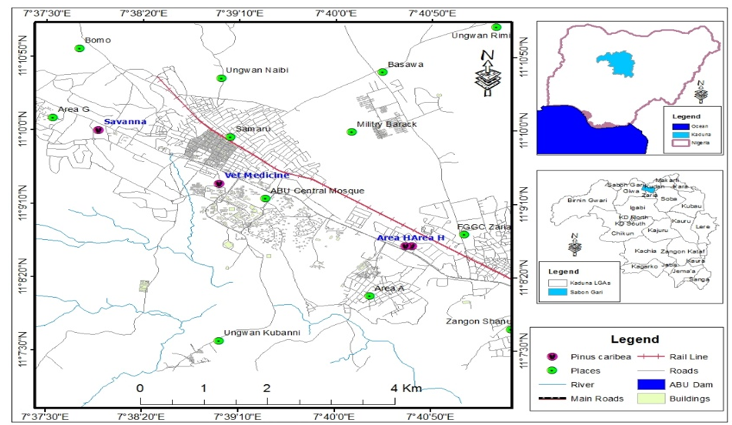
Pinus is a tree planted as an ornamental plant in Zaria Area. The aim of the research was to identify fungi from Pinus plant tissues grown as ornamental and rhizosphere in Zaria Area. Sampling was carried out at the Faculty of Veterinary Medicine, Area H Quarters, Botanical garden and Savanna Forestry Research Institute, Ahmadu Bello University, Zaria. Needles, stems, roots and rhizosphere soil were collected and analyzed respectively using standard mycological techniques. Ten genera of fungi were isolated with different percentage occurrences, Rhizoctonia sp had the highest percentage occurrence of 27.66% followed by Fusarium sp. 25.33%, Aspergillus sp. 23.40%, Penicillium sp. 10.64% while Rhizopus sp., Pestalotia sp., Dothistroma sp., Aspergillus flavus, Fusarium solani species complex, and Microsphaeropsis ovaliceae had the lowest percentage occurrence of 2.13% each. There was a diversity of fungi genera isolated from different parts of the plant Rhizoctonia sp. and Fusarium sp were isolated from all parts of the plant (needles, stem, root and rhizosphere soil), Dothistroma sp., Aspergillus flavus, Fusarium solani species complex, Microsphaeropsis ovaliceae were isolated from needles only, Aspergillus sp. was isolated from needles, stem and rhizosphere soil, Penicillium sp. was present in root and rhizosphere soil only, Pestalotia sp. and Rhizopus sp. were present in rhizosphere soil only.
References
Aksenova V. N. (1999). Catalog of cultivated woody plants in Russia (Sotchi; Petrozavodsk) p 173
Aoki, T., Smith, J. A., Mount, L. L., Geiser, D. M. and O'Donnell, K. (2013). Fusarium torreyae sp nov a pathogen causing canker disease of Florida torreya (Torreya taxifolia), a critically endangered conifer restricted to northern Florida and southwestern Georgia. Mycologia 105:312-319
Barnes, I., Crous, P. W., Wingfield, B. D. and Wingfield, M. J. (2004). Multigene phylogenies reveal that the red band needle blight of Pinus is caused by two distinct species of Dothistroma, D. septosporum, and D. pini. Studies in Mycology 50: 551-565
Barnes, I., Crous, P. W., Wingfield, B. D. and Wingfield, M. J. (2011). Multigene phylogenies reveal that the red band needle blight of Pinus is caused by two distinct species of Dothistroma, D. septosporum, and D. pini. Studies in Mycology 50: 551-565
Bednarova, M., Palovcikova, D. and Jankovsky, L. (2006). The host spectrum of Dothistroma needle blight Mycosphaerella pini E. Rostrup – new hosts of Dothistroma needle blight observed in the Czech Republic. Journal of Forest Science 52: 30-36
Bonello, P. and Blodgett, J.T. (2003). The aggressiveness of Sphaeropsis sapinea on Austrian pine varies with isolate group and site of infection. Forest Pathology 33: 15–1
Bracewell, B., Ronald, R., Rawlings, R. and John J. (2020). "Pinus (Pine) Notes". Trees of Stanford. Retrieved 2 February 2020
Browne, F.G (1968). Pest and diseases of forest plantation trees. Clarendon press, Oxford, 1330p
Bulman, L. S., Gadgil, P. D., Kershaw, D. J., and Ray, J. W. (2008). Assessment and control of Dothistroma needle-blight. Forest Research Bulletin No. 229, 48 p
Crisp, M. D. and Cook, L. G. (2005). Cenozoic extinctions account for the low diversity of extant gymnosperms compared with angiosperms. New Phytologist, 192 (4), 997– 1009. https://doi.org/10.1111/j.14698137.2011.03862.x
Darvas, J. M. (1976). Cercospora spot. South African avocado growers' association proceeding of the technical committee, 1:3-6
Darvas, J. M., Scott, D. B. and Kotzé, J. M. (1978). Fungi associated with damping-off in coniferous seedlings in South African nurseries. South African Forestry Journal, 104(1):15-19
Daughtrey M. L. And Benson, J. L. (2005). Compendium of flowering potted plant diseases. APS Press, The American Phytopathological Society, St. Paul, Minnesota, USA
Diener, U. L., Cole, R. J., Sanders, T. H., Payne, G. A., Lee, L. S. and Klich, M. A. (1987). Epidemiology of aflatoxin formation by Aspergillus flavus. Annual review of phytopathology, 25(1):249-270
Doroguine, M. (1911). A cryptogamic disease of pines. Bulletin de la Société mycologique de France, 27:105-106
Drenkhan, R., Hantula, J., Vuorinen, M., Janko¬vský, L. and Müller M.M. (2014). Genetic diversity of Doth¬istroma septosporum in Estonia, Finland, and the Czech Republic. European Journal of Plant Pathology. 10(136): 71–85
EPPO Bulletin. (2015). PM 7/46 (3) Lecanosticta aci¬cola (formerly Mycosphaerella dearnessii), Dothistroma septosporum (formerly My¬cosphaerella pini) and Dothistroma pini. 45(2): 163–82
Fabre, B., Ioos, R., Piou, D., and Marcais, B., (2012). Is the emergence of Dothistroma needle blight of pine in France caused by the cryptic species Dothistroma pini. Phytopathology, 102(1):47-54
Ganley, R. J. and Newcombe, G. (2006). Fungal endophytes in seeds and needles of Pinus monticola. Mycol Res 110:318–327
Gernandt, D. S., Platt, J. L., Stone, J. K., Spatafora, J. W., Holst-Jensen, A., Hamelin, R. C. and Kohn, L. M. (2005). Phylogenetics of Helotiales and Rhytismatales based on partial small subunit nuclear ribosomal DNA sequences. Mycologia, 93, 915-933
Gibson, I. A. S. (1972). Dothistroma blight of Pinus radiata. Annu. Rev. Phytopathol. 10:51–72
Guba, E. F. (1961). Monograph of Monochaetia and Pestalotia. Havard university Press, Cambridge, Massachusetts. 753p
Guo, L. D., Xu, L., Zheng, W. H., Hyde, K. D. (2004). Genetic variation of Alternaria alternata, an endophytic fungus isolated from Pinus tabulaeformis as determined by random amplified microsatellites (RAMS). Fungal Divers 16:53–65
Horn, B. W. and Dorner, J. W. (1998). Soil populations of Aspergillus species from section Flavi along a transect through peanut-growing regions of the United States. Mycologia, 90(5), 767-776
Hu, M., Ren, X., Sun, Q., Wang, Y. and Zhang, R. (2007). Characterization of Fusarium spp. causing potato dry rot in China and susceptibility evaluation of Chinese potato germplasm to the pathogen. Potato Res. 55:175–184
Huang, W. Y., Cai, Y. Z., Hyde, K. D., Corke, H., and Sun, M. (2008). Biodiversity of endophytic fungi associated with 29 traditional Chinese medicinal plants. Fungal Divers 33:61–75
Jankovsky, L., Bednarova, M., and Palovcikova, D. (2004). Dothistroma needle blight Mycosphaerella pini E. Rostrup, a new quarantine pathogen of pines in the CR. Journal of Forest Science 50:319-326
Jones, N.B., Ford, C.M., Light, M.E., Nadel, R.L., Greyling, I., Fourie, G., Wingfield, M.J. and Morris, A.R. (2014). Effect on nursery and field performance of Pinus patula seedlings after inoculation with Fusarium circinatum. South. For. 76:125-136
Li, Q., Li, Q., Wang, A., and Quan, W. (2025). "Medicinal potential of pine trees: A brief review focusing on three species," BioResources 20(1), 2346-2373.
Park, Y., Kim, C. K., Jeong, H., Lee, H. M., Kim, K. M., Lee, I. H., Kim, M. J., Kwon, G. B., Yoon, N., and Lee, N. (2024). “Evaluation of the basic properties for the Korean major domestic wood species: I. Korean red pine (Pinus densiflora) in Pyeongchang- gun, Gangwon-do,” Journal of the Korean Wood Science and Technology 52(1), 87- 100. DOI: 10.5658/WOOD.2024.52.1.87
Peace, R. T. (1962). Pathology of trees and shrubs. Oxford university Pres London. 723p
Perrin, R., and Sampangi, R. (1986). La fonte des semis en pepiniere forestiere. Eur.J.For.Path. 16: 309-321
Peterson, M. (2000). Fusarium infection routes. Victoria (BC): Applied Forest Science Limited. Contract report to the Forest Genetics Council of BC
Porter, V.I. (2018). Mystique Melodies. Dorrance Publishing
Philips and Burdekin (1992). Effect of combined bacterial and urea treatment on biodegradation of wood by basidiomycete fungi. Journal of Phytopathology, 146:(11‐12) :533-538
Promputtha, I., Lumyong, S., Dhanasekaran, V., Mc Kenzie, E. H. C., Hyde, K, D. and Jeewon, R., (2007). A phylogenetic evaluation of whether endophytes become saprotrophs at host senescence. Microb Ecol 53:579–590
Prihatini, I., Glen, M., Wardlaw, T. J., Ratkowsky, D. A., and Mohammed, C. L. (2015). Needle fungi in young Tasmanian Pinus radiata plantations in relation to elevation and rainfall. New Zealand Journal of Forestry Science, 45, 25 https://doi.org/10.1186/s40490-015-0055-
Raper, K.B. and Thom, C. (1949). A manual of the penicillia. Baltimore, Williams & Wilkins. responses in the the sapwood of Eucalyptus nitens (Maiden) following wounding and fungal inoculation. Physiological and Molecular Plant Pathology 58:63–72
Rao, P. S., Ganapathi, T. R., Suprasanna, P., and Bapat, V. A. (2004). Tobacco (Nicotiana tabacum L.)-A model system for tissue culture interventions and genetic engineering.
Santini, A., Ghelardini, L., De Pace, C., Desprez‐Loustau, M. L., Capretti, P., Chandelier, A., and Stenlid, J. (2013). Biogeographical patterns and determinants of invasion by forest pathogens in Europe. New Phytologist, 197(1),:238-250
Schulz, B., Wanke, U., Draeger, S. and Aust, H. J. (1993). “Endophytes from herbaceous plants and shrubs: effectiveness of surface sterilization methods,” Mycological Research, vol. 97, no. 12: 1447–1450x
Sharma, J.K., Mohanan, C., and Florence, J.M. (1984). Nursery diseases of Eucalyptus in Kerala. Eur. J. For Path. 14:77-89
Shaw, C. G., and Toes, E. H. (1977). Impact of Dothistroma needle blight and Armillaria root rot on diameter growth of Pinus radiata. New Zealand Forest Service
Suri, I. F., Purusatama, B. D., Kim, J. H., Yang, G. U., Prasetia, D., Kwon, G. J., Hidayat, W., Lee, S. H., Febrianto, F. and Kim, N. H. (2022). “Comparison of physical and mechanical properties of Paulownia tomentosa and Pinus koraiensis wood heat-treated in oil and air,” European Journal of Wood and Wood Products 80(6), 1389-1399. DOI:10.1007/s00107-022-01840-4
Sutherland, J. P. (1980). Dynamics of the epibenthic community on roots of the mangrove Rhizophora mangle, at Bahia de Buche, Venezuela. Marine Biology, 58:75-84
Vaartaja, O. And Cram, W.H. (1956). Damping-off of conifers and Caragana in Saskatchewan. Phytopathology 46:505–507
Vizcaíno-Palomar, N., Revuelta Eugercios, B., Zavala, M. A., Alía, R., & González-Martínez, S. C. (2014). The role of population origin and microenvironment in seedling emergence and early survival in Mediterranean maritime pine (Pinus pinaster Aiton). PLoS ONE, 9(10), e109132. https://doi.org/10.1371/journal.pone.0109132
Wang,W. and Guozhao, G. (2009). "Modeling golden section in plants". Progress in Natural Science. 19 (2): 255–260. doi:10.1016/j.pnsc.2008.07.004. The ratio between two pine needles is 0.618 [...] the angle between the two neighbors is about 135° and the angle between the main stem and each branch is close to 34.4° which is the golden section of 90°
Watt, M.S., Kriticos, D.J., Alcaraz, S., Brown, A.V., and Leriche, A., (2009). The hosts and potential geographic range of Dothistroma needle blight. Forest Ecology and Management, 257(6):1505-1519
Zeng,Z. and Lanling, L. (2009). "Modeling golden section in plants". Progress in Natural Science. 19 (2): 261–272
Downloads
Published
Issue
Section
Categories
License
Copyright (c) 2026 . F. Yahaya, D. B Dangora, A. M Zongoma, A. Yahaya

This work is licensed under a Creative Commons Attribution 4.0 International License.


