
Synthesis, Characterization, Multifunctional Bioactivity and Computation Study of 5-Fluorouracil-Thiamine HCl Mixed Ligands Complexes
DOI:
https://doi.org/10.33003/fjs-2026-1008-4903Keywords:
Molecular Docking, Geometry Optimization, BioactivityAbstract
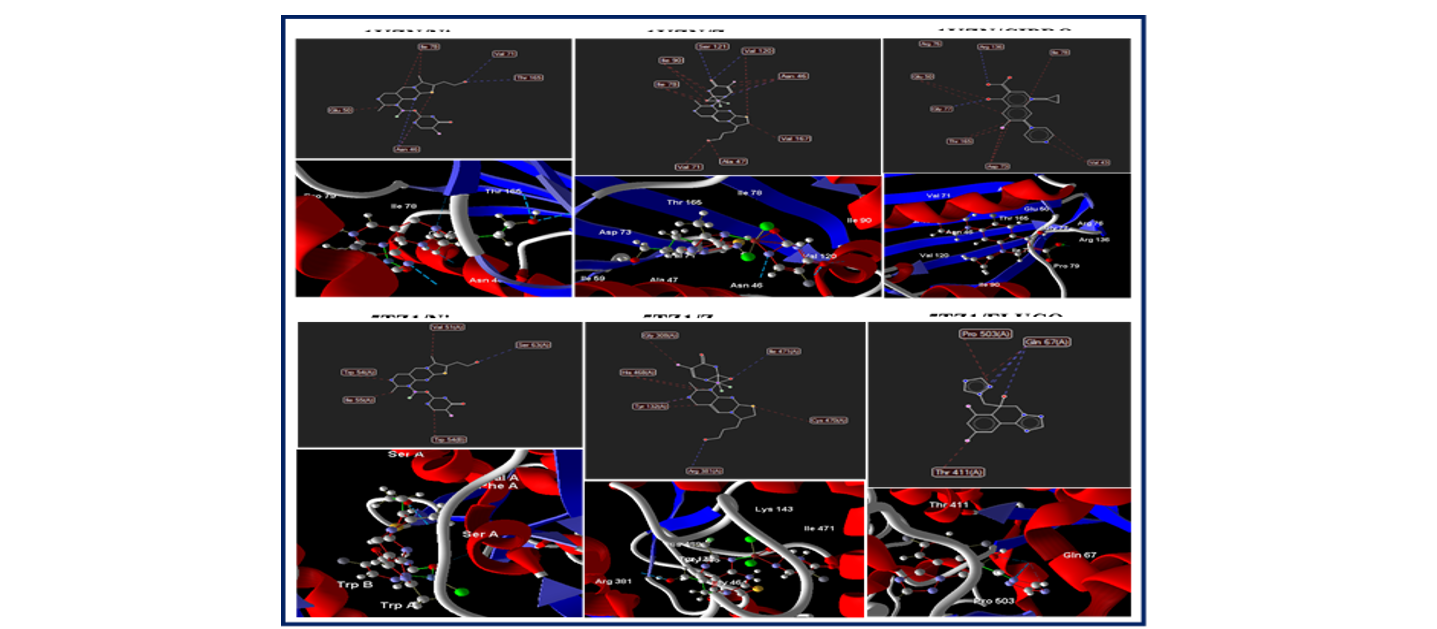
This study explored the structural, spectroscopic and biological properties of Ni(II) and Zn(II) mixed-ligand complexes of 5-fluorouracil–thiamine HCl synthesized through one-pot synthetic method using integrated approaches including computational study. 5-fluorouracil acts as bidentate ligand through nitrogen and carbonyl oxygen atoms of the pyrimidine ring while the thiamine HCl acts as monodentate through nitrogen atom of its pyridinic ring. Geometry optimization demonstrated that the Ni(II) complex exhibits shorter and stronger metal–ligand bonds, particularly with nitrogen and oxygen donor atoms, reflecting enhanced covalent character and greater structural distortion compared to the Zn(II) complex, which showed relatively longer and more ionic interactions. The Ni(II) complex exhibited better antimicrobial and antioxidant properties compared to the Zn (II) complex and the 5-flourouracil ligand. The molecular docking studies indicated that the two complexes showed superior binding affinities against both bacterial (1KZN) and fungal (5TZ1) target proteins compared to standard drugs but Ni (II) complex exhibited excellent antibacterial activity with a Moldock score of −153.39 kcal/mol and strong hydrogen bonding interactions (Val 71, Thr 65, and Asn 46), outperforming the standard drug Ciprofloxacin, which showed a lower binding affinity (−117.39 kcal/mol) and fewer hydrogen bonds. Similarly, both complexes demonstrated remarkable antifungal activity, with Zn (II) complex showing particularly strong binding (−131.12 kcal/mol) and favorable interactions with key residues (Ile 471, Tyr 132, and Arg 381), surpassing the performance of the Fluconazole standard, which exhibited weaker interaction profiles.
References
Ahmed, Y. M., Ashmawy, A. M., Abbas, A. A., & Mohamed, G. G. (2023). Synthesis, characterization, antibacterial, antioxidant activities, density functional theory, and molecular docking studies of new organic metal complexes and links to application of corrosion inhibitors. Applied Organometallic Chemistry, 37(4), e7015.
Aihara, J. I. (1999). Reduced HOMO− LUMO gap as an index of kinetic stability for polycyclic aromatic hydrocarbons. The Journal of Physical Chemistry A, 103(37), 7487-7495.
AL-Nama, K. S., Saeed, I. A., & Mohammed, A. F. (2025). Synthesis, characterization, DFT, molecular docking, and in vitro screening of metal chelates incorporating Schiff base. Bulletin of the Chemical Society of Ethiopia, 39(4), 687-701.
Althubeiti, K. (2025). Synthesis and characterization of the Co (ii), Ni (ii), and Cu (ii) complexes with a 1, 2, 4-triazine derivative ligand. Open Chemistry, 23(1), 20250186.
Berman, H. M., Westbrook, J., Feng, Z., Gilliland, G., Bhat, T. N., Weissig, H., & Bourne, P. E. (2000). The protein data bank. Nucleic acids research, 28(1), 235-242.
Bitencourt-Ferreira, G., & de Azevedo Jr, W. F. (2019). Molegro virtual docker for docking. In docking screens for drug discovery (pp. 149-167). New York, NY: Springer New York.
Bader, R. F. W., Slee, T. S., Cremer, D., & Kraka, E. (1983). Description of conjugation and hyperconjugation in terms of electron distributions. Journal of the American Chemical Society, 105(15), 5061-5068.
Carballo Rial, R., Castiñeiras Campos, A., Domínguez Martín, A., García Santos, I., & Niclós Gutiérrez, J. (2012). Solid state structures of cadmium complexes with relevance for biological systems.
Elgazar, S. M., Abd El-Karim, A. T., Mahmoud, W. H., & El-Sherif, A. A. (2025). Comprehensive analysis of nitrogen–oxygen schiff base derived from Triazole and its metal complex: synthesis, structural characterization, and biological activities with theoretical insights for anti-helicobacter pylori, antitumor, and anti-covid-19 applications. Egyptian Journal of Chemistry, 68(3), 169-191.
Glendening, E. D., Landis, C. R., & Weinhold, F. (2019). NBO 7.0: New vistas in localized and delocalized chemical bonding theory. Journal of computational chemistry, 40(25), 2234-2241.
Gmeiner, W. H., & Okechukwu, C. C. (2023). Review of 5-FU resistance mechanisms in colorectal cancer: Clinical significance of attenuated on-target effects. Cancer Drug Resistance, 6(2), 257–272. https://doi.org/10.20517/cdr.2022.136.
Hargrove, T. Y., Friggeri, L., Wawrzak, Z., Qi, A., Hoekstra, W. J., Schotzinger, R. J., ... & Lepesheva, G. I. (2017). Structural analyses of Candida albicans sterol 14α-demethylase complexed with azole drugs address the molecular basis of azole-mediated inhibition of fungal sterol biosynthesis. Journal of Biological Chemistry, 292(16), 6728-6743.
Hellweg, A., & Rappoport, D. (2015). Development of new auxiliary basis functions of the Karlsruhe segmented contracted basis sets including diffuse basis functions (def2-SVPD, def2-TZVPPD, and def2-QVPPD) for RI-MP2 and RI-CC calculations. Physical Chemistry Chemical Physics, 17(2), 1010-1017.
Hemingway, T. (2020). Chemistry of a Biscarborane Dithiol and Its Nickel (II) Complex (Doctoral dissertation, University of South Carolina).
Hrubša, M., Siatka, T., Nejmanová, I., Vopršalová, M., Kujovská Krčmová, L., Matoušová, K., & Oemonom. (2022). Biological properties of vitamins of the B-complex, part 1: vitamins B1, B2, B3, and B5. Nutrients, 14(3), 484.
Inah, B. E., Azogor, N. F., Akpan, H. T., Levi, O. E., Charlie, D., & Adeleye, A. P. (2025). Exploring the adsorption properties of PTFE-decorated and metal doped covalent organic frameworks for environmental cleanup: a computational outlook. Computational and Theoretical Chemistry, 1248, 115202.
Jamil, Y., Al-Baseer, M. M., Al-Akhali, B., & Alhakimi, A. N. (2025). Synthesis and characterization of mixed ligand complexes of Fluconazole drug and glycine with some transition metals: antifungal study. Sana'a University Journal of Applied Sciences and Technology, 3(2), 718-729.
Koller, D., Blaha, P., & Tran, F. (2013). Hybrid functionals for solids with an optimized Hartree–Fock mixing parameter. Journal of Physics: Condensed Matter, 25(43), 435503.
Lafitte, D., Lamour, V., Tsvetkov, P. O., Makarov, A. A., Klich, M., Deprez, P., & Gilli, R. (2002). DNA gyrase interaction with coumarin-based inhibitors: the role of the hydroxybenzoate isopentenyl moiety and the 5 ‘-methyl group of the noviose. Biochemistry, 41(23), 7217-7223.
Lefebvre, C., Rubez, G., Khartabil, H., Boisson, J. C., Contreras-García, J., & Hénon, E. (2017). Accurately extracting the signature of intermolecular interactions present in the NCI plot of the reduced density gradient versus electron density. Physical Chemistry Chemical Physics, 19(27), 17928-17936. Accessed: Dec. 20, 2025. [Online]. Available: https://pubs.rsc.org/en/content/articlehtml/2005/zq/c7cp02110k
Liu, C. (2022). Anion induced synthesis and crystal structures of Schiff base copper (II) and zinc (II) complexes with antibacterial activity. Russian Journal of Coordination Chemistry, 48(6), 385-396.
Marinova, P. E., & Blazheva, D. E. (2025). A Comprehensive Review of the Synthesis, Characterization, and Therapeutic Potential of Gold, Platinum, and Ruthenium Complexes and Organic Compounds.
Melo-Betances, E., Rodríguez-Bautista, C. C., & Núñez-Sellés, A. J. (2025). Synthesis of mangiferin derivatives, complexes, and carriers as potential therapeutic candidates for cancer treatment: An update. Frontiers in pharmacology, 16, 1598719.
Omer, P. K., Aziz, N. M., & Omer, R. A. (2024). Comprehensive review of metal-based coordination compounds in cancer therapy: from design to biochemical reactivity. Reviews in Inorganic Chemistry, 44(4), 699-710.
Parr, R. G., Szentpály, L. V., & Liu, S. (1999). Electrophilicity index. Journal of the American Chemical Society, 121(9), 1922-1924.
Pasieczna-Patkowska, S., Cichy, M., & Flieger, J. (2025). Application of Fourier transform infrared (FTIR) spectroscopy in characterization of green synthesized nanoparticles. Molecules, 30(3), 684.
She, W. J., Cui, Y. F., Liu, C., and Wang, L. (2020). Structurally characterized dinuclear zinc (II) and copper (II) coumarin-based N2O2-donor complexes: syntheses, Hirshfeld analyses and fluorescent properties. Transition Metal Chemistry, 45(5), 363-372.
Silva, V. R., Corrêa, R. S., Santos, L. D. S., Soares, M. B. P., Batista, A. A., and Bezerra, D. P. (2018). A ruthenium-based 5-fluorouracil complex with enhanced cytotoxicity and apoptosis induction action in HCT116 cells. Scientific reports, 8(1), 1-13.
T. Schaafsma, J. K.-T. J. of C. Physics, and undefined 1965, “Electron Delocalization and Charge Transfer,” pubs.aip.org, Accessed: Jan. 22, 2026. [Online]. Available: https://pubs.aip.org/aip/jcp/article-abstract/42/1/438/81386.
Tyagi, A., Banerjee, S., Cherusseri, J., & Kar, K. K. (2020). Characteristics of transition metal oxides. In Handbook of Nanocomposite Supercapacitor Materials I: Characteristics (pp. 91-123). Cham: Springer International Publishing.
Wishart, D. S., Feunang, Y. D., Guo, A. C., Lo, E. J., Marcu, A., Grant, J. R., ... & Wilson, M. (2018). DrugBank 5.0: a major update to the DrugBank database for 2018. Nucleic acids research, 46(D1), D1074-D1082.
Yadav, M., Yadav, D., Singh, D. P., & Kapoor, J. K. (2025). Macrocyclic Schiff base complexes of Zn (II), Cu (II), Co (II), and Ni (II) targeting topoisomerase IIβ: Synthesis, docking, and evaluation as potential anticancer agents. Applied Organometallic Chemistry, 39(3), e7885.
Yusuff, O. K., Abdul Raheem, M. A. O., Mukadam, A. A., and Sulaimon, R. O. (2019). Kinetics and Mechanism of the Antioxidant Activities of C. olitorius and V. amygdalina by Spectrophotometric and DFT Methods. ACS omega, 4(9), 13671-13680.
Downloads
Published
Issue
Section
Categories
License
Copyright (c) 2026 Sheriff Ayinla, Abdullah Rajee, Louis Hitler, Francisca Bassey, Hassan BUSARI

This work is licensed under a Creative Commons Attribution 4.0 International License.


