
Performance Evaluation of Some Selected Ensemble Classifiers for Users' Online Book Reviews Based on Sentiment Analysis
DOI:
https://doi.org/10.33003/fjs-2026-1009-4892Keywords:
Ensemble Classifier, Sentiment Analysis, Stacking Ensemble Classifiers, User ReviewsAbstract
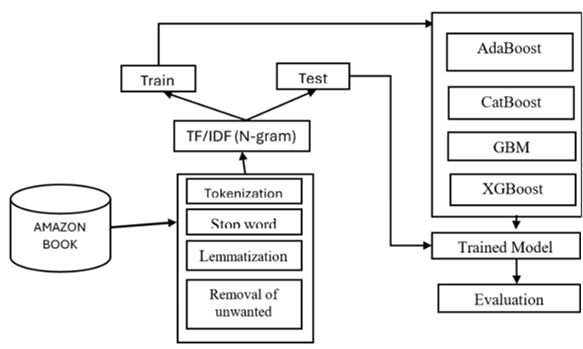
User reviews on platforms such as Amazon have become a focal point due to their extensive use in sentiment analysis, which provides valuable feedback to the public, private companies, and governments. Analysing these reviews not only contributes to enhancing the quality of products and services but also supports the development of marketing and financial strategies aimed at boosting profitability and customer satisfaction. Even with several models developed for this task, there is room to enhance the processing, classification, and interpretation of user feedback, thereby assisting product managers in refining product quality. This paper introduces ensemble classifiers designed to categorize reviews as positive, negative, or neutral. The study first assesses the performance of widely used ensemble methods, including Adaptive Boosting (AdaBoost), Categorical Boosting (CatBoost), Gradient Boosting (GBM), and Extreme Gradient Boosting (XGBoost). It then evaluates stacking ensemble classifiers, where outputs from Random Forest (RF), Naive Bayes (NB), and Support Vector Machine (SVM) are combined with CatBoost, XGBoost, AdaBoost, and GBM. Using dataset sourced from Amazon, experimental results demonstrate that stacked ensemble classifiers achieve superior accuracy, 88.23%, 86.01%, 84.56%, and 85.12%, compared to traditional ensemble classifiers.
References
Abheek, N & Preeti, S (2021). Interdisciplinary Research in Technology and Management
Proceedings of the International Conference on Interdisciplinary Research in Technology and Management (IRTM, 2021), 26-28 February,2021, Kolkata, India.
Basha, S. M., & Rajput, D, S. (2017). Evaluating the Impact of Feature Selection on Overall
Performance of Sentiment Analysis, Proceedings of the 2017 International Conference on
Information Technology, pp. 96-102. ttps://doi.org/10.1145/3176653.3176665
Bhowmic, A., Parua, S., Mandal, D., Ghosh, B. K., and Karmakar, S. (2024) "Leveraging
Ensemble Learning for Enhanced Sentiment Analysis," International Conference on
Distributed Computing and Optimization Techniques (ICDCOT), Bengaluru, India, 2024,
pp. 1-6, Doi: 10.1109/ICDCOT61034.2024.10515983.
Cambria, E., Poria, S., Bajpai, R., & Schuller, B. (2017). Sentiment analysis and effective Computing: A review. Emotion, Sentiment and Affect in Human-Computer Interaction, 1–18.
Dave, K.; Lawrence, S.; Pennock, D.M. Mining the peanut gallery: Opinion extraction and semantic classification of product reviews. In Proceedings of the 12th International Conference on World Wide Web, Budapest, Hungary, 20–24 May 2003; pp. 519–528.
Guru. P. M. S., Praveen. G. J, Rishi, K, Prasanna. K. H. R., Vinay. S. K and Aryan, D (2024), "Sentiment Analysis Using Transfer Learning for E-Commerce Websites," 2024 International Conference on Advances in Modern Age Technologies for Health and Engineering Science (AMATHE), Shivamogga, India, 2024, pp. 1-5, doi: 10.1109/AMATHE61652.2024.10582143.
Hussein, D.M.E.D.M. A survey on sentiment analysis challenges. J. King Saud Univ.-Eng. Sci. 2018, 30, 330–338.
Kasper, W.; Vela, M. Sentiment analysis for hotel reviews. In Proceedings of the Computational Linguistics-Applications Conference, Jachranka, Poland, 17–19 October 2011; Volume 231527, pp. 45–52.
Kadu, S., Joshi, B. (2024). ESFMS: Design of an Ensemble Sentiment Analysis Model
for Feedback Evaluation via Multimodal Feature Selection Process. In: Nanda, S.J., Yadav, R.P.,
Gandomi, A.H., Saraswat, M. (eds) Data Science and Applications. ICDSA 2023. Lecture Notes
in Networks and Systems, vol 818. Springer, Singapore. https://doi.org/10.1007/978-981-99-7862-
5_30
Khalid, M., Ashraf, I., Mehmood, A., Ullah, S., Ahmad, M., & Choi, G. S. (2020). GBSVM: sentiment classification from unstructured reviews using an ensemble classifier. Applied Sciences, 10(8), 2788.
Liu, B. (2009). Handbook Chapter: Sentiment Analysis and Subjectivity. Handbook of Natural Language Processing. In Handbook of Natural Language Processing; Marcel Dekker, Inc.: New York, NY, USA, 2009.
Liu, B. (2015). Sentiment analysis: A literature review. Computer Science Review, 5(1), 1- 10. Mikolov, T., Chen, K., Corrado, G., & Dean, J. (2013). Efficient estimation of word representations.
Mukherjee, A.; Venkataraman, V.; Liu, B.; Glance, N. What Yelp fake review filter might be doing? In Proceedings of the Seventh International AAAI Conference on Weblogs and Social Media, Cambridge, MA, USA, 8–11 July 2013.
Olufunwa, G, Abdullahi, F.B, Belgore, A (2025), Sentiment Classification for Online Book Reviews Using Ensemble Classifiers, TAA International Journal of Science Research and Technology (TIJSRAT), Vol. 8(9), pages 239-259 DOI: https://doi.org/10.70382/tijsrat.v08i9.056
Ramdani, F. (2025). Natural Language Processing and Sentiment Analysis. In: Data Science:
Foundations and Hands-on Experience. Springer, Singapore. https://doi.org/10.1007/978-981-96-
4683-8_9
Srivastava, R., and Bhatia, M. P. S. (2016), "Ensemble methods for sentiment analysis of online micro-texts," 2016 International Conference on Recent Advances and Innovations in Engineering (ICRAIE), Jaipur, India, 2016, pp. 1-6, doi: 10.1109/ICRAIE.2016.7939525.
Tan, K. L., Lee, C. P., Lim, K. M., and Anbananthen, K. S. M. (2022) "Sentiment Analysis
With Ensemble Hybrid Deep Learning Model," in IEEE Access, vol. 10, pp. 103694-103704,
2022, Doi: 10.1109/ACCESS.2022.3210182.
Thien, K. T. & Phan, T. T, (2019). Deep Learning Application to Ensemble Learning: The
Simple. but Effective, Approach to Sentiment Classifying, Applied Science, 9(13), 2760
https://doi.org/10.3390/app9132760
Tiwari, D., Nagpal, B., Bhati, B.S. (2023). A Systematic Review of Social Network Sentiment
Analysis with Comparative Study of Ensemble-based Techniques. Artificial Intelligence
Review, 56, 13407–13461, https://doi.org/10.1007/s10462-023-10472-w
Vidyashree, K P., Rajendra, A B., Gururaj, H. L., Vinayakumar, R, Moez, K (2024). A tweet
sentiment classification approach using an ensemble classifier, International Journal of Cognitive
Computing in Engineering, Vol. 5, pp 170-177, ISSN 2666-3074,
https://doi.org/10.1016/j.ijcce.2024.04.001.
Yadav, V., & Singh, M. (2020). Sentiment analysis of social media data using word embeddings
and classifier algorithms. International Journal of Computer Applications, 975, 8887
Zhao, Y., Qin, B., & Liu, T. (2018). Deep learning for sentiment analysis: A survey. IEEE
Transactions on Affective Computing.
Zhang, L., Wang, S., and Lui, B (2018). Deep Learning for Sentiment Analysis: A Survey,
Wiley Interdisciplinary Reviews: Data Mining and Knowledge Discovery, Vol 8, pp. 1-34
https://api.semanticscholar.org/CorpusID:10694510
Zhenbing, H., Ivan, D., Kateryna, P., Vasyi, M. (2024), Augmenting Sentiment Analysis
Prediction in Binary Text Classification through Advanced Natural Language Processing Models
and Classifiers, International Journal of Information and Computer Science (IJITCS) Vol. 16(2),
pp. 16-31
Downloads
Published
Issue
Section
Categories
License
Copyright (c) 2026 Fatimah Abdullahi, Great Olufunwa

This work is licensed under a Creative Commons Attribution 4.0 International License.


