
BACTERIAL ANALYSIS OF SOLID WASTE FROM REFUSE DUMPSITE IN IBI METROPOLIS, TARABA STATE NIGERIA
DOI:
https://doi.org/10.33003/fjs-2026-1006-4873Keywords:
Frequency of Occurrence, Pathogenic Bacteria, Health, Microscopic, MediaAbstract
Solid waste disposal remains a major environmental and public health challenge in many developing urban centers. Improper waste management practices promote the proliferation of pathogenic microorganisms that pose serious health risks to exposed populations. Culture media was prepared following the manufacturer’s instructions and sterilized in an autoclave at a temperature of 1210c and a pressure of 15psi. Biochemical test including catalase test, Coagulase test and IMViC Reactions were carried out according to clinical laboratory standard guidelines to further confirm the isolates from the solid waste dumpsites soil samples.The following biochemical test was carried out;Bacteriological analysis revealed the presence of five major bacterial isolates: Bacillus subtilis (24%), Escherichia coli (22%), Klebsiella spp. (20%), Pseudomonas aeruginosa (18%), and Staphylococcus aureus (16%). Both Gram-positive bacteria (40%) and Gram-negative bacteria (60%) were recorded, indicating diverse microbial contamination across the dumpsites. Enteric bacteria such as E. coli and Klebsiella spp., which together accounted for 42% of total isolates, suggest significant fecal contamination of the waste materials. Total viable bacterial counts varied across locations, with higher counts (5.2 × 10⁶ cfu/ml) observed in dumpsites containing a greater proportion of decomposable organic waste and lower (3.5 × 10⁶ cfu/ml), The findings indicate a high prevalence of pathogenic and opportunistic bacteria in solid waste dumpsites within Ibi Metropolis, posing notable public health risks. Improved waste segregation, sanitary disposal systems, routine microbial surveillance, and provision of personal protective equipment for waste handlers are strongly recommended to reduce bacterial contamination and protect community health.
References
Aakanchha, S., Gupta, R., & Sharma, K. (2020). IMViC tests for identification of Enterobacteriaceae. Journal of Microbiological Methods, 172, 105906.
Adeleke, R. A., Adeyemi, A. A., & Adesina, O. A. (2015). Bacteriological assessment of solid waste dumpsites in urban areas of Nigeria. African Journal of Environmental Science and Technology, 9(6), 525–531.
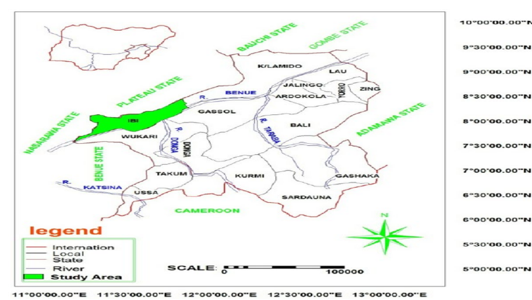
Akoga, I. M. (2012). Geographical analysis of Ibi Local Government Area, Taraba State. Unpublished manuscript.
Atlas, R. M., & Bartha, R. (2018). Microbial ecology: Fundamentals and applications (5th ed.). Pearson Education.
Cheesbrough, M. (2006). District laboratory practice in tropical countries (Part 2). Cambridge University Press.
Cheesbrough, M. (2009). District laboratory practice in tropical countries (2nd ed.). Cambridge University Press.
Collee, J. G., Fraser, A. G., Marmion, B. P., & Simmons, A. (2016). Mackie and McCartney practical medical microbiology (14th ed.). Churchill Livingstone.
Forbes, B. A., Sahm, D. F., & Weissfeld, A. S. (2021). Bailey and Scott’s diagnostic microbiology (14th ed.). Elsevier.
Guerrero, L. A., Maas, G., & Hogland, W. (2013). Solid waste management challenges for cities in developing countries. Waste Management, 33(1), 220–232.
Hoornweg, D., & Bhada-Tata, P. (2012). What a waste: A global review of solid waste management. World Bank.
Madigan, M. T., Bender, K. S., Buckley, D. H., Sattley, W. M., & Stahl, D. A. (2018). Brock biology of microorganisms (15th ed.). Pearson.
Murray, P. R., Rosenthal, K. S., & Pfaller, M. A. (2023). Medical microbiology (10th ed.). Elsevier.
Okafor, N., Aniekwe, C., & Chukwu, O. (2017). Microbial contamination of municipal solid waste dumpsites in Nigeria. Nigerian Journal of Microbiology, 31(2), 4120–4128.
Todar, K. (2020). Todar’s online textbook of bacteriology. University of Wisconsin-Madison. Retrieved from http://textbookofbacteriology.net
Valencia, R., Morales, J., & Castillo, A. (2019). Morphological and biochemical identification of environmental bacteria. Journal of Applied Microbiology, 126(4), 1120–1130.
Downloads
Published
Issue
Section
Categories
License
Copyright (c) 2026 Muslim Mohammed Tanko, Gideon D. Nanfwang, Mary Obioha, Abdulkarim Hashim, Audu Kingsley, Iliya Andesiye, Abdul D. Ibrahim

This work is licensed under a Creative Commons Attribution 4.0 International License.


