
SENSORY EVALUATION AND CONSUMER ACCEPTABILITY OF BREAD PRODUCED FROM COMPOSITE FLOUR CABBAGE AND CARROTS
DOI:
https://doi.org/10.33003/fjs-2026-1007-4821Keywords:
Bread, Composite flour, Sensory evaluation, Proximate Analysis, Consumer AcceptabilityAbstract
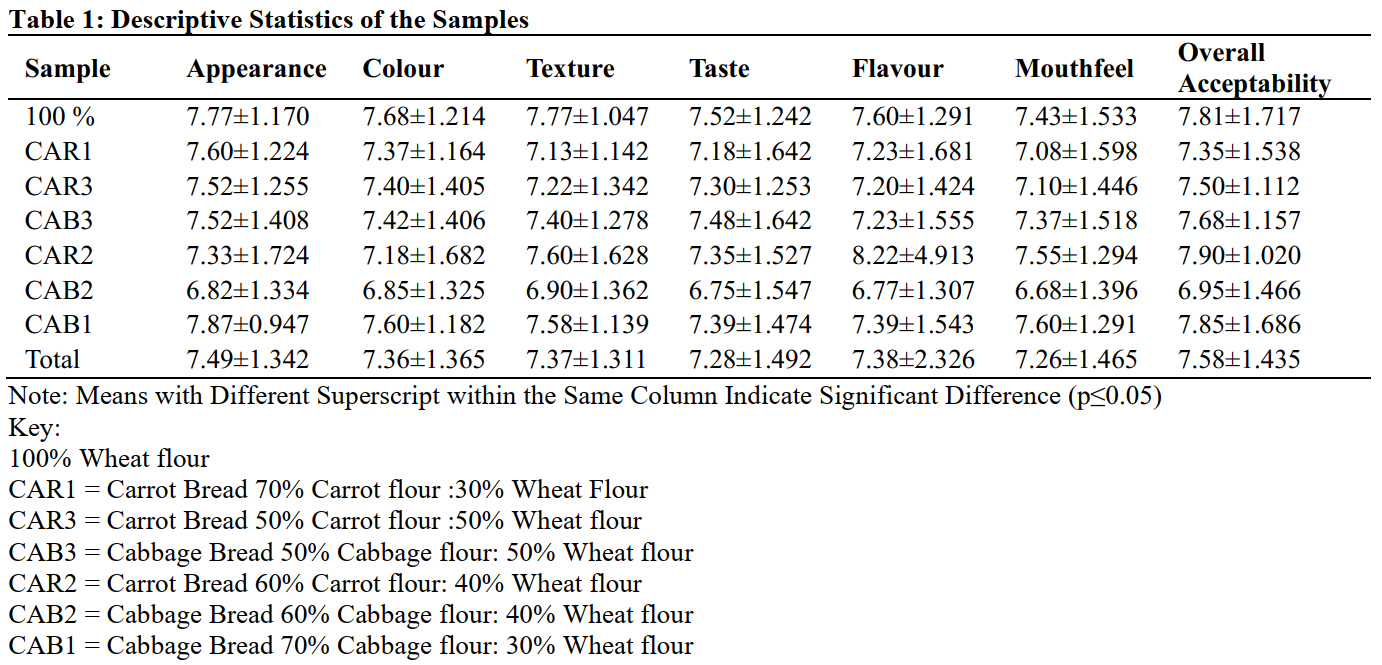
This study determined the sensory evaluation, consumer acceptability and proximate composition of bread produced from composite flours made from cabbage and carrots, compared with 100% wheat flour (control). Bread samples were formulated with varying ratios of cabbage (50:50, 60:40, 70:30) and carrot (50:50, 60:40, 70:30) flour blends. Sensory evaluation tested attributes such as appearance, color, taste, flavor, texture, mouthfeel, and overall acceptability using a 9-point hedonic scale, while proximate analysis assessed moisture, protein, fat, fiber, carbohydrate, and ash contents. Fifty panelists, staff and students from Federal Polytechnic, Ilaro, participated in the evaluation. Sensory scores ranged as follows: appearance (6.82–7.87), color (6.85–7.68), taste (6.75–7.52), flavor (6.77–8.22), texture (6.90–7.60), mouthfeel (6.68–7.60), and overall acceptability (6.95–7.90). Sample CAB1 (70% cabbage flour: 30% wheat flour) scored highest in appearance (7.87 ± 0.95) and overall acceptability (7.85 ± 1.69). CAR2 (60% carrot flour: 40% wheat flour) excelled in flavor (8.22 ± 4.91) and texture (7.60 ± 1.63), while the control sample performed well in taste (7.52 ± 1.24) and color (7.68 ± 1.21).Proximate analysis showed moisture content ranging from 22.55% (control) to 42.30% (CAB3), protein content from 11.35% (CAB3) to 14.21% (CAR2), and carbohydrate content from 32.01% (CAB2) to 47.22% (control). The study concludes that carrot and cabbage flours can enhance both sensory and nutritional qualities of bread. CAR2 stood out as the most nutrient-dense option, making it ideal for functional bread products. It is recommended that food industries adopt composite flours like CAR2 for healthier bread innovations.
References
Adeola, T. F., Ogundele, T. A., & Ajayi, O. M. (2021). The influence of visual and textural properties on consumer preferences for vegetable-enriched bread. Journal of Food Science and Nutrition, 7(2), 115-128.
Adeyemi, O. A., & Alade, F. T. (2023). Mineral and ash content variations in bread enriched with vegetable extracts. Nigerian Journal of Food Science, 39(3), 210-218.
Adeyemi, O. A., Aluko, F. T., & Oladunjoye, A. A. (2020). Textural quality of carrot and cabbage-enriched bread: Implications for consumer acceptability. Nigerian Journal of Food Science, 35(1), 45-58.
Ajayi, B. F., Bello, A. A., & Okafor, C. C. (2022). The role of fat in texture and mouthfeel of enriched bread. International Journal of Culinary Science, 4(1), 112-121.
Alade, F. A., Adedokun, T. J., & Omole, B. T. (2020). Exploring flavor profiles of vegetable-enriched bread: A case study of carrot and cabbage inclusion. African Journal of Food Science, 14(5), 222-229.
Bello, A. B., Oloye, A. A., & Adebayo, K. F. (2022). Evaluating the impact of vegetable incorporation on the sensory properties of bakery products. International Journal of Culinary Innovation, 3(4), 187-200.
Compaore-Sereme, D., Hama-Ba, F., Tapsoba, F. W. B., Manner, H., Maina, N. H., Dicko, M. H., & Sawadogo-Lingani, H. (2023). Production and sensory evaluation of composite breads based on wheat and whole millet or sorghum in the presence of Weissella confusa A16 exopolysaccharides. Heliyon, 9(3).
Irigoytia, K. F., Espósito, N. N., de Escalada Pla, M. F., Parodi, M. B., & Genevois, C. E. (2024). Technological and multi-sensory analysis approach to holistically understand the quality and consumer perception of gluten-free breads with alternative flours. International Journal of Food Science and Technology, 59(11), 8606-8614.
Malik, P., Sindhu, S. C., & Yadav, R. (2025). Sensory Profiling and Consumer Acceptability of Composite Flour Blends Developed from Acacia nilotica Seed and Banana for Potential Use in Functional Foods. Journal of Scientific Research and Reports, 31(6), 211-218.
Mamat, H., Ibrahim, S. N., Ronie, M. E., Aziz, A. H. A., Kobun, R., Pindi, W & Putra, N. R. (2025). Composite Flour as an Innovative Food Ingredient in Bakery Products: A Review. International Journal of Food, 2(1), 11-24.
Noorfarahzilah, M., Lee, J. S., Sharifudin, M. S., Mohd Fadzelly, A. B., & Hasmadi, M. (2014). Applications of composite flour in development of food products. International Food Research Journal, 21(6), 2061–2074.
Nwachukwu, F. E., Okoro, A. C., & Ogundipe, T. A. (2023). Sensory evaluation of functional bread products enriched with vegetables. Nigerian Journal of Food Science, 39(2), 120-131.
Ogunleye, J. S., Adeniran, K. A., & Kolawole, O. D. (2022). The impact of dietary fiber in bread products: A focus on carrot and cabbage-enriched bread. Journal of Nutritional Science and Technology, 14(3), 187-197.
Olaniyi, A. O., Fakoya, T. O., & Yusuf, M. K. (2021). Assessing consumer preferences for taste in vegetable-enriched bread products. Journal of Food Technology Research, 8(3), 153-162.
Olaniyi, T. M., Oguntade, O. A., & Faleye, O. O. (2021). Dry matter composition in enriched bread and its relationship with texture. Nigerian Journal of Food Technology, 34(2), 150-159.
Parmigiani, M., López, D. N., Llopart, E. E., & Boeris, V. (2025). Sensory evaluation of wheat bread supplemented with chickpea: The effect of the chickpea flour fermentation. Food and Humanity, 4, 100527.
Sampson, G. O. (2020). Assessing consumer acceptability of composite cassava (Manihot esculenta) bread. Food and Nutrition Sciences, 11(11), 990-1002.
Downloads
Published
Issue
Section
Categories
License
Copyright (c) 2026 Adeola A. Folalu, Oluwaseun O. Okparavero, Abiodun Rasheedat Oluseye

This work is licensed under a Creative Commons Attribution 4.0 International License.


