
FRAMEWORK OF A LIGHTWEIGHT BLOCKCHAIN-BASED MODEL FOR SECURE INTERNET OF MEDICAL THINGS (IOMT) DATA MANAGEMENT.
DOI:
https://doi.org/10.33003/fjs-2026-1003-4793Keywords:
Internet of Medical Things (IoMT), Blockchain technology, Interoperability, Data security, Consensus mechanism, Lightweight cryptographyAbstract
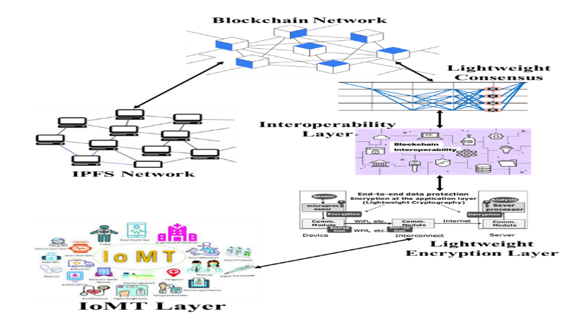
The widespread adoption of the Internet of Medical Things (IoMT) is the main factor that brought about big changes in the healthcare system but also at the same time made the system struggle with major issues like data breaches, device incompatibility, scalability problems, delays, and cyber security risks. The conventional security procedures and central cloud storage systems are always limited if one looks at the throughput, cost of implementation, and failure points along with threats to security that are associated with them. This research proposed a lightweight blockchain-based system for the protection of IoMT data while concurrently tackling the issues of performance and scalability. The proposed system consists of six interconnected layers: IoMT device layer, lightweight encryption layer, interoperability layer, lightweight consensus layer, blockchain network layer, and the InterPlanetary File System (IPFS) storage layer. In this architecture, IPFS has been picked as a replacement for traditional cloud storage with an intention to allow decentralized, tamper-proof, and efficient management of medical data. A lightweight consensus mechanism which is specifically designed for IoMT devices that consume low power and are resource constrained is incorporated into the system to bring down transaction processing overhead and at the same time raise system responsiveness. The proposed framework provides a high level of throughput with a low latency when executing transactions ranging from 50 transactions to 5000 transactions.
References
Aboshosha, B.W., Zayed, M.M., khalifa, H.S. (2025). Enhancing Internet of Things security in healthcare using a blockchain-driven lightweight hashing system. Beni-Suef Univ J Basic Appl Sci 14, 56 (2025). https://doi.org/10.1186/s43088-025-00644-8
Alabdulatif, A. (2025). Blockchain-Based Privacy-Preserving Authentication and Access Control Model for E-Health Users. Information 2025, 16, 219. https://doi.org/10.3390/info16030219
Ba, A.F., Yingchi, M., Muhammad, A.U. (2025). Blockchain federated learning with sparsity for IoMT devices. Cluster Comput 28, 47. https://doi.org/10.1007/s10586-024-04810-y
Cheikhrouhou, O., Mershad, K., Jamil, F., Mahmud, R., Koubaa, A., & Moosavi, S. R. (2023). A lightweight blockchain and fog-enabled secure remote patient monitoring system. Internet of Things, 22, 100691. https://doi.org/10.1016/j.iot.2023.100691
Dobraunig, C., Eichlseder, M., Mendel, F. (2021). Ascon v1.2: Lightweight Authenticated Encryption and Hashing. J Cryptol 34, 33 . https://doi.org/10.1007/s00145-021-09398-9
Farshadinia, H., Barati, A., & Barati, H. (2025). Designing a layered framework to secure data via improved multi-stage lightweight cryptography in IoT–cloud systems. arXiv preprint arXiv:2509.01717. https://arxiv.org/abs/2509.01717
Fugkeaw, S., Wirz, L., & Hak, L. (2023). Secure and lightweight blockchain-enabled access control for fog-assisted IoT cloud based electronic medical records sharing. IEEE access, 11, 62998-63012.
Ghadi, Y.Y., Mazhar, T., Shahzad, T. et al. The role of blockchain to secure internet of medical things. Sci Rep 14, 18422 (2024). https://doi.org/10.1038/s41598-024-68529-x
Jayabalan, J & Jeyanthi, N. (2022). Scalable blockchain model using offchain IPFS storage for healthcare data security and privacy, J. Parallel Distrib. Comput., vol. 164, pp. 152–167, Jun. 2022, https://doi.org/10.1016/j.jpdc.2022.03.009
Khan, M., et al. (2025). Lightweight Privacy Preservation Authentication Protocol for IoMT using ECC. SAGE Journal.
Khatter, K & DevanjaliRelan. (2022). Non-functional requirements for blockchain enabled medical supply chain. Int J Syst Assur Eng Manag 13, 1219–1231 (2022). https://doi.org/10.1007/s13198-021-01418-y
Okoli, F. U., Oludiji, S. M., Ofoegbunam, E. I., Oyesiji, A. O., & Akindiya, O. M. (2024). Blockchain Technology for Land Registration In Nigeria: A Review of Opportunities and Challenges . Fudma Journal of Sciences, 8(6), 252-257. https://doi.org/10.33003/fjs-2024-0806-2919
Oloruntoba, L. J., Obiniyi, A. (2025). Trends in the Application of Blockchain Technology to the Internet of Medical Things (IoMT). Direct Research Journal of Engineering and InformationTechnology,13(3),29-34. https://journals.directresearchpublisher.org/index.php/drjeit/article/view/469
Othman, S.B., Getahun, M.(2025). Leveraging blockchain and IoMT for secure and interoperable electronic health records. Sci Rep 15, 12358 (2025). https://doi.org/10.1038/s41598-025-95531-8
Papaioannou, M., Karageorgou, M., Mantas, G. (2022). A Survey on Security Threats and Countermeasures in Internet of Medical Things (IoMT). Trans Emerging Tel Tech. 2022;33:e4049. https://doi.org/10.1002/ett.4049
Quazi, F., Khanna, A., nalluri, S., & Gorrepati, N. (2024). Data Security & Privacy in Healthcare. International Journal of Global Innovations and Solutions (IJGIS). https://doi.org/10.21428/e90189c8.4e2c586a
Rasheed, A,M., & Kumar, R,M,S. (2025) Efficient lightweight cryptographic solutions for enhancing data security in healthcare systems based on IoT. Front. Comput. Sci. 7:1522184. doi: 10.3389/fcomp.2025.1522184
Reegu, F. A., Abas, H., Gulzar, Y., Xin, Q., Alwan, A. A., Jabbari, A., Sonkamble, R. G., & Dziyauddin, R. A. (2023). Blockchain-Based Framework for Interoperable Electronic Health Records for an Improved Healthcare System. Sustainability, 15(8), 6337.
Robert, W., Denis, A., Thomas, A., Samuel, A., Kabiito, S. P., Morish, Z., & Ali, G. (2024). A comprehensive review on cryptographic techniques for securing Internet of Medical Things: A state-of-the-art, applications, security attacks, mitigation measures, and future research direction. Mesopotamian Journal of Artificial Intelligence in Healthcare, 2024, 135–169. https://doi.org/10.58496/MJAIH/2024/016
Samal, K., Sunanda, S,K, Jena, D., Patnaik, S. (2025) A lightweight privacy preservation authentication protocol for IoMT using ECC based blind signature. International Journal of Engineering Business Management. 2025;17. doi:10.1177/18479790251318538
Singh, S., Sharma, P.K., Moon, S.Y. (2024). Advanced lightweight encryption algorithms for IoT devices: survey, challenges and solutions. J Ambient Intell Human Comput 15, 1625–1642 (2024). https://doi.org/10.1007/s12652-017-0494-4
Stefanescu, D., Montalvillo, L., Galán-García, P., Unzilla, J., & Urbieta, A. (2022). A Systematic Literature Review of Lightweight Blockchain for IoT," in IEEE Access, vol. 10, pp. 123138-123159, 2022, doi: 10.1109/ACCESS.2022.3224222.
Xie, H., Zheng, J., He, T. et al. A blockchain-based ubiquitous entity authentication and management scheme with homomorphic encryption for FANET. Peer-to-Peer Netw. Appl. 17, 569–584 (2024). https://doi.org/10.1007/s12083-024-01624-y
Downloads
Published
Issue
Section
Categories
License
Copyright (c) 2026 Afolayan Ayodele Obiniyi, Leke Joseph Oloruntoba

This work is licensed under a Creative Commons Attribution 4.0 International License.


