
TREE SPECIES DIVERSITY AND DISTRIBUTION PATTERNS OF PROTECTED AREAS OF SAVANNA ECOSYSTEM OF NORTHERN NIGERIA
DOI:
https://doi.org/10.33003/fjs-2026-1006-4779Keywords:
biodiversity assessment, protected areas, savannas, tree density, ecosystem functionAbstract
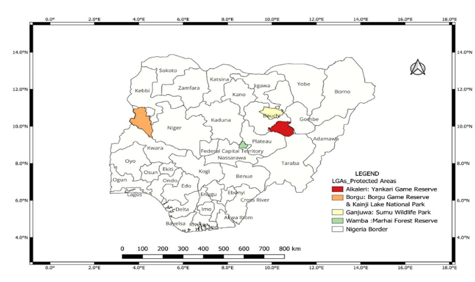
Savanna ecosystems are shaped by complex interactions among disturbances, climate extremes, and management, yet quantitative assessments of their structural and floristic characteristics in Nigeria remain limited. This study, therefore, examined the present status of protected areas (PAs) within the savanna ecological zone of Northern Nigeria, focusing on tree species diversity, abundance, stand structure, density, and distribution patterns with the view of providing information for management and conservation purposes. Data were collected from five randomly selected PAs: Yankari Game Reserve and Sumu Wildlife Park (Bauchi State), Kainji Lake National Park and Borgu Game Reserve (Niger State), and Marhai Forest Reserve (Nasarawa State). A systematic line-transect sampling technique was used, with four 50 m × 50 m plots established at 250 m intervals in alternate directions within each site. All trees with DBH ≥10 cm were measured and identified. A total of 1,051 trees, 71 species and 22 families were recorded. Tree density ranged from 68 to 275 trees ha⁻¹. Combretaceae and Fabaceae were the most dominant families, while Combretum micranthum, Anogeissus leiocarpa, and Vitellaria paradoxa were the most frequent species. Despite low population density, Adansonia digitata contributed substantially to basal area and volume. Kainji recorded the highest Shannon index (3.21), evenness (0.95) and Margalef's index of species richness (6.87). Tree density and height varied significantly (p<0.05), but basal area and DBH did not differ. Strong correlations between structural variables and diversity indices highlight the need to conserve and protect large-tree growth in the Nigerian savanna.
References
Adekunle, V. A. J., Olagoke, A.O. & Akindele, S.O. (2013). Tree Species Diversity and
Structure of a Nigerian Strict Nature Reserve. Tropical Ecology 54(3): 275-289.
Adekunle, V.A.J. (2022). Conservation of tree species diversity in tropical rainforest ecosystem
of South-west Nigeria Journal of Tropical forest science, 18(2), 91-101.
Adeniji, O. A., Irunokhai, E., Adigun, J., & Olorunfemi, S. (2021). Diversity and Abundance of
Tree species of a protected woodland, southern guinea savanna zone, Nigeria. Turkey Journal of Biodiversity 4 (2) 1-8.
Attua, E. M., & Pabi, O. (2013). Tree species composition, richness and diversity in the northern
Forest–savanna ecotone of Ghana. Journal of Applied Biosciences, 69, 5437–5448.
Bassey, S.E., Adedeji, E.T & Adekunle, V.A.J. (2025). Diameter Distribution Models on Carbon
Sequestration potentials of Afi Forest Reserve, Cross River State, Nigeria. Asian Journal of Advanced Research and Reports 19(2): 84-94.
Brashears, M.B., Fajvan,M.A., & Schuler,T.M.(2004). An assessment of Canopy Stratification
and Tree species Diversity Following Clear cutting in Central Appalachian Hardwoods. Forest Science, 50, 54-64.
Bond, W. E., & Parr, C. L. (2010). Beyond the forest edge: Ecology, diversity and conservation
of the grassy biomes. Biological Conservation, 143(10), 2395–2404.
Curtis, J.T. & McIntosh, R.P. (1950). The Interrelations of Certain Analytic and Synthetic Phyto-
Sociological Characters. Ecology, 31, 434-455.
Egbinola, C. N. (2015). Impacts of human activities on tree species composition along the forest-
savanna boundary in Nigeria. Indonesian Journal of Geography, 47(2): 115-123
Hooper, D. U., Chapin III, F. S., Ewel, J. J., Hector, A. Inchausti, P. Lavorel, S. Lawton, J. H.
Lodge, D. M. Loreau, M. Naeem, S. Schmid, B. Setälä, H. Symstad, A. J. Vandermeer, J. Wardle, D. A., (200)5. Effects of Biodiversity on Ecosystem Functioning: A Consensus of Current Knowledge. John Wiley & Sons, Inc.
Husch, B., Beers, T. W., & Kershaw, J. A., Jr. (2003). Forest Mensuration (4th ed.). John Wiley
& Sons.
Ijomah, J. U., Igiri, M. R. & Okey, I. B. (2022). Evaluation of Trees Species Diversity,
Abundance and Soil Physicochemical Properties of Ukpon River Forest Reserves, Cross River, Nigeria. Asian Journal of Research in Agriculture and Forestry Vol. 8(4): 109-122
Leishangthem, D. & Singh, M. R. (2018). Tree Diversity, Distribution and Population Structure
of a Riparian Forest from Certain Zones along the Dikhu River in Nagaland, India. Journal of Forest and Environmental Science 34(1): 31-45
Maiguru, A. A. & Akpan, J.J. (2023). Evaluation of Tree Species Composition and Density in
Bisaula Forest Reserve Taraba State, Nigeria, Journal of Engineering and Computer Sciences, 1(5): 47-53.
Margalef, R. (1958) Information Theory in Ecology. General Systems, 3, 36-71.
Magurran, A. E. (2004). Measuring biological diversity. Blackwell Publishing.
Modibbo, M.A & Shahidah, M. A. (2018). Assessing the forest cover changes of Yankari
Game Reserve using remote sensing and GIS techniques. ARPN Journal of Engineering and Applied Sciences, 13(5):1631-1638.
Nabaloum, A., Goetze, D., Ouédraogo, A., Porembski, S., & Thiombiano, A. (2022). Local
perception of ecosystem services and their conservation in Sudanian savannas of Burkina Faso (West Africa). Journal of Ethnobiology and Ethnomedicine, 18, Article 8.
Nwaigbo, L C., ((1989). Human and Animal Impacts on Vegetation and Forage Plants in the
Southern Guinea Savanna of Nigeria. IGC Proceedings 31.
Ogunjemite, B.G (2015). Assessment of floristic composition of Ologbo Concession, Edo State,
Nigeria, for conservation planning, Revue Scientifique et Technique Forêt et Environnement du Bassin du Congo 4:10-19.
Parresol, B. R. (1995). Basal area growth for 15 tropical tree species in Puerto Rico. Forest
Ecology and Management, 73, 211–219.
Pielou, E.C. (1966) The measurement of diversity in different types of biological collections,
Journal of Theoretical Biology, Volume 13, 131-144.
Sankaran, M., Hanan, N.P., Scholes, R.J., Ratnam, J., Augustine, D.J., Cade, B.S., Gignoux, J.,
Higgins, S.I. & Le Roux, X. (2005). Determinants of woody cover in African savannas. Nature. 438 (7069): 846–849.
Shannon, C. E. (1948) A mathematical theory of communication. The Bell System Technical
Journal, 27, 379–423 and 623–656.
Simpson, E. (1949) Measurement of Diversity. Nature 163, 688.
Shuaibu, R. B. (2014). Status of Tree Diversity in Idah Local Government Area of Kogi State,
Nigeria. Applied Tropical Agriculture 19 (2): 71-76.
Shuaibu, R. B., Jatau, D. F. & Saka, M. G (2021). Development of allometric models for
above-ground biomass estimation of Adansonia digitata (baobab) in Sudano-Sahelian region of Nigeria. Applied Tropical Agriculture, 26(1), 30-42
Wakawa, L., Suleiman, A, Ibrahim, Y & Adam, L (2017). Tree Species Biodiversity of a
Sahelien Ecosystem in North-East Nigeria, Journal of Bartin Faculty of Forestry, 19(2): 166-173.
Zankan, J. A. A, Endas, L., Abubakar, Y. M. & Yakubu, I. B. (2019). Tree Species Density and
Diversity in Jemaa Local Government Area of Kaduna State, Nigeria. FUDMA Journal of Science, Vol. 3 No. 2, pp 302 – 311.
Downloads
Published
Issue
Section
Categories
License
Copyright (c) 2026 Faithful Olayinka Iyagin, Victor Adekunle, Amadu Lawal, Jerry Idoko Alfa

This work is licensed under a Creative Commons Attribution 4.0 International License.