
FIRST ISOLATION OF LUPEOL FROM THE ETHYL ACETATE SOLUBLE FRACTION OF THE METHANOL ROOT BARK EXTRACT OF Pterocarpus erinaceus (POIR)
DOI:
https://doi.org/10.33003/fjs-2026-1004-4743Keywords:
Column chromatography, hemorrhoid, Isolation, Lupeol, Pterocarpus erinaceusAbstract
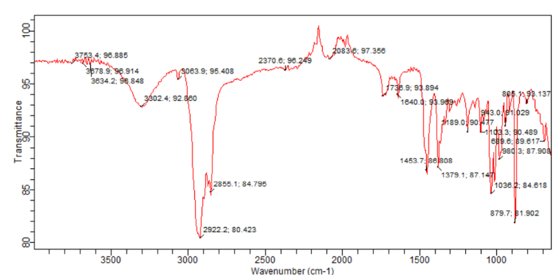
Lupeol, a known pentacyclic triterpenoid was isolated from ethyl acetate soluble fraction of the methanol extract of the root-bark of Pterocarpus erinaceus. The plant is used in ethno-medicine to treat inflammation, hemorrhoid, cancer, wounds healing, worm expulsion and abdominal pain. One kilogram (1.0 kg) of the plant material was extracted with 2.5 L of methanol yielding 100 g (10.0 %) of the methanol extract using cold maceration method. The methanol extract was partioned with ethyl acetate and n- hexane yielding 20.5 g (2.05 %) and 15.6 g (1.56. %) respectively. Fifteen (15 mg) of 6.0 g (0.25 %) of the ethyl acetate soluble fraction was isolated by a combination of thin layer chromatography (TLC), column chromatography (CC) and preparative thin layer chromatography (PTLC). The structure of the compound which was coded as PEB2 was determined by analyses of its FTIR and MS spectral data as well as comparison with reported literature. FTIR showed broad absorption frequency at 3302.4 cm-1 which is typical of a hydroxyl group. A fairly intense bands at 2922.2 cm-1 and 2851.4 cm-1 that can be assigned to an aliphatic C-H (stretch) was observed. The C=C vibration frequency was observed at 1640.0 cm-`1. Mass spectral data gave a molecular formula C30H50O with m/z 426. The compound appeared as white needle- like crystal with melting point of 217-218oC. The compound was further confirmed by positive Liebermann - Buchard test for triterpenoid. This is the first report of isolation of Lupeol from the root bark of Pterocarpus erinaceus.
References
Abubakar, A. R., Haque, M., Yusuf, A. B., & Sani, I. H. (2019). Traditional herbal medicine use among hypertensive patients in Nigeria: A survey of the literature. Frontiers in Pharmacology, 10, 686.
Ahlam, E., Rawa, Z., & Sherif, A. (2011). Phytochemical and pharmacological studies of Ficus auriculata Lour. Journal of Natural Product, 4: 184-195
Akinmoladun, F. O., Akinrinlola, B. L., & Farombi, E. O. (2020). Phytochemical constituents and medicinal potential of Nigerian ethnomedicinal plants: Focus on Pterocarpus erinaceus. Nigerian Journal of Natural Products and Medicine, 24, 75–85.
Arowosegbe, S., & Olaleye, T. M. (2017). Phytochemical Constituents and Antimicrobial Activity of Pterocarpus erinaceus stem bark extracts. BMC Complementary and Alternative Medicine, 17(1), 24.
Bani, S, Kaul, A., Khan, B., Ahmad, S. F., Suri, K. A., Gupta, B. D., Satti, N.K., & Qazi, G. N (2006). Suppression of T lymphocyte activity by lupeol isolated from Crataeva Religiosa, Phytotherapy Research, 20: 279-287
Carvalho, T.C., Polizeli, A. M., Turatti, I. C. C., Severiano, M. E., Carvalho. C. E., & Ambrosio, S. R. (2010). Screening of filamentous Fungi to Identify Biocatalysts for Lupeol Biotransformation. Molecules, 15 (9): 6140–6151
Dalziel, J. M (2007). The useful plants of West tropical Africa. The crown agents dor the colonies, London P. 612
Dhawan, D., & Gupta, J. (2017). Comparison of different solvents for extraction potential from Datura metal plant Leaves. International Journal of Biological Chemistry, 11, 17-22
El Sayed, A. M. (2016). Leaves of Schinus polygamous (Cav.) Cabrera (Anacardiaceae) are a potential source of hepatoprotective and antioxidant phytochemicals. Journal of Medicinal Plants Research, 10:223–231
Gabriel, A. F, & Onigbanjo, H. O. (2010). Phytochemical and Antimicrobial Screening of the Stem Bark extract of Pterocarpus erinaceus (Poir) Nigerian Journal of basic and applied science, 18 (1): 1-5
Harish, BG; Krishna, V; Kumar, H. S. S., Ahamed, B. M. K; Sharath, R., & Swamy, H. M. (2008). Wound healing activity and docking of glycogensynthase-kinase-3-ˇ-protein with isolated triterpenoid lupeol in rats, Phytomedicine.15: 76-767.
Hifzur, S., & Mohammad S., (2011). Beneficial health effects of Lupeol triterpene: A review of preclinical studies, Life Sciences, 88, 285–293
Howes, M. J. R. (2017). Phytochemicals as anti-inflammatory nutraceuticals and phytopharmaceutical. In Immunity and Inflammation in Health and Disease: Emerging
Roles of Nutraceuticals and Functional Foods in Immune Support. Elsevier Inc.
https://doi.org/10.1016/B978-0-12-805417-8.00028-7
Irvin, F.R. (2005). Woody plants of Ghana. Oxford University Press. London. P.868
Jasiem, T. M. (2018). Isolation of terpene and pharmacognostical study of Iraqi caper shrubs (Capparis spinosa) L. Research Journal of Pharmacy and Technology, 11(6):2388-92.
Kiria, M. J. (2018). Antimicrobial Activity and Constituents of the Root Bark of Loncocarpus eriocalyx. MSc Thesis, University of Nairobi, Nairobi, Kenya
Kouadio, F., Konan, B. A., N’guessan, J. D., & Djaman, A. J. (2022). Evaluation of Antimicrobial Activity of Pterocarpus erinaceus Bark and Roots used in Ivorian traditional medicine. African Journal of Traditional, Complementary and Alternative Medicines, 19 (1), 23–30.
Leite, S. P., Adami, T. B., Bjerk, T. R, dos Reis Souza, M. R., Cardoso, C. A. L., Krause, L. C., & Caramao, E. B. (2020). Ultrasonic Assisted Extraction of Bioactive Compounds from different Parts of Hancornia speciosa Gomes. Journal of Medicinal Plants Research 14 (7):300–308
Nadembega, P., Boussim, J. J., Nikiena, J. B., Poli, F., & Antogeni, F. (2011). Medicinal plants in Baskoure, Kourittenga province, Burkina Faso: an ethnobotanical study. Journal of Ethnopharmacology, 133, 378-395
Noor, A K., Widad, M. K. A., & Ibrahem, S A. (2019). Detection of Lupeol in Calendula Officinalis Grown in Iraq by GC-MS Analysis. Al Mustansiriyah Journal of Pharmaceutical Sciences, 19 (4): 69-76.
Orwa, C., Mutua, A., Kindt, R., Jamnadas, R., & Simons, A. (2019). Agroforestry database: A tree species reference and selection guide version. World Agroforestry centre International Centre for Research in Agroforestry, Nairobi, Kenya P. 340
Osei, D., Darko, G., & Frimpong-Manso, J. (2020). Isolation and characterization of bioactive compounds from Pterocarpus erinaceus and evaluation of their antimicrobial properties. International Journal of Phytomedicine, 12 (1): 88–95.
Palanimuthu, D., Baskaran, N., Silvan, S., Rajasekaran, D., & Manoharan, S. (2012). Lupeol a bioactive triterpene prevents tumor formation during 7,12- dimethyl Benz(a) anthracene-induced oral carcinogenesis, Pathology and Oncology Research, 18: 1029 – 1037.
Saleem, M (2009). Lupeol, a novel anti-inflammatory and anti-cancer dietary triterpene. Cancer Letters, 285: 109–115.
Silverstein, R. M., Webster, F. X., Kiemle, D. J., & Bryce, D. L. (2014). Spectrometric Identification of Organic Compounds. John wiley & sons, New Jersey, USA
Sudhahar, V; Kumar, SA; Mythili, Y; Varalakshmi, P. (2007). Remedial effect of lupeol and its ester derivative on hypercholesterolemia-induced oxidative and inflammatory stresses, Nutrition Research Journal. 27: 778-787.
Sudhahar, V; Kumar, SA; Varalakshmi, P (2008). Role of lupeol and lupeol linoleate on lipemicoxidative stress in experimental hypercholesterolemia. Life Sciences, 78:1329-1335
Tsai, F. S., Lin, L. W., & Wu, C. R. (2016). Lupeol and its role in chronic diseases. In Advances in Experimental Medicine and Biology (Vol. 929). https://doi.org/10.1007/978-3-319-41342-6_7
Uba, A., Sulaiman, M. A., & Bello, A. I. (2020). Preliminary Phytochemical Screening and Antimicrobial Properties of Pterocarpus erinaceus. Bayero Journal of Pure and Applied Sciences, 13 (2): 167–
Downloads
Published
Issue
Section
Categories
License
Copyright (c) 2026 Manasseh Bidam Yakubu, James Yusuf, Victor Abarau Rwuaan

This work is licensed under a Creative Commons Attribution 4.0 International License.


