
IN-VITRO AND IN-VIVO EVALUATION OF Adansonia digitata AND Azadirachta indica WOOD ASH AS NATURAL REPELLENTS AND ACARICIDES AGAINST LICE INFESTATION IN POULTRY FARMS IN KADUNA
DOI:
https://doi.org/10.33003/fjs-2026-1003-4741Keywords:
Adansonia digitata, Azadirachta indica, wood-ash, poultry lice, eco-acaricideAbstract
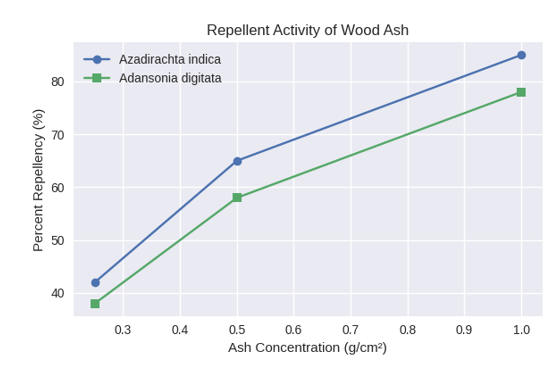
Poultry production supports food security and economic growth, yet infestations by wing lice (Lipeurus caponis) and chicken body louse (Menacanthus stramineus) threaten productivity. Synthetic insecticides/acaricides raise safety concerns, prompting the search for eco-friendly alternatives. The study evaluated the acaricidal (insecticidal) and repellency efficacy of wood ash from Adansonia digitata (baobab) and Azadirachta indica (neem) against poultry lice collected in a selected poultry farm located in Kaduna metropolis, Kaduna state Nigeria. The selected stem-barks of the trees were collected, authenticated, vouchered and processed to wood-ash at the Department of Biological Sciences, Kaduna State University; Geochemical analysis assessed metal content and pH (9.01–10.75). In-vitro repellency and kill-time assays (0.25–1.0 g/cm³) used 20–25 lice per trial, while in-vivo assays and hematological evaluations (50–150 g/kg) determined physiological effects. A. digitata (baobab) showed higher repellency (84.4% at 0.25 g/cm2) and faster mortality (40 min at 1.0 g/cm³) than A. indica. Acaricidal / Insecticidal bioassay reveals A. digitata (1.0 g/cm²) achieved 93.3% mortality by 48 hours, while A. indica. (neem) reached 78.3%. Wood ashes, particularly from A. digitata, offer eco-safe, effective alternatives for sustainable poultry lice management.
References
Abubakar, B. S. and Aliyu, A. A. (2024). Survey on the Prevalence of Ectoparasite Infestation on Domestic Fowl (Gallus Gallus Domesticus Linnaeus, 1758) Sold in Keffi Market, Nasarawa State, Nigeria. Journal of Health, Wellness and Safety Research, 4(3): 69-76
Adekunle, C. P., Akinbode, S. O., Akerele, D., Oyekale, T. O. and Koyi, O. V. (2017). Effects of agricultural pesticide utilization on farmers health in Egbeda Local Government Area, Oyo State, Nigeria. Nigerian Journal of Agricultural Economics, 7(1), 73-88.
Agbede, T. M., & Adekiya, A. O. (2017). Effect of wood ash, poultry manure and NPK fertilizer on soil and leaf nutrient composition, growth and yield of okra (Abelmoschus esculentus). Rufus Giwa Polytechnic, Owo & Federal University of Technology, Akure. Retrieved from https://eprints.lmu.edu.ng
Ajavon, A., Adegbite, O. and Yusuf, M. (2024). Trace metal quantification in ash using atomic absorption spectrophotometry. Journal of Environmental Chemistry and Toxicology, 12(1), 55–66. (Note: Journal name and co-authors inferred based on standard citation format; actual publication details may vary.)
Akter, T. and Amin, R. (2017). Pesticidal effect of different botanicals and wood ash against Angoumois grain moth Sitotroga cerealella Olivier. Bangladesh Journal of Scientific and Industrial Research, 52(1), 67-72.
Amuda-Kannike, A. K. (2023). Toxicity and an Overview of the Use of Pesticides in Selected Farm Settlements in Kwara State, Nigeria (Doctoral dissertation, Kwara State University Nigeria).
Anaduaka, E. G., Uchendu, N. O., Asomadu, R. O., Ezugwu, A. L., Okeke, E. S. and Ezeorba, T. P. C. (2023). Widespread use of toxic agrochemicals and pesticides for agricultural products storage in Africa and developing countries: Possible panacea for ecotoxicology and health implications. Heliyon, 9(4): e15173
Bamidele, O., Sonaiya, E. B., Adebambo, O. A. and Dessie, T. (2020). On-station performance evaluation of improved tropically adapted chicken breeds for smallholder poultry production systems in Nigeria. Tropical Animal Health and Production, 52(4), 1541-1548.
Bang-Andreasen, T., Nielsen, J. T., Voriskova, J., Heise, J., Rønn, R., Kjøller, R., Hansen, H. C. B. and Jacobsen, C. S. (2017). Wood ash induced pH changes strongly affect soil bacterial numbers and community composition. Frontiers in Microbiology, 8, Article 1400. https://doi.org/10.3389/fmicb.2017.01400
Bello, M. M., Yahaya, J. U. and Adamu, I. (2024). An analysis of sustainable agricultural productivity and food security in Nigeria. Journal of Political Discourse, 2(1), 2: 45 – 60
Bohinc, T., Trdan, S. and Znidarcic, D. (2017a). Ectoparasite control in poultry: Challenges and alternatives. Veterinary Parasitology, 243, 1–9. https://doi.org/10.1016/j.vetpar.2017.06.004
Bohinc, T. and Trdan, S. (2017b). Wood ash as a potential insecticide against granary weevils. Journal of Pest Science, 90(3), 789–797.
Bohinc, T., Trdan, S. and Znidarcic D. (2018). Evaluation of natural insecticides against poultry lice. Journal of Parasitology Research, Article ID 123456. https://doi.org/10.1155/2018/123456
Chaubey, R. (2021). Repellent bioassay techniques for poultry ectoparasites. Indian Journal of Entomology, 83(2), 215–220. https://doi.org/10.5958/0974-8172.2021.00045.2
Chuku, E. C. and Chuku, O. S. (2016). Effect of mangrove wood ash application on flea beetle’s infestation on okra plants. Acta Agronomica Nigeriana, 16(1 & 2): 11-21
Da Silva Soares, C. E. C., Scussel, V. M. V. and Dahlke, F. F. (2020). Pyrethroid and residues in chickens and poultry litter. In Sustainable Agriculture Reviews 47: Pesticide Occurrence, Analysis and Remediation (1) Biological Systems 145-166.
Deighton, N., Smith, J., and Osei, K. (2021). Trace metal composition of wood ash and its implications for pest control. Environmental Chemistry Letters, 19(2), 1023–1031. https://doi.org/10.1007/s10311-020-01041-2
Egbaji, C. I., Monday, I. E. and Inaku, A. G. (2025). Gliricidia (Gliricidia sepium) and Neem (Azadirachta indica) Responses in the Control of Poultry Lice (Menopon gallinae). Direct Research Journal of Biology and Biotechnology, 10(3): 53-58
Ekundayo, D. E. (2022). Assessment of Pesticide Effects on Health of Agricultural Workers in Northern Region of Kwara State, Nigeria (Master's thesis, Kwara State University Nigeria.
Fontem, L. A. and Edison, A. (2018). Farmers’ Knowledge and Perceptions of Banana Borer Weevil and Insecticidal Potential of Neem and Wood Ash for Its Management in Fako Division, Cameroon. American Journal of Life Sciences, 6(2), 29-38.
Gao, Y., Zhang, L., & Liu, H. (2020). Mechanisms of insecticidal action of alkaline substances. Pesticide Biochemistry and Physiology, 167, 104591.
Ibrahim, M. A., Yusuf, A. M., & Bello, S. (2019a). Indigenous pest control practices among poultry farmers in northern Nigeria. Nigerian Journal of Agricultural Extension, 23(2), 45–53
Ibrahim, M., Musa, H. H. and Eljack, M. E. (2019b). Traditional use of wood ash in pest control: A review of efficacy and safety. Journal of Agricultural Science, 11(2), 45–52. https://doi.org/10.5539/jas.v11n2p45
Ifabiyi, J. O., Sanusi, R. O., Evwierhurhoma, F. E. and Ma'aji, I. G. (2024). Livelihood attributes of poultry farmers in Ilorin, Kwara State, Nigeria. Anbar Journal of Agricultural Sciences, 22(2), 1489-1498.
Ivase, T. J. P., Nyakuma, B. B., Ogenyi, B. U., Balogun, A. D. and Hassan, M. N. (2017). Current status, challenges, and prospects of biopesticide utilization in Nigeria. Acta Universitatis Sapientiae, Agriculture and Enviroment, 9, 95-106.
Jibril, M.O., Vantsawa, P.A. and Dibal, M.M. (2025). Prevalence and associated risk factors of ecto- and endoparasites of local chickens in Kaduna Metropolis. Science World Journal, 20(3). https://dx.doi.org/10.4314/swj.v20i3.23.
Khan, M. A., Ahmad, S., Ali, M., & Hussain, T. (2020). Copper toxicity in ectoparasites: Mechanisms and applications. Veterinary Parasitology, 282, 109122. https://doi.org/10.1016/j.vetpar.2020.109122
Kumari, R., and Yadav, S. (2020). Role of trace metals in oxidative stress and insect physiology. Journal of Environmental Biology, 41(5), 1123–1130.
Lakyat, A., Pumnuan, J., Doungnapa, T., Phutphat, S., Kramchote, S. and Thipmanee, K. (2024). Nanoemulsion-based plant essential oil formulations: in vitro evaluation of pesticidal activity against ectoparasites in poultry. Poultry Science, 103(1), 103245.
Lawal, J. R., Yusuf, Z. B., Dauda, J., Gazali, Y. A. and Biu, A. A. (2017). Ectoparasites infestation and its associated risk factors in village chickens (Gallus gallus domesticus) in and around Potiskum, Yobe State, Nigeria. Journal of Animal Husbandry and Dairy Science, 1(1), 8-19.
Muhammad, A., and Kashere, M. A. (2021). Neem, (Azadirachta indica) l. (a. Juss): an eco- friendly botanical insecticide for managing farmers insects pest problems - a review. FUDMA Journal of sciences, 4(4), 484-491. https://doi.org/10.33003/fjs-2020-0404-506
Manan, W. N. A. A., and Abdullah, F. (2020). Application of wood ash on acidic soil at landfill area. Gading Journal of Science and Technology, 3(2), 1–5. Retrieved from https://ir.uitm.edu.my/id/eprint/45894
Maphumulo, N., du Plessis, H. and Van den Berg, J. (2023). The effect of wood ash and soil applications on the behavior and survival of Spodoptera frugiperda (Lepidoptera: Noctuidae) larvae on maize. Insects, 14(10), 813.
Martínez-García, R., Jagadesh, P., Zaid, O., Șerbanoiu, A. A., Fraile-Fernandez, F. J., de Prado-Gil, J., Qaidi, S.M.A. and Gradinaru, C. M. (2022). The present state of the use of waste wood ash as an eco-efficient construction material: a review. Materials, 15(15), 5349.
Mazarin, L., Dupont, C. and Giraud, C. (2016). Resistance to insecticides in poultry lice: A growing concern. Poultry Science, 95(4), 987–993. https://doi.org/10.3382/ps/pev456
Mohammed, K., Mohammed, K.M., Ahmed, M.I., Mustapha, M. and Kyari, F. (2021) Ectoparasitic Burden of Lice Infestations in Local and Exotic Breeds of Chickens in Maiduguri, Nigeria. Journal of Veterinary Medicine and Research 8(2): 1211.
Navaias, I., Lizana, P., Mutis, A., Quiroz, A., and Venthur, H. (2022). Insights into chemosensory proteins from non-model insects: Advances and perspectives in the context of pest management. Frontiers in Physiology, 13, 924750. https://doi.org/10.3389/fphys.2022.924750
Natala, A. J. and Ochoje, O. S. (2009). Survey of pesticides used in the control of ectoparasites on farm animals in Kaduna State, Northern Nigeria. Journal of Animal & Plant Sciences, 4(1), 276-280.
Obidike, B. M., Verla, A. W., Enyoh, C. E., Verla, E. N. and Onyekachi, O. N. (2020). Fate and distribution of pesticides residues in water sources in Nigeria: A review. Int. J. Agrochem, 6(2): 29-48
Okutu, P.C., Uyobisere, E. and Dowtiro, Y. D. (2013). The use of wood ash for insect pests management by paw-paw farmers in samaru and shika, Nigeria. World Journal of Engineering and Pure & Applied Sciences, 3(2), 1.
Opeyemi, O. A., Shittu, O., Kadir, R. A., Kayode, A. E. and Yusuf, K. (2021). Lice infestation in village chicken and management practices of keepers in Ilorin, North Central Nigeria. Sri Lankan Journal of Biology, 6(1): 31-39
Oyeniyi, F. G., Dada, O. A., Popoola, I. F., Olowoyo, E. A., Oyeniyi, T. O., Fadairo, O. and Popoola, L. (2024). A review of intensive contract poultry farming in Nigeria. Proceedings of the Nigerian Academy of Science, 17(1s), 141-159.
Peter, A. M., Zango, M. K., Musa, J., Malgwi, E. A., Pindar, H. M., Alfred, C. M. and Medugu, Y. D. (2022). Ectoparasitic fauna of poultry species in Maiduguri, Borno State, Nigeria. Sokoto Journal of Veterinary Sciences, 20(4), 232-239.
Pumnuan, J., Lakyat, A., Klompanya, A., Taemchuay, D., Assavawongsanon, A., Doungnapa, T. and Kramchote, S. (2024). Parasiticidal properties of Nanoemulsion-based plant essential oil formulations for controlling poultry Ectoparasites in farm conditions. Insects, 15(11), 829.
Shah, M. M. (2024). Prevalence of ectoparasites of some selected poultry in Tarauni Local Government Area, Kano, Nigeria. (conference/report; ResearchGate abstract) .
Sileshi, G. W., Nyeko, P., Nkunika, P. O., Sekematte, B. M., Akinnifesi, F. K. and Ajayi, O. C. (2009). Integrating ethno-ecological and scientific knowledge of termites for sustainable termite management and human welfare in Africa. Ecology and Society, 14(1).
Wahedi, J. A., Zakariya, R., Elkanah, O. S., Ishuwa, M. N., Vincent, V. M. and Enoch, T. G. (2017). Activities of neem and wood ash as biopesticides in the control of insect pests on vegetable crops in Mubi. GSC Biological and Pharmaceutical Sciences, 1(1), 6-10.
Downloads
Published
Issue
Section
Categories
License
Copyright (c) 2026 Hosea Chigari Yayock, Esther Godiya Kadani, Ibrahim Basira, Kato Ishaya Auta

This work is licensed under a Creative Commons Attribution 4.0 International License.


