
PROXIMATE COMPOSITION, HEAVY METAL CONTENT AND MACROELEMENT PROFILE OF CHICKEN FEED SUPPLEMENTS FROM Egeria radiata(CLAM) AND Tympanotonus fuscatus (PERIWINKLE) SHELLS
DOI:
https://doi.org/10.33003/fjs-2026-1003-4732Keywords:
Egeria radiata, Heavy metals, Macroelement composition, Poultry nutrition, Proximate composition, Tympanotonus fuscatusAbstract
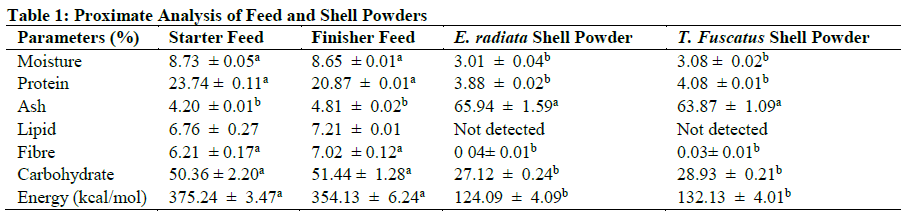
Poultry farming relies on feed supplements to maximize .growth by providing nutrients which may be lacking in their basic diets. This study evaluated the nutritional composition and safety characteristics of mollusk shell powders from Egeria radiata (clam) and Tympanotonus fuscatus (periwinkle) as alternative calcium supplements for poultry feed. Clams and periwinkles were collected from Ishiet River in Akwa Ibom State, processed into fine powder, and subjected to comprehensive proximate analysis, macroelements composition and heavy metal screening following standard methods. Results revealed that shell supplements exhibited predominant mineral composition with significant (p < 0.05) elevated ash content, relative to standard feed. Calcium and potassium content were also significantly (p < 0.05) higher in the shells compared to standard feed. T. fuscatus shells demonstrated significantly (p < 0.05) elevated iron content in comparison to E. radiata and feed. Heavy metal concentrations were below WHO/FAO permissible limits, with no detectable cadmium. Shell supplements demonstrated significantly (p < 0.05) low moisture content, and protein levels, likely representing residual organic matrix proteins. From the findings, it can be concluded that shell preparations had favourable compositional and safety characteristics. Nevertheless, controlled feeding trials remain essential for validating biological efficacy, establishing optimal inclusion rates, and assessing long-term performance outcomes in commercial poultry production systems.
References
Addadi, L., Joester, D., Nudelman, F. and Weiner, S. (2006). Mollusk shell formation: a source of new concepts for understanding biomineralization process. Chemistry, 12(4):980-7.
Adeyemi, S. O. and Sogbesan, A. O. (2014). Nutritive value of some aquatic macro-invertebrates as fishfeed resources in Nigeria. African Journal of Biotechnology, 13(5), 625–634.
American Public Health Association. (1995). Standard methods for the examination of water and wastewater (19th ed.). APHA.
AOAC International. (1984). Official methods of analysis (14th ed.). Association of Official Analytical Chemists.
Ayalew, H., Zhang, H., Wang, J., Wu, S., Qiu, K., Qi, G., Tekeste, A. and Karangiya, D. M. (2022). Potential feed additives as antibiotic alternatives in broiler production. Frontiers in Veterinary Science, 9, 916473.
Effiong, M. E., Akpan, E. R., and Etuk, I. F. (2021). Determination of calcium carbonate content in shells of periwinkle (Tympanotonus fuscatus) and clam (Egeria radiata) from Cross River estuary, Nigeria. Asian Journal of Applied Chemistry Research, 8(1), 30-37.
Ekpo, N. D., Udoinyang, E. P., Ating, E. A., Archibong, I. J., Ukpong, N. C., Uno, A. U. and Essien, U. B. (2026). Influence of Ecotoxicological stressors on shrimp community dynamics in a polluted Niger Delta Estuary - Iko River, Eastern Obolo, Nigeria. Journal of Public Health and Toxicological Research, 3(1), 184–195.
FAO and WHO. (1989). Classification of foods and animal feeds. CXA 4-1989. Codex Alimentarius Commission. Rome.
Gupta, S., Sharma, R. K. and Patel, M. N. (2021). Heavy metal contamination in feed supplements: Sources, health implications, and mitigation strategies. Animal Feed Safety Review, 45(3), 234-251.
Khan, Z., Sultan, A., Khan, R., Khan, S. I. and K. F. (2016). Concentrations of Heavy Metals and Minerals in Poultry Eggs and Meat Produced in Khyber Pakhtunkhwa, Pakistan. Meat Science and Vet Public Health. 1(1):4.
Lichovníková, M., Jandásek, J. and Jůzl, M. (2020). The effect of dietary calcium source and particle size on tibia and femur characteristics in laying hens. Czech Journal of Animal Science, 65(8), 305-313.
Marin, F., Le Roy, N. and Marie, B. (2012). The formation and mineralization of mollusk shell. Frontiers in Bioscience, 4, 1099-1125.
National Research Council (NRC). (1994). Nutrient requirements of poultry (9th rev. ed.). National Academy Press.
Opeh, P. A. and Udo, I. U. (2011). Proximate and mineral composition of two edible bivalve molluscs (Egeria radiata and Cardium costatum) from the Cross River, Nigeria. International Journal of Science and Nature, 2(1), 24-27.
Proszkowiec-Weglarz, M. and Angel, R. (2013). Calcium and phosphorus metabolism in broilers: Effect of homeostatic mechanism on calcium and phosphorus digestibility1. The Journal of Applied Poultry Research, 22(3), 609-627.
Rumbeiha, W. K. and Oehme, F. W. (2017). Heavy metals. In R. C. Gupta (Ed.), Reproductive and developmental toxicology (pp. 485-502). Academic Press.
Singh, A., Kumar, P. and Sharma, V. (2020). Feed contamination and safety concerns in modern poultry production. World Poultry Science Journal, 76(2), 289-305.
Taylor, J. D., Williams, S. T., Glover, E. A. and Dyal, P. (2007). A molecular phylogeny of heterodont bivalves (Mollusca: Bivalvia: Heterodonta): New analyses of 18S and 28S rRNA genes. Zoologica Scripta, 36(6), 587-606.
Udoinyang, E. P., Okon, A. O., Akinjogunla, V. F. and Isangedighi, R. F. (2022). Proximate and selected mineral compositions in Periophthalmus barbarus from the Ibaka mangrove ecosystem, Akwa-Ibom State, Nigeria. Journal of Innovative Research in Life Sciences. 4(1):80-91
Walk, C. L., Bedford, M. R. and McElroy, A. P. (2012). Influence of limestone and phytase on broiler performance, gastrointestinal pH, and apparent ileal nutrient digestibility. Poultry Science, 91(6), 1371-1378.
Downloads
Published
Issue
Section
Categories
License
Copyright (c) 2026 Esu A. Ubong, Orji O. Blessing, Etim E. Oboso, Ekpo D. Ndifreke, Bassey E. Utibe

This work is licensed under a Creative Commons Attribution 4.0 International License.


