
ASSESSMENT OF THE NUTRITIONAL VALUES AND PROXIMATE ANALYSIS OF THE AFRICAN BLACK OLIVE (Canarium schweinfurthii linn) (ATILI) OIL SOLD AT DANTSE, GANAWURI MARKET OF RIYOM LOCAL GOVERNMENT AREA, PLATEAU STATE, NIGERIA
DOI:
https://doi.org/10.33003/fjs-2026-1003-4721Keywords:
Olive oil, proximate, Analysis, nutrientsAbstract
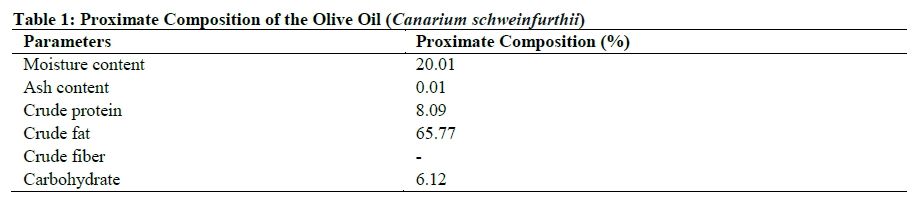
The olive tree has global significance and high economic value because of its oil, which has a centuries-long history in the Mediterranean diet and is widely consumed worldwide. Alongside the economic value to the national economy of many countries, olive oil also serves as an important food in terms of its nutritional value. Olive oil extracted from the ripe fruit (Canarium schweinfurthii) is a liquid fat obtained from Olives. It is commonly used in cooking particularly, frying food or as a salad dressing. Despite the wide consumption of black olive fruits and their oil in the study area, the nutritional values have not been sufficiently investigated. Therefore, the study was to determine the nutritional and proximate values of the black Olive oil sold in Ganawuri market in Riyom Local Government Area of Plateau State using standard laboratory methods. The result of nutritional analysis indicated that olive oil had crude fat of 65.77%, protein of 8.09% crude fibre of 0%, and carbohydrate of 6.12%. The proximate analysis indicated that the olive oil had no calcium and phosphorus as it was negative (-) or 0%. The consumption of black olive oil due to its nutritional benefits is therefore justified and should be encouraged.
References
Al-Bachir, M. & Sahloul, H. (2017). Fatty acid profile of olive oil extracted from irradiated and non-irradiated olive fruits, International Journal of Food Properties, 20:11, 2550- 2558, DOI: 10.1080/10942912.2016.1243557
AOAC Association of Official Analytical Chemists (2016). Official Methods of Analysis of the AOAC. 20th edn. (Gaithersburg, S. edn) In: Washington DC USA. PP.78-90.
Centrone, M., Ranieri, M., Di Mise, A., D'Agostino, M., Venneri, M., Valenti, G., & Tamma, G. (2021). Health benefits of olive oil and by-products and possible innovative applications for industrial processes. Functional Foods in Health and Disease, 11(7), 295-309.
Damián, M., Damián, B. & Romina, B. (2019). Nutritional profile and nutraceutical components of olive (Olea europaea L.) seeds. J Food Sci Technol 56, 4359–4370 https://doi.org/10.1007/s13197-019-03904-5
Davis, C.; Bryan, J.; Hodgson, J.; Murphy, K. (2015). Definition of the Mediterranean Diet; a Literature Review. Nutrients, 7, 9139–9153
Denis, M and Hamptom, M. (2019). Olive Oil and Health Benefits 3r edn.CRC Press. P 12
Díaz-Curiel, M., Torrubia, B., Martín-Fernández, M., Rubert, M., & Piedra, C. D. L. (2020). Effects of virgin olive oil on bone health in ovariectomized rats. Nutrients, 12(5), 1270.
Foscolou, A, Critselis, E. & Panagiotakos, D. (2018). Olive oil consumption and human health: A narrative review; Maturitas, 118, 60-66
Garcia-Martinez, O., Ruiz, C., Gutierrez-Ibanez, A., Illescas-Montes, R., & Melguizo- Rodriguez, L. (2018). Benefits of olive oil phenolic compounds in disease prevention. Endocrine, Metabolic & Immune Disorders-Drug Targets (Formerly Current Drug Targets-Immune, Endocrine & Metabolic Disorders), 18(4), 333-340.
Gavahian, M., Khaneghah, A. M., Lorenzo, J. M., Munekata, P. E., Garcia-Mantrana, I., Collado, M. C. & Barba, F. J. (2019). Health benefits of olive oil and its components: Impacts on gut microbiota antioxidant activities, and prevention of noncommunicable diseases. Trends in food science & technology, 88, 220-227.
Guo, Z., Jia, X., Zheng, Z., Lu, X., Zheng, Y., Zheng B. & Xiao, J. (2018). Chemical composition and nutritional function of olive (Olea europaea L.): a review. Phytochem Rev 17, 1091– 1110.
Gorzynik-Debicka, M., Przychodzen, P., Francesco Cappello, F., Kuban-Jankowska, A., Stefanska, B.; Karlic, H.; Varga, F.; Fabianowska-Majewska, K.; Haslberger, A. (2018). Epigenetic mechanisms in anti-cancer actions of bioactive food components–the implications in cancer prevention. Br. J. Pharmacol. 167, 279–297.
Ilak, P, A. S., & Težak. D. A. (2021). Connections between healthy behaviour, perception of olive oil health benefits, and olive oil consumption motives. Sustainability, 13(14), 7630.
Kelebek, H., Kesen, S., Selli, S. (2015). Comparative study of Bioactive Constituents in Turkish Olive Oils by LC-ESI/ MS/MS. International Journal of Food Properties 18(10), 2231– 2245.
Nyam, M. A., Obashola, O. E. & Dawang, S. (2018). A Survey of Some Varieties of Canarium schweinfurthii (Atili) Grown in Some Parts of Jos East LGA, Plateau State, Nigeria and their Antibacterial Activities. Journal of Microbiology and Laboratory Science.1:1, 1-12
Nyam, M A. & Wonang, D. L. (2004) proximate chemical analysis of canarium schweinfurthii linn endosperm and elemented analysis of the oil nutrition society of Nigeria 35th annual conference, book of proceeding, p, 78-81.
Massaro, M., Egeria, S., Maria, A. C., Nadia, C., Giuseppe, S., Tiziano, V. & Raffaele D. (2020). Effects of Olive Oil on Blood Pressure: Epidemiological, Clinical, and Mechanistic Evidence Nutrients. Int. J. Mol. Sci, 19, 547; doi: 10.3390/ijms19030686
Medeiros, D. M., & Hampton, M. (2019). Olive oil and health benefits. In Handbook of nutraceuticals and functional foods. pp. 211-222. CRC Press.
Tous, J., & Ferguson, L. (1996). Mediterranean fruits. Progress in new crops, 416, 430.
Yao, Q., Shen, Y., Bu, L., Yang, P., Xu, Z. & Guo, X. (2019) Ultrasound-assisted aqueous extraction of total flavonoids and hydroxytyrosol from olive leaves optimized by response surface methodology. Preparative Biochemistry & Biotechnology 49:9, 837-845
Downloads
Published
Issue
Section
Categories
License
Copyright (c) 2026 George Shwamyil Dasat, Folakemi Olusola Kum, Esther Ngal Dakum

This work is licensed under a Creative Commons Attribution 4.0 International License.


