
EFFECTS OF FERTILISER SOURCE ON NITROGEN USE EFFICIENCY, BIOMASS PARTITIONING, AND AGRONOMIC AND PHYSIOLOGICAL RESPONSES OF SWEET POTATO VARIETIES
DOI:
https://doi.org/10.33003/fjs-2026-1007-4718Keywords:
Biomass Production, Cylas Weevil, Integrated Nutrient Management, Orange-Fleshed Sweet potato, Soil Fertility, Tillage Systems, White-Fleshed Sweet PotatoAbstract
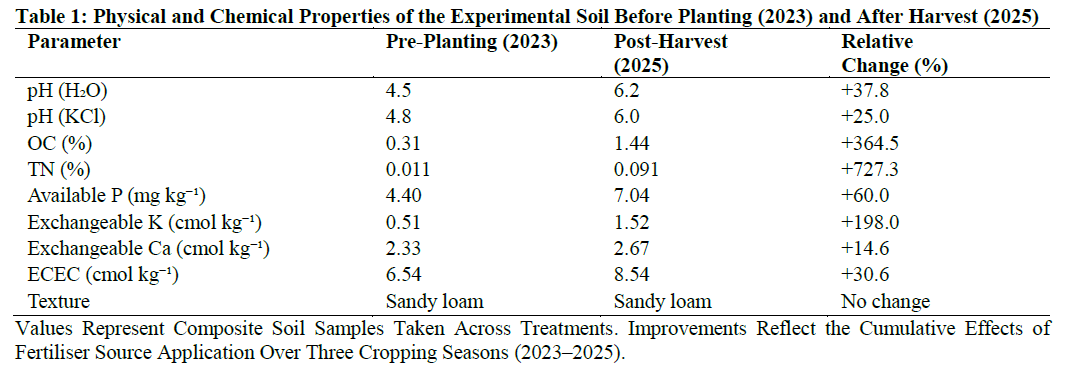
Sweet potato (Ipomoea batatas L.) productivity in sub-Saharan Africa is constrained by degraded soils, low fertility, and infestation by the Cylas weevil (Cylas spp.). A three-year field study (2023–2025) at the University of Abuja, Nigeria, assessed the interactive effects of variety, tillage, and fertiliser on soil properties, growth, physiology, pest incidence, and storage root yield. A 2 × 3 × 4 factorial Randomised Complete Block Design with three replications tested two varieties (white-fleshed TIS 87/0087 and orange-fleshed UMUSP3), three tillage systems (Flat, Mound, Ridge), and four fertiliser regimes (Control, NPK 15:15:15, Poultry manure, Hyptis suaveolens green manure). Integrated management improved soil fertility, increasing pH from 4.5 to 6.5, organic carbon by 365%, total nitrogen by 727%, available phosphorus by 60%, and ECEC by 31%. Early crop establishment was high (sprouting 95–97.6%, survival 90–93.1%). The white-fleshed variety performed best under mound × NPK, achieving SPAD-N 36.53, vine length 237 cm, fresh biomass 10.08 kg/plot, and root yield 41.53 t/ha. The orange-fleshed variety yielded 36.15 t/ha under ridge × Poultry manure. Total root number (r = 0.815; path coefficient = 0.72) was the main yield determinant, while organic amendments reduced Cylas infestation by up to 77%. Economic analysis showed WFSP + mound + NPK gave the highest net return, whereas OFSP + Ridge + Poultry manure had the highest benefit-cost ratio (3.27). These findings provide genotype-specific production pathways and support integrated, precision-based tillage and nutrient management for sustainable, climate-smart, and nutrition-sensitive sweet potato production in degraded savanna soils.
References
Abidin, P.E., Dery, E.K., Amagloh, F.K., & Gaveh, E. (2020). Sweet potato development and delivery in sub-Saharan Africa. African Journal of Food, Agriculture, Nutrition and Development, 20(2), 15474–15489. https://doi.org/10.18697/ajfand.91.18120
Abidin, P.E., Dery, E.K., Amagloh, F.K., Asare, K., & Guba, B.Y. (2022). Sweet potato for nutrition and climate resilience in sub-Saharan Africa: A review. Journal of Agriculture and Food Research, 8, 100298. https://doi.org/10.1016/j.jafr.2022.100298
Agegnehu, G., Nelson, P.N., & Bird, M.I. (2018). The effects of biochar, compost and their mixture and nitrogen fertiliser on yield and nitrogen use efficiency of barley grown on a Nitisol in the highlands of Ethiopia. Science of the Total Environment, 569–570, 869–879. https://doi.org/10.1016/j.scitotenv.2016.05.033
Amagloh, F.C., Yada, B., Tumuhaise, V., Amagloh, F.K., & Kaaya, A.N. (2021). The potential of sweet potato as a functional food in sub-Saharan Africa and its health implications: A review. Molecules, 26(10), 2971. https://doi.org/10.3390/molecules26102971
Ayilara, M.S., Olanrewaju, O.S., Babalola, O.O., & Odeyemi, O. (2020). Waste management through composting: Challenges and potentials. Sustainability, 12(11), 4456. https://doi.org/10.3390/su12114456
Barnabas, I.L., & Nwaka, G.I.C. (2014). Analysis of rainfall distribution in Gwagwalada, FCT, Abuja, Nigeria. Journal of Earth Science and Climate Change, 5(7), 1-5.
Bolo, P., Kihara, J., Mucheru-Muna, M., Njeru, E.M., & Kinyua, M. (2021). Lessons from long-term nutrient management studies in Africa: A review. Soil Security, 4, 100012. https://doi.org/10.1016/j.soisec.2021.100012
CIMMYT- International Maize and Wheat Improvement Centre. (2022). Economic data analysis: Tools and methods for on-farm research. https://www.cimmyt.org/resources/
Dimkpa, C.O., Fugice, J., Singh, U., & Lewis, T.D. (2020). Development of fertilisers for enhanced nitrogen use efficiency – Trends and perspectives. Science of the Total Environment, 731, 139113. https://doi.org/10.1016/j.scitotenv.2020.139113
FAOSTAT. (2023). Food and Agriculture Data. Food and Agriculture Organisation of the United Nations. http://www.fao.org/faostat/en/
Food and Agriculture Organization of the United Nations. (2022). The State of Food Security and Nutrition in the World 2022. FAO. https://www.fao.org/documents/card/en/c/cc0639en
Gurmu, F., Shimelis, H., & Laing, M. (2021). The potential of orange-fleshed sweet potato to prevent vitamin A deficiency in Africa. International Journal of Food Science & Technology, 56(8), 3646-3664. https://doi.org/10.1111/ijfs.15016
Ilozobhie, N.E., Anyaegbu, P.O., Habibu, D., Mustapha, A., Alobo, A.J., Aihebhoria, D.O., & Maihula, J.T. (2024). Performance of orange flesh sweet potato (Ipomoea batatas L. (Lam.)) as influenced by tillage and fertiliser type in Federal Capital Territory (FCT), Abuja, Nigeria. African Journal of Agriculture and Allied Sciences, 4(1), 1-12. https://www.ajaas.com.ng/wp-content/uploads/2024/07/AJASS-Vol.4-Issue1-Article-13.pdf
Ishaya, S., & Grace, M.K. (2007). Soil characteristics of the University of Abuja Teaching and Research Farm, Gwagwalada. Nigerian Journal of Soil and Environmental Research, 7, 45-50.
Jiang, Y., Zhang, Y., Li, M., & Liu, X. (2019). Soil acidification of the soil profile across the Chengdu Plain of China from the 1980s to 2010s. Science of The Total Environment, 698, 134320. https://doi.org/10.1016/j.scitotenv.2019.134320
Kebede, E. (2021). Contribution, utilisation, and improvement of legume-driven biological nitrogen fixation in agricultural systems. Frontiers in Sustainable Food Systems, 5. https://doi.org/10.3389/fsufs.2021.767998
Kifle, M. H., Laing, M.D., & Araya, H.T. (2022). Effects of organic amendments on soil fertility and crop productivity in sustainable agriculture: A review. Frontiers in Plant Science, 13, 1004550. https://doi.org/10.3389/fpls.2022.1004550
Kihara, J., Bolo, P., Kinyua, M., Nyawira, S. S., & Sommer, R. (2020). Soil health and ecosystem services: Lessons from sub-Saharan Africa (SSA). Geoderma, 370, 114342. https://doi.org/10.1016/j.geoderma.2020.114342
Kintché, K., Guibert, H., Sogbedji, J. M., Levêque, J., & Bonfoh, B. (2017). Long-term mineral fertiliser use and maise residue incorporation do not compensate for carbon and nutrient losses from a Ferralsol under continuous maise-cotton cropping. Field Crops Research, 212, 109-118. https://doi.org/10.1016/j.fcr.2017.07.013
Lee, S., Kim, H., & Park, J. (2023). Varietal differences in nitrogen use efficiency and biomass allocation of sweet potato (Ipomoea batatas L.) under contrasting fertilisation regimes. Journal of Plant Nutrition and Soil Science, 186(4), 512-525.
Li, S., Li, J., Zhang, B., Li, D., Li, G., & Li, Y. (2020). Effect of different organic fertilisers application on soil organic matter and nitrogen use efficiency in upland crops. Agriculture, Ecosystems & Environment, 295, 106886. https://doi.org/10.1016/j.agee.2020.106886
Liu, Y., Zhang, G., Luo, X., Hou, E., Zheng, M., Zhang, L., ... & He, X. (2021). Nitrogen use efficiency in crop plants: From in vitro to the field. Frontiers in Plant Science, 12, 628-645. https://doi.org/10.3389/fpls.2021.628645
Low, J.W., Mwanga, R.O., Andrade, M., Carey, E., & Ball, A.M. (2017). Tackling vitamin A deficiency with biofortified sweet potato in sub-Saharan Africa. Global Food Security,14, 23-30. https://doi.org/10.1016/j.gfs.2017.01.004
Motsa, N.M., Modi, A.T., & Mabhaudhi, T. (2015). Sweet potato (Ipomoea batatas L.) as a drought tolerant and food security crop. South African Journal of Science, 111(11/12), 1-8. https://doi.org/10.17159/sajs.2015/20140252
Motsara, M. R., & Roy, R. N. (2020). Guide to laboratory establishment for plant nutrient analysis (FAO Fertilizer and Plant Nutrition Bulletin 19). Food and Agriculture Organization of the United Nations.
Mwanga, R.O.M., Andrade, M.I., Carey, E.E., Low, J.W., Yencho, G.C., & Grüneberg, W. J. (2016). Sweetpotato (Ipomoea batatas L.). In Genetic improvement of tropical crops (pp. 181-218). Springer, Cham.
Ndambi, O. A., Pelster, D. E., Owino, J. O., de Buisonjé, F., & Vellinga, T. (2019). Manure management practices and policies in sub-Saharan Africa: Implications on manure quality as a fertiliser. Frontiers in Sustainable Food Systems, 3. https://doi.org/10.3389/fsufs.2019.00029
Ngoze, S., Muyonga, J., Mwanjala, T., & Kinyua, M. (2021). Variability in nutrient composition of organic fertilisers and its implications for soil fertility management. African Journal of Agricultural Research, 17(2), 179-189. https://doi.org/10.5897/AJAR2020.15309
Nyambo, P., Chiduza, C., & Araya, T. (2022). Conservation agriculture effects on soil water holding capacity and water-saving varied with management practices and agro-ecological conditions: A review. Advances in Agronomy, 176, 155-295. https://doi.org/10.1016/bs.agron.2022.07.003
Olatunji, J. R., Olorunmaiye, P. M., & Ojo, D. K. (2024). Influence of fertiliser types on infestation and damage by Cylas puncticollis Boheman (Coleoptera: Brentidae) on sweet potato in Nigeria. Journal of Agricultural Science, 16(3), 45-56
Olujugba, S. O., Alake, A. D., & Odeyemi, F. (2016). Comparative effect of organic and inorganic fertilisers on soil properties, nutrient uptake and growth of tomato (Lycopersicon esculentum Mill). African Journal of Agricultural Research, 11(14), 1215-1222. https://doi.org/10.5897/AJAR2015.10666
Oteng-Darko, P., Addy, S. N. T., Yeboah, S., & Amponsah, S. K. (2021). Sweet potato (Ipomoea batatas L.) yield gap analysis in Ghana. Scientific African, 12, e00771. https://doi.org/10.1016/j.sciaf.2021.e00771
Pittelkow, C. M., Liang, X., Linquist, B. A., van Groenigen, K. J., Lee, J., Lundy, M. E., van Gestel, N., Six, J., Venterea, R. T., & van Kessel, C. (2022). Productivity limits and potentials of the principles of conservation agriculture. Nature, 517(7534), 365–368. https://doi.org/10.1038/nature13809
Poorter, H., Niklas, K. J., Reich, P. B., Oleksyn, J., Poot, P., & Mommer, L. (2012). Biomass allocation to leaves, stems and roots: meta-analyses of interspecific variation and environmental control. New Phytologist, 193(1), 30-50. https://doi.org/10.1111/j.1469-8137.2011.03952.x
R Core Team. (2023). R: A language and environment for statistical computing (Version 4.5.0) [Computer software]. R Foundation for Statistical Computing. https://www.R-project.org/
Thierfelder, C., Chivenge, P., Mupangwa, W., Rosenstock, T. S., Lamanna, C., & Eyre, J. X. (2018). How climate-smart is conservation agriculture (CA)? – its potential to deliver on adaptation, mitigation and productivity on smallholder farms in southern Africa. Food Security, 10(3), 537–560. https://doi.org/10.1007/s12571-018-0803-6
Tittonell, P., & Giller, K. E. (2013). When yield gaps are poverty traps: The paradigm of ecological intensification in African smallholder agriculture. Field Crops Research, 143, 76-90. https://doi.org/10.1016/j.fcr.2012.10.007
Tumuhimbise, G. A., Namutebi, A., & Turyashemererwa, F. (2019). Pro-vitamin A crops: Acceptability, bioavailability, efficacy and effectiveness. Food Science & Nutrition, 7(8), 2475–2480. https://doi.org/10.1002/fsn3.1108
Unagwu, B. O., Ene, J. O., & Ezeh, C. U. (2019). Influence of poultry manure and NPK fertiliser on growth and yield of sweet potato (Ipomoea batatas L.) in southeastern Nigeria. International Journal of Agriculture and Environmental Research, 5(2), 259-270.
Vanlauwe, B., Descheemaeker, K., Giller, K. E., Huising, J., Merckx, R., Nziguheba, G., Wendt, J., & Zingore, S. (2019). Integrated soil fertility management in sub-Saharan Africa: Unravelling local adaptation. Soil, 5, 491–508. https://doi.org/10.5194/soil-5-491-2019
Welsch, R., Zhou, X., & Li, L. (2018). Carotenoid biosynthesis and its regulation in plants. In Carotenoids in Nature (pp. 187-212). Springer. https://doi.org/10.1007/978-3-319-92952-7_9
Zhang, W., Liu, D., Liu, Y., Chen, X., & Zou, C. (2020). Overuse of phosphorus fertiliser reduces the grain yield and enhances the environmental risk in a double rice cropping system. Journal of Integrative Agriculture, 19(11), 2651-2663. https://doi.org/10.1016/S2095-3119(20)63230-2
Zhang, X., Davidson, E. A., Mauzerall, D. L., Searchinger, T. D., Dumas, P., & Shen, Y. (2018). Managing nitrogen for sustainable development. Nature, 528, 51–59. https://doi.org/10.1038/nature15743
Zingore, S., Njoroge, S., & Mashingaidze, N. (2022). Priority interventions for transformational change in the agri-food systems of sub-Saharan Africa. Agricultural Systems, 203, 103520. https://doi.org/10.1016/j.agsy.2022.103520
Zomer, R. J., Bossio, D. A., Sommer, R., & Verchot, L. V. (2017). Global sequestration potential of increased organic carbon in cropland soils. Scientific Reports, 7(1), 15554. https://doi.org/10.1038/s41598-017-15794-8
Downloads
Published
Issue
Section
Categories
License
Copyright (c) 2026 Polycarp O. Anyaegbu, Daniel Osebhie Aihebhoria, Nicholas E. Ilozobhie

This work is licensed under a Creative Commons Attribution 4.0 International License.


