
Preliminary Evaluation of The Effects of Phyllanthus amarus On Conception, Pregnancy Outcome And Litter Weights, In Female Wistar Rats
DOI:
https://doi.org/10.33003/fjs-2026-1009-4689Keywords:
Fertility, antifertility, conception, pregnancy outcome, gestation-period, litter-weightAbstract
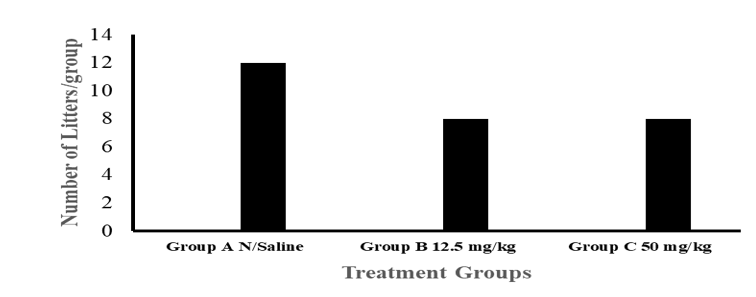
Previous studies have reported both antifertility and fertility-promoting effects of extracts from Phyllanthus amarus. In this study, we evaluated the effects of the ethanol extract of the aerial parts of Phyllanthus amarus on conception, pregnancy outcomes, and litter weights in female Wistar rats. Twenty-five (15) female Wistar rats were divided into five groups (A–C), with five animals per group. Each group was paired with two male Wistar rats for mating. Group A animals received normal saline (0.5 mL) and served as the control, while Groups B and C were administered 12.5, and 50 mg/kg of the extract orally for 30 days. The female rats were paired with the male rats from day 1, to 7 days, before the male Wistar rats were removed. The female Wistar rats were observed for conception and pregnancy outcomes after a 28-day gestation period, and litters from all groups were weighed and compared with the control. Results showed that the treated Groups of B and C produced eight (8) litters each, with mean litter weights of 12.8 ± 1.76 g and 13.69 ± 2.03 g, respectively. These values compared positively with the twelve (12) litters and mean litter weight of 15.33 ± 2.14 g observed in the control group (p > 0.05). It is therefore concluded that the ethanol extract of Phyllanthus amarus has the potential to promote fertility in female Wistar rats and exerts a positive influence on conception and pregnancy outcomes.
References
1. World Health Organization (2022). Critical Consideration and actions for Achieving Universal Access to Sexual and Reproductive Health in the Context of Universal Health Coverage. Downloaded from: https://www.who.int/publications/i/item/9789240052659#:~:text=Overview.%20The%20objective%20of%20Critical%20Considerations%20and,especially%20in%20the%20context%20of%20UHC%20strategies, on 05/03/2026
2. Akbaribazm M., Goodazi N., & Rahimi M. (2021). Reproductive and Herbal Medicine: An Overview of New Findings. Food Sci Nutri. 15; 9(10): 5869–5882. doi: 10.1002/fsn3.2523
3. Singh K., Coopoosamy R., David A., & Naidoo K. (2024). ‘Unlocking nature’s secrets: Medicinal plants for enhanced female fertility’, Journal of Medicinal Plants for Economic Development 8(1), a258. https://doi.org/10.4102/jomped.v8i1.258
4. Alifariki L. O., Rahmawati., Rangki L., Sukurni (2022). Efficacy of Herbal Medicine in the Treatment of Female Infertility: A Systematic Review. International Journal of Science and Healthcare Research (www.ijshr.com) 249 Vol.7; Issue: 4
5. Taylor R.C.R. (2022) Alternative medicine and the medical encounter in Britain and the United States. In: Alternative Medicines. Routledge; page 191–228
6. Osawaru M.E., Ogwu M.C. (2023). Plants Used in the Management and Treatment of Female Reproductive Health Issues: Case Study from Southern Nigeria. In: Izah, S.C., Ogwu, M.C., Akram, M. (eds) Herbal Medicine Phytochemistry. Reference Series in Phytochemistry. Springer, Cham. https://doi.org/10.1007/978-3-031-21973-3_5-1
7. Dasiman R., Bahari E.A. (2021). Malaysian Phyllanthus sp: An Updated Review of Their Impacts on The Reproductive Functions and Fertility. Mal J Med Health Sci 17(SUPP3): 343-350
8. Adedapo A., Ofuegbe S., & Oguntibeju O. (2014). The Antidiabetic Activities of the Aqueous Leaf Extract of Phyllanthus Amarus in some Laboratory Animals. Intechopen.com/chapters/45741. Doi.org/10.5772/57030
9. Amaechina F. C., & Omogbai E.K.I. (2007). Hypotensive Effect of Aqueous Extract of The Leaves of Phyllanthus Amarus Schum and Thonn (Euphorbiaceae). Acta Poloniae Pharmaceutica ñ Drug Research, Vol. 64 No. 6 pp. 547ñ552. ISSN 0001-6837Polish Pharmaceutical Society
10. Rajeshkumar N.V., Joy K.L., Kuttan G., Ramsewak R.S., Nair M.G., & Kuttan R. (2002). Antitumour and anticarcinogenic activity of Phyllanthus amarus extract. J Ethnopharmacol. 81(1):17-22. doi: 10.1016/s0378-8741(01)00419-6. PMID: 12020923.
11. Amaechina F.C., & Omogbai E.K.I. (2013). Some Central Nervous System Effects of The Aqueous Extract of the Leaves of Phyllanthus Amarus Schum, (Euphorbiaceae). Nig. J. Nat. Prod. and Med. Vol. 17; 61 – 65. Doi: : http://dx.doi.org/10.4314/njnpm.v17i1.5
12. Nurudeen Q.O., & Yakubu M.T. (2016). Aqueous Extract of the Leaves of Phyllanthus amarus Restore Sexual Competence in Fluoxentine-induced Sexual Dysfunction in Female Wistar Rats. Nigerian Journal of Biochemistry and Molecular Biology. 31(1&2): 1-14
13. Ataman J.E., & Sakpa C.L. (2017). Effects of Ethanolic Leaf Extract of Phyllanthus Amarus
(Schum and Thonn) on Ovarian Morphology and Reproductive Parameters in Wistar Rats. African Scientist Vol. 18, No. 4, 1595-6881. Nigerian Society for Experimental Biology
Downloads
Published
Issue
Section
Categories
License
Copyright (c) 2026 Fabian C. Amaechina, Kirsten Oghenefejiro Etukpere

This work is licensed under a Creative Commons Attribution 4.0 International License.


