
PERFORMANCE EVALUATION OF HOT MIX ASPHALT INCORPORATING VITRIFIED TILE WASTE AS FINE AGGREGATE REPLACEMENT
DOI:
https://doi.org/10.33003/fjs-2026-1001-4681Keywords:
Hot mix asphalt, Vitrified tile waste, Fine aggregate replacement, Marshall stability, Performance evaluation, Sustainable pavement materialsAbstract
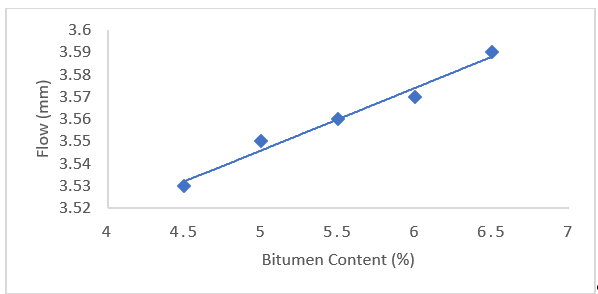
The performance of hot mix asphalt (HMA) largely depends on the properties and gradation of the aggregates used in the mixture. The depletion of natural aggregates and improper disposal of construction waste have posed serious environmental challenges, leading to the need for alternative sustainable materials in asphalt production. This study investigates the influence of vitrified tile waste (VWT) as a partial substitute for natural fine aggregates on the mechanical and volumetric properties of hot mix asphalt (HMA). Fine aggregates were replaced at 0%, 10%, 20%, 30%, and 40% by weight, and mixtures were evaluated based on standard Marshall parameters, including stability, flow, bulk density, air voids (Va), voids in mineral aggregate (VMA), and voids filled with bitumen (VFB), using ASTM D6926–20 and D6927–20. Results show that as the percentage of vitrified tile waste increased, the stability of the mix also increased from 4.68 kN (control) to 5.41 kN at 30% replacement level, while flow decreased from 3.88 mm to 2.40 mm. Bulk density also increased with replacement up to 30%, indicating improved compaction. Air voids and VMA reduced, while VFB increased, signifying better densification and lower permeability. At 40% replacement, stability slightly decreased, showing that excessive substitution of fine aggregate reduces cohesion in the asphalt mix. All properties at 30% VWT met the Nigerian General Specification requirements for wearing course. The findings demonstrate that vitrified tile waste is a viable fine aggregate replacement that improves mixture performance while supporting sustainable material utilization in asphalt production.
References
ASTM C 33/C 33M-22 (2022). Standard Specification for Concrete Aggregates. West Conshohocken, PA: American Society for Testing and Materials (ASTM) International.
ASTM D2041-11: Standard Test Method for Theoretical Maximum Specific Gravity and Density of Asphalt Mixtures. ASTM International, West Conshohocken, PA.
ASTM D2726-19: Standard Test Method for Bulk Specific Gravity and Density of Non-Absorptive Compacted Asphalt Mixtures. ASTM International, West Conshohocken, PA.
ASTM D3203-17: Standard Test Method for Percent Air Voids in Compacted Asphalt Mixtures. ASTM International, West Conshohocken, PA.
ASTM D6926-20. (2020). Standard Practice for Preparation of Asphalt Mixture Specimens Using Marshall Apparatus. West Conshohocken, PA: American Society for Testing and Materials (ASTM) International.
ASTM D6927–20 (2020). Standard Test Method for Marshall Stability and Flow of Bituminous Mixtures.West Conshohocken, PA: American Society for Testing and Materials (ASTM) International.
European Standard (EN) 12697-22:2022 - "Bituminous Mixtures - Test Methods for Hot Mix Asphalt - Part 22: Wheel Tracking".
Fatima, E., Sahu, S., Jhamb, A., & Kumar, R. (2014). Use of ceramic waste as filler in semi-dense bituminous concrete. American Journal of Civil Engineering and Architecture, 2(3), 102-106.
Hossain, W. A. (2021). Production of Lightweight Concrete by Using Polystyrene (Cork) Waste. In Journal of Physics: Conference Series (Vol. 1973, No. 1, p. 012128). IOP Publishing.
Huang, Y. H. (2009). Pavement Analysis and Design (2nd ed.). Pearson Prentice Hall, New Jersey.
Lim, M. B., Mortera, R. I. M., Pangilinan, D. J. C. B., & Macario, V. S. P. (2019). Pulverized ceramic tile waste as potential mineral filler in hot mix asphalt. Journal of the Eastern Asia Society for Transportation Studies, 13, 1616–1629.
Lira, B. E. R. N. A. R. D. I. T. A. (2020). Influence of aggregates on permanent deformation of asphalt. (Elektroniskt) Tillgänglig: Influence of aggregates (2023-08-17).
Nigeria Specification for Roads and Bridges. (NGSRB) (1997). Federal Ministry of Works & Housing, Abuja.
Pipil, P., Tomer, T., & Payal, R. (2024). Ceramics as potential materials in pollution prevention and control. International Journal of Applied Ceramic Technology.
Rahman, M. T. (2013). Performance evaluation of asphalt mixtures incorporating waste materials. Journal of Materials in Civil Engineering, 25(12), 1857–1865.
Shamsaei, M., Khafajeh, R., Ghasemzadeh Tehrani, H., & Aghayan, I. (2020). Experimental evaluation of ceramic waste as filler in hot mix asphalt. Clean Technologies and Environmental Policy, 22, 535-543.
Silvestre, R., Medel, E., García, A., & Navas, J. (2013). Using ceramic wastes from tile industry as a partial substitute of natural aggregates in hot mix asphalt binder courses. Construction and Building Materials, 45, 115–122.
Sunarjono, S., Mumfaz, Z. Z., Hidayati, N., & Harnaeni, S. R. (2024, February). Durability test method of hot mix asphalt: A review. In AIP Conference Proceedings (Vol. 2838, No. 1). AIP Publishing.
Yuan, Q., Robert, D., Mohajerani, A., Tran, P., & Pramanik, B. K. (2022). Utilisation of waste-to-energy fly ash in ceramic tiles. Construction and Building Materials, 347, 128475.
Zanelli, C., Conte, S., Molinari, C., Soldati, R., & Dondi, M. (2021). Waste recycling in ceramic tiles: A technological outlook. Resources, Conservation and Recycling, 168, 105289.
Downloads
Published
Issue
Section
Categories
License
Copyright (c) 2026 Ahmad Deedat Abdullahi, Umar Ahmad Masari, Abdulmumin Isah Ahmed

This work is licensed under a Creative Commons Attribution 4.0 International License.


