
FRACTIONAL-ORDER MATHEMATICAL MODELING FOR POPULATION PROJECTION AND MANAGEMENT: A CASE STUDY OF OGUN STATE, NIGERIA
DOI:
https://doi.org/10.33003/fjs-2026-1007-4612Keywords:
Fractional order, population projection, logistic growth,ogun stateAbstract
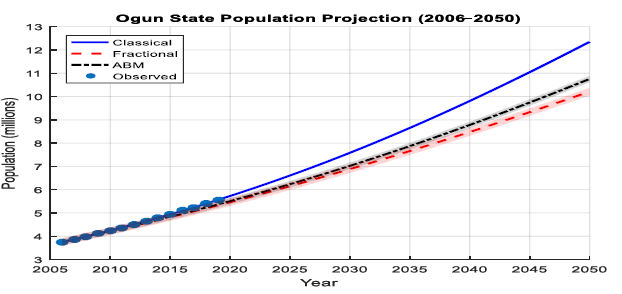
Population projection is an essential tool for effective population management and sustainable development planning at the sub-national level in Nigeria. This study applies classical and fractional-order logistic growth models to project the population of Ogun State up to the year 2050 and to examine the implications of projected growth for policy and development planning. Population data obtained from the 2006 National Population Census and annual projections from the National Bureau of Statistics(NBS) and the World Bank for 2007–2019 were used for model calibration. Model parameters were initially estimated using a four-point initialization approach and subsequently refined through nonlinear least-squares optimization implemented in MATLAB R2016a. Numerical solutions of the fractional-order model were obtained using the Adams-Bashforth-Moulton predictor-corrector scheme. Model performance was evaluated using goodness-of-fit measures and information criteria. The findings showed that the classical logistic model provided the most parsimonious representation of the observed population dynamics, although the fractional-order and numerical models offered additional insight into long-term uncertainty and structural variation. The projections indicate that Ogun State’s population is expected to rise steadily from approximately 3.75million in 2006 to about 12.35million by 2050 under the classical logistic model, while the fractional-order and Adams-Bashforth-Moulton models produced projected values of approximately 10.21million and 10.75million respectively by 2050.The results further suggest that Ogun State is likely to exceed the 10 million population threshold between 2040 and 2042. These findings provide a quantitative basis for threshold-based planning, scenario analysis, and evidence-driven policy decisions in housing, healthcare, education, transportation,and urban infrastructure development within Ogun State.
Downloads
Published
Issue
Section
Categories
License
Copyright (c) 2026 Funmilayo Amurawaye

This work is licensed under a Creative Commons Attribution 4.0 International License.


