
ASSESSMENT OF NON-FIBER CARBOHYDRATES, Β-GLUCANS, PECTIN, AND ANTINUTRIENTS IN INDIGENOUS NIGERIAN EDIBLE CROPS FOR FUNCTIONAL FOOD APPLICATIONS
DOI:
https://doi.org/10.33003/fjs-2026-1001-4538Keywords:
Antinutrients, Beta-glucan, Pectin, Soluble fiber, Short-chain fatty acidsAbstract
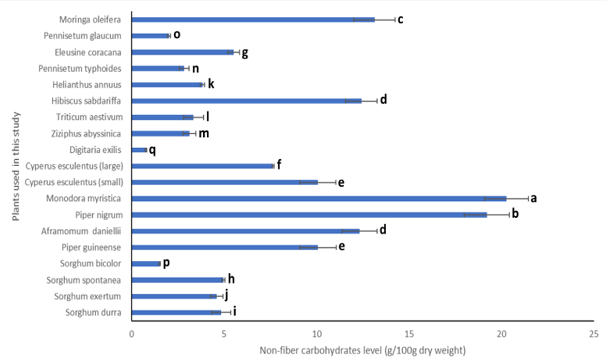
Dietary fibers such as soluble fiber, beta-glucan, and pectin play crucial roles in gut health and glycemic regulation, offering potential benefits for managing type 2 diabetes mellitus. Despite this, many indigenous Nigerian crops remain underexplored for their fiber composition and antinutrient contents. By employing standard biochemical assays, this study quantified soluble fiber, beta-glucan, and pectin levels, alongside saponin, tannin, and oxalate contents, in nineteen selected crops. It further assessed total short-chain fatty acid (TSCFA) production following fermentation with Lactobacillus species to evaluate fermentability and functional value. The highest non-fiber carbohydrates content was observed in Monodora myristica (20.28%), Piper nigrum (19.21%), and Moringa oleifera (13.14%). Helianthus annuus showed the highest beta-glucan (3.14%) and pectin (10.32%) levels, followed by Sorghum spontanea and Monodora myristica. Antinutrient analysis revealed Moringa oleifera contained the highest saponin (2.48 mg/100 g), tannin (1.12 mg/100 g), and oxalate (1.98 mg/100 g) levels. Fermentation results indicated significant TSCFA production in Hibiscus sabdariffa (0.09 M), Cyperus esculentus (large seed) (0.08 M), and Piper guineense (0.078 M), demonstrating good fermentability and prebiotic potential, whereas Sorghum durra and Eleusine coracana produced lower values. In conclusion, several underutilized Nigerian crops possess high levels of beneficial dietary fibers with promising fermentability, highlighting their potential as functional foods for glycemic control and gut microbiota modulation. However, their elevated antinutrient levels underscore the need for effective processing and detoxification strategies. Future research should investigate in vivo effects, microbial interactions, and crop improvement to optimize health benefits.
References
Akangbe, E.E., Odukoya, A.A., and Osayande, U.D. (2024). Effect of Moringa Oleifera Saponin Extract on Serum Enzymes and Immunomodulatory Doses Administered in Wistar Rats. Nigerian Journal of Animal Production 219–221.
AOAC (1990) Official Methods of Analysis.
Arsov, A., Tsigoriyna, L., Batovska, D., Armenova, N., Mu, W., Zhang, W., Petrov, K., and Petrova, P. (2024). Bacterial Degradation of Antinutrients in Foods: The Genomic Insight. Foods 13: 2408.
Ashaolu, T.J., Ashaolu, J.O., and Adeyeye, S.A.O. (2021). Fermentation of prebiotics by human colonic microbiota in vitro and short‐chain fatty acids production: a critical review. Journal of Applied Microbiology 130: 677–687.
Bai, Y., Zhao, J. biao, Tao, S. yu, Zhou, X. jian, Pi, Y., Gerrits, W.J.J., Johnston, L.J, Zhang, S., Yang, H., Liu, L., Zhang, S., and Wang, J. (2020). Effect of dietary fiber fermentation on short-chain fatty acid production and microbial composition in vitro. Journal of the Science of Food and Agriculture 100: 4282–4291.
Cassidy, Y.M., McSorley, E.M., and Allsopp, P.J. (2018). Effect of soluble dietary fibre on postprandial blood glucose response and its potential as a functional food ingredient. Journal of Functional Foods 46: 423–439.
Chawla, R. and Patil, G.R. (2010). Soluble Dietary Fiber. Comprehensive Reviews in Food Science and Food Safety 9: 178–196.
Chen, V., Zurbau, A., Ahmed, A., Khan, T.A., Au-Yeung, F., Chiavaroli, L., Mejia, S.B., Leiter, L.A, Jenkins, D.JA., Kendall, C.W.C., Sievenpiper, J.L. (2022). Effect of oats and oat ß-glucan on glycemic control in diabetes: a systematic review and meta-analysis of randomized controlled trials. BMJ Open Diabetes Research and Care 10: 2784.
Edo, G.I., Ndudi, W., Makia, R.S., Ainyanbhor, I.E., Yousif, E., Gaaz, T.S., Zainulabdeen, K., Jikah, A.N., Opiti, R.A., Akpoghelie, P.O, Owheruo, J.O., Essaghah, A.E.A., Umar, H. (2024). Beta-glucan: An overview in biological activities, derivatives, properties, modifications and current advancements in food, health and industrial applications. Process Biochemistry 147: 347–370.
Ghavami, A., Ziaei, R., Talebi, S., Barghchi, H., Nattagh-Eshtivani, E., Moradi, S., Rahbarinejad, P., Mohammadi, H., Ghasemi-Tehrani, H., Marx, W.M., and Askari, G. (2023). Soluble Fiber Supplementation and Serum Lipid Profile: A Systematic Review and Dose-Response Meta-Analysis of Randomized Controlled Trials. Advances in Nutrition 14: 465–474.
Grassino, A.N., Barba, F.J., Brnčić, M., Lorenzo, J.M., Lucini, L., and Brnčić, S.R. (2018). Analytical tools used for the identification and quantification of pectin extracted from plant food matrices, wastes and by-products: A review. Food Chemistry 266: 47–55.
Held, S. and Fox, G. (2023). Simultaneous Evaluation of β-Glucan and β-Glucanase Relationship during Different Mash Temperature Profiles. Journal of the American Society of Brewing Chemists 81: 544–553.
Hoque, M.B., Tanjila, M.J., Hosen, M.I., Hannan, M.A., Haque, P., Rahman, M.M., and Hasan, T. (2025). A comprehensive review of the health effects, origins, uses, and safety of tannins. Plant and Soil 507: 221–240.
Hossain, M.M., Tovar, J., Cloetens, L., Geraldi, M.V., Venuti, C., and Nilsson, A. (2025). Oat beta-glucans consumed at breakfast improve glucose tolerance acutely and after a subsequent lunch – a randomized dose–response study in healthy young adults. Food and Function 16:4161-4171.
Huynh, N.K., Nguyen, D.H.M., and Nguyen, H.V.H. (2022). Effects of processing on oxalate contents in plant foods: A review. Journal of Food Composition and Analysis 112: 104685.
Jiang, M., Hong, C., Zou, W., Ye, Z., Lu, L., Liu, Y., Zhang, T., and Ding, Y. (2024). Recent advances in the anti-tumor activities of saponins through cholesterol regulation. Frontiers in Pharmacology 15: 1469392.
Kalita, P., Bhattacharjee, B., Pachuau, L., and Roy, S. (2025). Recent trends in pectin sources, extraction, and active-edible coating applications. Food Control 171: 111105.
Kaur, N., Agarwal, A., Sabharwal, M., and Jaiswal, N. (2021). Natural food toxins as anti-nutritional factors in plants and their reduction strategies. Food Chemistry: The Role of Additives, Preservatives and Adulteration 217–266.
Khoddami, A., Messina, V., Vadabalija Venkata, K., Farahnaky, A., Blanchard, C.L., and Roberts, T.H. (2023). Sorghum in foods: Functionality and potential in innovative products. Critical Reviews in Food Science and Nutrition 63: 1170–1186.
Manoshree, M. and Devangi, C. (2019). Sensitivity of AOAC and Folin’s Method in Estimation of Tannins from Different Plants. World J Pharm Res 8:.
Marcon, M. V., Vriesmann, L.C., Wosiacki, G., Beleski-Carneiro, E., and Petkowicz, C.L.O. (2005). Pectins from apple pomace. Polímeros 15: 127–129.
Nitzke, D., Czermainski, J., Rosa, C., Coghetto, C., Fernandes, S.A., and Carteri, R.B. (2024). Increasing dietary fiber intake for type 2 diabetes mellitus management: A systematic review. World Journal of Diabetes 15: 1001.
Oakenfull, D. and Sidhu, G.S. (2023). Saponins. Toxicants of Plant Origin: Glycosides: Volume II 97–141.
Ojo, O., Ojo, O.O., Zand, N., and Wang, X. (2021). The Effect of Dietary Fibre on Gut Microbiota, Lipid Profile, and Inflammatory Markers in Patients with Type 2 Diabetes: A Systematic Review and Meta-Analysis of Randomised Controlled Trials. Nutrients 13: 1805.
Onawo, O.L. and Egboduku, W.O. (2025). Highlighting the untapped potential of neglected and underutilized crop species for sustainable food security. Journal of Underutilized Legumes 7: 73–93.
Opperman, C., Majzoobi, M., Farahnaky, A., Shah, R., Van, T.T.H., Ratanpaul, V., Blanch, E.W., Brennan, C., and Eri, R. (2025). Beyond soluble and insoluble: A comprehensive framework for classifying dietary fibre’s health effects. Food Research International 206: 115843.
Pareek, Ashutosh, Pant, M., Gupta, M.M., Kashania, P., Ratan, Y., Jain, V., Pareek, A., and Chuturgoon, A. (2023). Moringa oleifera: An Updated Comprehensive Review of Its Pharmacological Activities, Ethnomedicinal, Phytopharmaceutical Formulation, Clinical, Phytochemical, and Toxicological Aspects. International Journal of Molecular Sciences 24: 2098.
Peng, K., Jin, L., Niu, Y.D., Huang, Q., McAllister, T.A., Yang, H.E., Denis, H., Xu, Z., Acharya, S., and Wang, S., Wang, Y. (2017). Condensed Tannins Affect Bacterial and Fungal Microbiomes and Mycotoxin Production during Ensiling and upon Aerobic Exposure. Applied and Environmental Microbiology 84: 2274–2291.
Portincasa, P., Bonfrate, L., Vacca, M., De Angelis, M., Farella, I., Lanza, E., Khalil, M., Wang, D., Sperandio, M., and Di Ciaula, A. (2022). Gut Microbiota and Short Chain Fatty Acids: Implications in Glucose Homeostasis. International Journal of Molecular Sciences, 23: 1105.
Rastogi, S., and Singh, A. (2022). Gut microbiome and human health: Exploring how the probiotic genus Lactobacillus modulate immune responses. Frontiers in Pharmacology, 13: 1042189.
Ren, T., Fan, X., Wu, Q., Wu, Y., Sun, X., and Tong, H. (2025). Structural insights and therapeutic potential of plant-based pectin as novel therapeutic for type 2 diabetes mellitus: A review. International Journal of Biological Macromolecules 307: 141876.
Salgado, N., Silva, M.A., Figueira, M.E., Costa, H.S., and Albuquerque, T.G. (2023). Oxalate in Foods: Extraction Conditions, Analytical Methods, Occurrence, and Health Implications. Foods 12: 3201.
Van Soest, P.J., Robertson, J.B., and Lewis, B.A. (1991). Methods for Dietary Fiber, Neutral Detergent Fiber, and Nonstarch Polysaccharides in Relation to Animal Nutrition. Journal of Dairy Science 74: 3583–3597.
Srivastava, P. and Malviya, R. (2011). Sources of pectin, extraction and its applications in pharmaceutical industry − An overview. Indian Journal of Natural Products and Resources 2: 10–18.
Sultana, N. (2023). Biological Properties and Biomedical Applications of Pectin and Pectin-Based Composites: A Review. Molecules 28: 7974.
Tao, S., Bai, Y., Zhou, X., Zhao, J., Yang, H., Zhang, S., and Wang, J. (2019). In Vitro Fermentation Characteristics for Different Ratios of Soluble to Insoluble Dietary Fiber by Fresh Fecal Microbiota from Growing Pigs. ACS Omega 4: 15158–15167.
Villalba, J. J., Ates, S., and MacAdam, J. W. (2021). Non-fiber carbohydrates in forages and their influence on beef production systems. Frontiers in Sustainable Food Systems 5: 566338.
Vinelli, V., Biscotti, P., Martini, D., Del Bo’, C., Marino, M., Meroño, T., Nikoloudaki, O., Calabrese, F., Turroni , S., and Riso, P. (2022). Effects of Dietary Fibers on Short-Chain Fatty Acids and Gut Microbiota Composition in Healthy Adults: A Systematic Review. Nutrients 14: 2559.
Wu, S., Jia, W., He, H., Yin, J., Xu, H., He, C., Zhang, Q., Peng, Y., and Cheng, R. (2023). A New Dietary Fiber Can Enhance Satiety and Reduce Postprandial Blood Glucose in Healthy Adults: A Randomized Cross-Over Trial. Nutrients 15: 4569.
Wu, W., Li, Z., Qin, F., and Qiu, J. (2021). Anti-diabetic effects of the soluble dietary fiber from tartary buckwheat bran in diabetic mice and their potential mechanisms. Food and Nutrition Research 65: 1–14.
Zhang, L., Guan, Q., Jiang, J., and Khan, M.S. (2023). Tannin complexation with metal ions and its implication on human health, environment and industry: An overview. International Journal of Biological Macromolecules 253: 127485.
Downloads
Published
Issue
Section
Categories
License
Copyright (c) 2026 Maimuna Muhammad Salihu, Emmanuel Haruna, Hassan Bala Salihu, Agu Perpetual Nkemdilim, Amos Alvan, Samson Baranzan Wayah

This work is licensed under a Creative Commons Attribution 4.0 International License.


