
EMPIRICAL ASSESSMENT OF FM RADIO SIGNAL STRENGTH VARIATIONSWITH DISTANCE AND WEATHER CONDITIONS IN WARRI, NIGERIA
DOI:
https://doi.org/10.33003/fjs-2026-1001-4534Keywords:
FM Radio Propagation, Received Signal Strength (RSSI), Weather-Induced Signal Variation, Temperature and Humidity, Tropical Climate Propagation, Warri, NigeriaAbstract
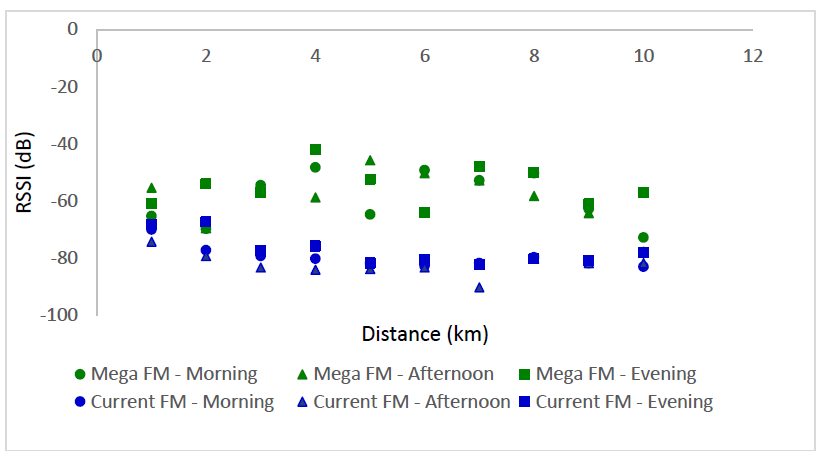
Reliable frequency modulation (FM) broadcast coverage depends significantly on signal strength variations with distance and short-term environmental conditions. This study presents an exploratory field investigation of Received Signal Strength Indicator (RSSI) variations from four FM radio stations - Mega FM, Crown FM, Current FM, and DBS Warri - in Warri, Delta State, Nigeria. Observational field measurements were obtained at distances between 1 km and 10 km during morning, afternoon, and evening periods in a one-day pilot campaign conducted in June 2024. Alongside RSSI, temperature and humidity were recorded to examine their associations with short-term signal propagation. The results show a clear decay of RSSI with increasing distance and consistent diurnal variability across all stations. Correlation analysis indicates that humidity exhibits a stronger negative association with RSSI (–0.45 to –0.61) than temperature (+0.12 to –0.22). To further quantify these relationships, a pooled ordinary least squares regression incorporating station-specific effects was performed. Distance emerged as a statistically significant predictor of RSSI, while humidity showed a weak negative influence and temperature was not statistically significant within the short observation window. Station-dependent differences in RSSI were also evident, reflecting variations in transmitter characteristics. As a temporally limited pilot study, the findings indicate associations rather than causal relationships, but they demonstrate the value of combining distance-based measurements with environmental parameters and station-specific effects in FM propagation analysis within tropical urban environments. The study provides a foundation for extended multi-day measurements and future predictive modelling of FM broadcast signal behaviour.
Downloads
Published
Issue
Section
Categories
License
Copyright (c) 2026 Akpevwe Ejiro Ohworho, Jude Oruaode Vwavware, Ezekiel Onoriode Abriku

This work is licensed under a Creative Commons Attribution 4.0 International License.


