
ANALYSIS OF PETROLEUM TANKER FIRE AND EXPLOSION ACCIDENTS IN NIGERIA
DOI:
https://doi.org/10.33003/fjs-2025-0912-4463Keywords:
Petroleum tanker, Fire, Explosion, AccidentAbstract
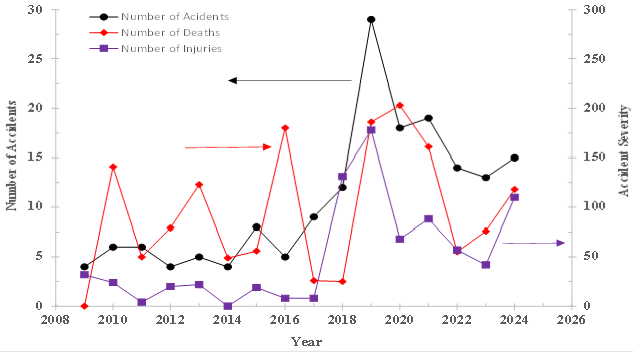
The menace of petroleum tanker fire and explosion accidents in Nigeria continues to increase in recent years with attendant consequences of loss of lives and properties. The present study performed a 16-year in-depth analysis of petroleum tanker fire and explosion accidents in Nigeria using secondary sources of data. It employed a mixed-method relating both qualitative and quantitative data collection and analysis techniques using 171 accident cases, 1822 deaths and 811 injuries. Year 2019 recorded the highest number of accidents of injuries as 29 and 178 respectively. However, the highest number of fatalities of 294 occurred in 2024. Also, the entire tanker accidents fall within “unacceptable” risk level in relation to societal risk curves. Five major aggravating factors namely mechanical, collision, impact, scooping and human were found to increase the severity of the accidents. Human factor accounted for both the highest number of accidents and injuries as 101 and 416 respectively, whereas, scooping of spilled petroleum products led to the peak number of fatalities of 730. Finally, an overview of the causes and aggravating factors of petroleum tanker accidents in Nigeria as well as the corresponding preventive/mitigative measures was given in Haddon Matrix. Regulatory agencies should strengthen tanker safety enforcement through rigorous vehicle inspection, driver training, and strict penalties for traffic violations. Public education campaigns must discourage fuel scooping. Investment in road infrastructure, emergency response systems, and pre-event preventive strategies, guided by the Haddon Matrix, is essential to reduce tanker fire and explosion risks.
References
Adsuls, N., Acharya, S. and Acharya A.S. (2017). An Overview Of Determinants Of Road Traffic Accidents. In book: Road Traffic and Safety Chapter: 6. Publisher: Nova Science Publishers, Editors: Amit Agrawal, Geetha R. Menon.
Al-Masaeid, H. R. (1996) Fuel tanker accidents: Causes and safety measures from driver's perspective. Journal of Traffic Medicine 24(1-2):49-53.
Carpenter, W. (2024). The Main Oil Producing Countries in Africa. Available at https://www.investopedia.com/articles/investing/101515/biggest-oil-producers-africa.asp
Chanut, C., Casal, J., Dusserre, G. and Darbra, R.M. (2015). Domino effect accidents in hazardous materials transportation by road and rail (2009). 7th European Meeting on Chemical Industry and Environment. Tarragona-Spain (10-12 June 2015). EMChIE Conference Proceedings Volume 1. Edited by Christophe Bengoa.
Creswell, J.W. (2014). Research Design: Qualitative, Quantitative and Mixed Methods Approaches (4th ed.). SAGE Publications Inc. Los Angeles
Dare, A.A., Oke, S.A. and Olanrewaju, K.L. (2009), "Incidents of fire outbreaks during fuel truck accidents in Oyo State", Disaster Prevention and Management, Vol. 18 No. 4, pp. 443-450. https://doi.org/10.1108/09653560910984492
Ewbank, C., Gupta, S., Stewart, B. T., Kushner, A. L. and Charles, A. A. (2019). systematic review of oil tanker truck disasters: Identifying prevention targets. Burns., 45(4):905-913. doi: 10.1016/j.burns.2018.12.010. Epub 2019 Feb 23. PMID: 30808527.
Georef (2024). Federal Republic of Nigeria, Population Density based on 2022 Estimates. Available at https://www.geo-ref.net/ph/nga.htm.
Hajizadeh, R., Koohpaei, A., Khodaparast, E. and Taheri, F. (2022). A survey on road hazardous material transportation accidents in Iran, International Journal of Injury Control and Safety Promotion, 29:3, 312-320, DOI:10.1080/17457300.2022.2029909)
Maselli, G., Macchiaroli, M. and Nesticò, A. (2021). ALARP Criteria to Estimate Acceptability and Tolerability Thresholds of the Investment Risk. Applied Sciences, 11(19):9086. http://10.3390/app11199086
Na’inna, A. M., Ani, C. L. and Kassimu, A. A. (2025). Regional and State Analysis of Petroleum Tanker Fire and Explosion Accidents in Nigeria. Bima Journal of Science and Technology, 9(2A): 102-116. https://doi.org/10.64290/bimagombe.v9i2A.1084
Na'inna, A.M. (2024). Overview of Petroleum Tanker Fire and Explosion Accidents in Nigeria from 2009 to 2024. Nigerian Research Journal of Engineering and Environmental Sciences, 9(2): 552-575. https://doi.org/10.5281/zenodo.14565617.
Na'inna, A.M. (2025). Overview of Petroleum Tanker Fire and Explosion Accidents in Nigeria from 2009 to 2024 [Data set]. Zenodo. https://doi.org/10.5281/zenodo.15032760
Odogun, A. (2021) Developing a safety assessment framework for the transportation of petroleum products: A case study of the Nigerian petroleum downstream industry. University of Wolverhampton. http://hdl.handle.net/2436/624943
Oggero, A., Darbra, R.M., Muñoz, M., Planas, E. and Casal, J. (2006) 'A survey of accidents occurring during the transport of hazardous substances by road and rail', Journal of hazardous materials, 133(1), pp. 1-7. doi: https://doi.org/10.1016/j.jhazmat.2005.05.053.
Downloads
Published
Issue
Section
Categories
License
Copyright (c) 2025 Na’inna Abdulmajid M., Ani Chukwuemeka L., Kassimua Abdullahi A.

This work is licensed under a Creative Commons Attribution 4.0 International License.


