
ENHANCED GATED RECURRENT UNIT DEEP LEARNING MODEL FOR VEHICULAR NETWORKS ANOMALY-BASED INTRUSION DETECTION
DOI:
https://doi.org/10.33003/fjs-2026-1002-4351Keywords:
Gated Recurrent Unit (GRU), Vehicular Ad Hoc Networks (VANETs), Intrusion Detection System (IDS), Adaptive Synthetic Sampling (ADASYN), Principal Component Analysis (PCA)Abstract
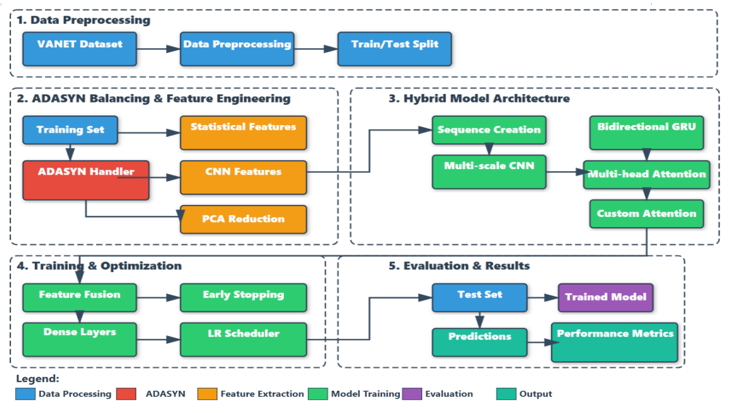
ABSTRACTThe growing connection and dynamic communication patterns of vehicle-to-everything (V2X) systems provide serious security concerns for modern vehicular networks. In vehicle contexts, traditional intrusion detection techniques are insufficient for identifying new assaults and adjusting to quickly evolving network topologies. An improved Gated Recurrent Unit (GRU)-based deep learning model for anomaly-based intrusion detection in vehicular networks is presented in this study. Multi-scale convolutional neural networks (CNN) with variable kernel sizes (3, 5, and 7) for temporal pattern recognition, principal component analysis (PCA) for dimensionality reduction while maintaining 95% variance, multi-head attention mechanisms for focused feature engineering, statistical feature extraction for capturing distributional characteristics of traffic patterns, and Adaptive Synthetic Sampling (ADASYN) for handling imbalanced datasets are all integrated into the suggested architecture. The hybrid CNN-GRU model combines CNN's spatial feature extraction capabilities with bidirectional GRU layers to capture temporal dependencies. The findings of performance evaluation on five publicly accessible datasets (NSL-KDD, CAN_HCRL_OTIDS, Car-Hacking, Network-Traffic, and Road-Traffic) are remarkable, with accuracy rates ranging from 97.09% to 100%. The CAN_HCRL dataset exhibits perfect classification. The model successfully detects a variety of attack types, such as denial-of-service, replay attacks, and fake information injection, while maintaining low false positive rates (lowest value, 0.01%) and high ROC-AUC scores (0.9000 to 1.0000). ADASYN greatly increased minority class detection by improving class balance by up to 99.4%. By offering a reliable, real-time intrusion detection solution appropriate for safety-critical autonomous driving applications, this research increases vehicular network security.
References
References
Aidil Redza Khan; Mohd Faizal Jamlos; Nurmadiha Osman; Muhammad Izhar Ishak: "DSRC
Technology in Vehicle-to-Vehicle (V2V) and Vehicle-to-Infrastructure (V2I) IoT System for
Intelligent Transportation System (ITS): A Review". January 2022. DOI:10.1007/978-981-33
-4597.-3_10.
Thanh Nguyen Canh; Xiem HoangVan: "Machine Learning-Based Malicious Vehicle Detection for
Security Threats and Attacks in Vehicle Ad-Hoc Network (VANET) Communications".
Corpus ID: 267028266. DOI:10.1109/RIVF60135.2023.10471804.
Yan Lin Aung; Shanshan Wang; Wang Cheng: " Intrusion Detection System for In-Vehicle Networks". Information Security: 26th International Conference, ISC 2023, Groningen, The Netherlands, November 15–17, 2023, ProceedingsNov 2023Pages 79–98. DOI:10.1007/978-3-031-49187- 0_5.
Junchao Xiao; Lin Yang; Fuli Zhong; Hongbo Chen: "Robust anomaly-based intrusion detection system for in-vehicle network by graph neural network framework". May 2022Applied Intelligence 53(2). DOI:10.1007/s10489-022-03412-8.
Ghayth ALMahadin; Yassine Aoudni; Mohammad Shabaz; Anurag Vijay Agrawal; Ghazaala Yasmin; Esraa Saleh Alomari; Hamza Mohammed Ridha Al-Khafaji; Debabrata Dansana; Renato R. Maaliw III: "VANET Network Traffic Anomaly Detection using GRU-Based Deep Learning Model". DOI 10.1109/TCE.2023.3326384.
Saleha Saudagar; Rekha Ranawat: "An Amalgamated Novel IDS Model for Misbehaviour Detection using VeReMiNet". DOI:10.1016/j.csi.2023.103783.
Kothai G; Poovammal E: "A hybrid CNN-GRU-based intrusion detection system for secure communication in vehicular adhoc network". DOI:10.1080/19393555.2024.2361244.
Monika Arya; Hanumat Sastry; Bhupesh Kumar Dewangan; Mohammad Khalid Imam Rahmani ; Surbhi Bhatia; Abdul Wahab Muzaffar; Mariyam Aysha Bivi: "Intruder Detection in VANET Data Streams Using Federated Learning for Smart City Environments". Electronics 2023, 12(4), 894; DOI:10.3390/electronics12040894.
Kaijun Zhang; Jiayu Yang; Yangfei Shao; Lehua Hu: "Intrusion Detection Model for Internet of Vehicles Using GRIPCA and OWELM". January 2024IEEE Access PP(99):1-1. DOI:10.1109/ ACCESS.2024.3368392.
Hsiao-Yuan Hsu; Nai-Hsin Cheng; Chun-Wei Tsai: "A Deep Learning-Based Integrated Algorithm for Misbehavior Detection System in VANETs". ACM ICEA '21: Proceedings of the 2021 ACM International Conference on Intelligent Computing and its Emerging Applications December 2021Pages 53–58. DOI:10.1145/3491396.3506509.
Defeng Ding; Yehua Wei; Can Cheng; Jing Long: "Intrusion Detection for In-Vehicle CAN Bus Based on Lightweight Neural Network". Journal of Circuits, Systems and ComputersVol. 32, No. 07, 2350110 (2023). DOI:10.1142/S0218126623501104.
Gupta, R., & Singh, A. (2024). Comparative analysis of integrated development environments for machine learning project development. International Journal of Software Engineering and Applications, 15(2), 45-62. DOI: 10.5121/ijsea.2024.15204
Martinez, L., Chen, W., & Park, S. (2024). Enhancing deep learning development efficiency through intelligent code completion systems. IEEE Software, 41(3), 78-86. DOI: 10.1109/MS.2024.3367842.
Thompson, J., Anderson, M., & Roberts, K. (2024). Version control best practices for machine learning model development and hyperparameter optimization. ACM Transactions on Software Engineering and Methodology, 33(2), Article 48. DOI: 10.1145/3632146.
Rahman, M. A., Hossain, M. S., & Islam, N. (2024). Machine learning library ecosystems for cybersecurity applications: Performance analysis and selection criteria. Expert Systems with Applications, 241, 122634. DOI: 10.1016/j.eswa.2023.122634.
Kim, J., Lee, S., & Choi, H. (2024). Rapid prototyping methodologies for deep learning-based network intrusion detection systems. Neural Computing and Applications, 36(8), 4321-4338. DOI: 10.1007/s00521-023-09234-x
Downloads
Published
Issue
Section
Categories
License
Copyright (c) 2026 Tose Oziegbe, Abel Edje, Maureen Akazue

This work is licensed under a Creative Commons Attribution 4.0 International License.


