
FOODCARDQR: A SECURED STUDENT FOOD CARD MANAGEMENT AND PAYMENT SYSTEM USING QR CODE AUTHENTICATION
DOI:
https://doi.org/10.33003/fjs-2026-0912-4341Keywords:
FoodCardQR, QR Code, Authentication, Food Card System, Secure Payment, Cafeteria ManagementAbstract
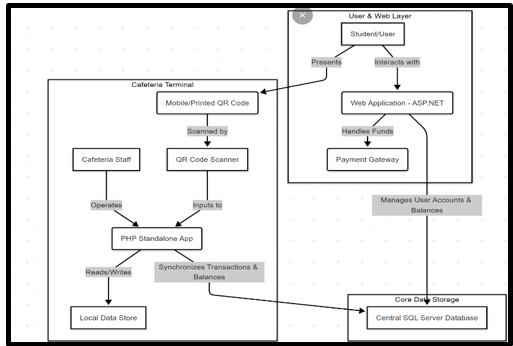
This study presents the FoodCardQR: A secured student food card management and payment system using QR code authentication. The system provides students with a seamless platform for registration, wallet funding, and balance monitoring, while cafeteria terminals enable fast, offline QR-based transactions. Core technologies such as ASP.Net, C#.Net, SQL Server, and the Interswitch Payment Gateway were combined with the ZXing.Net library to ensure secure, reliable, and efficient operations. Hardware requirements were deliberately kept moderate, making the system practical for deployment in typical campus environments. By merging QR code authentication with secure payment processing, the system streamlines operations, improves user experience, and enhances accountability through accurate reporting. Experimental evaluation demonstrated a transaction success rate of approximately 92%, average processing times less than 10 seconds, audit accuracy of 95%, and positive user satisfaction, indicating both reliability and usability. With these findings, it confirms that the FoodCardQR model addresses the inefficiencies and security challenges of traditional cash-based and manual payment methods associated with cafeterias on campus. The model will provide a scalable and dependable framework for modernizing cafeteria management in educational institutions.
References
Abdullah, F., & Aziz, N. A. (2014). The role of technology in enhancing the learning environment: A study on QR code integration. Journal of Educational Technology, 11(2), 123-135.
Adewale, T. A., Yusuf, M., & Omotosho, F. (2021). RFID technology in cafeteria automation. IEEE Transactions on Industrial Electronics, 68(5), 1150–1159.
Adlet, K., Zhanagul, S., Tolkin, Y., Olga, F., Nazymgul, A., & Kadir, N. (2022). Interactive educational technologies as a factor in the development of the subjectivity of university students. World Journal on Educational Technology, current issues, 14(3), 533-543. https://www.ceeol.com/search/article-detail?id=1049236
Agarwal, S., & Zhang, J. (2022). Digital payments in higher education: adoption, challenges, and impact. Journal of Financial Technology & Education, 14(3), 112–129. https://doi.org/10.1016/j.jfte.2022.06.005
Anazia, E. K., Eti, E. F., Ovili, P. H., & Ogbimi, O. F. (2024). Speech-To-Text: A secured real-time language translation platform for students. FUDMA Journal of Sciences (FJS), Vol. 8 No. 6, December, 2024, DOI: https://doi.org/10.33003/fjs-2024-0806-2890
Anazia, K.E., Ubrurhe, O., Eti, I.F., Okeke. O.V., & Francis, I.O. (2025). A hybrid algorithm for improving recognition system in human activities. International Journal of Multidisciplinary Research and Growth Evaluation, www.allmultidisciplinaryjournal.com, ISSN (online): 2582-7138 Volume: 06 Issue: 03, DOI: https://doi.org/10.54660/.IJMRGE.2025.6.3.584-591
Avoine, G., Hernandez-Castro, J. C., & Martin, T. (2021). RFID security and privacy: A research survey. ACM Computing Surveys, 53(6), 1–35. https://doi.org/10.1145/3391190
Chen, Y., & Li, X. (2024). QR code payment systems: Integration and user satisfaction in Asian markets. Journal of Payment Systems, 10(1), 22-45
Chen, W., Sun, J., & Huang, L. (2023). Cashless Financial Aid Disbursement: The Role of QR-Based Payment Platforms. Journal Financial Inclusion in Education, 10(2), 35–50. https://doi.org/10.1016/j.jfie.2023.02.008
Deng, Y., Zhang, Z., & Li, C. (2024). A review of RFID authentication protocols: Security models and future directions. IEEE Access, 12, 45712–45730. https://doi.org/10.1109/ACCESS.2024.3376541
Eren, B. A. (2022). QR code m-payment from a customer experience perspective. Journal of Financial Services Marketing, https://doi.org/10.1057/s41264-022-00186-5
Ertem, M. A., Buyukozkan, G., & Aras, N. (2017). RFID-based cafeteria payment systems: A case study in institutional food services. Journal of Foodservice Business Research, 20(5), 479–497. https://doi.org/10.1080/15378020.2017.1333250
Gupta, P., & Sharma, K. (2023). QR code-based cashless transactions in higher education: trends and challenges. International Journal Educational. Technology & Finance, 12(3), 77–93. https://doi.org/10.1016/j.ijetf.2023.03.010
Johnson, T., & Riley, K. (2019). Embedded systems and microcontrollers: concepts and design. Engineering Systems Journal, 4(2), 65–80.
Kale, G., & Dube, S. (2020). Web-based e-wallet canteen management system using RFID. International Resources Journal Engineering Technology (IRJET), 7(8), 3735.
Kanbul, S., & Guldal, N. K. (2019). The results of needs analysis for a mobile application which will be developed with the purpose of supporting the intra-faculty communication and professional development of academics. World Journal On Educational Technology, 11(1), 10-20. https://eric.ed.gov/?id=EJ1205378
Karygiannis, T., Eydt, B., Barber, G., Bunn, L., & Phillips, T. (2018). Guidelines for securing radio frequency identification (RFID) systems. National Institute of Standards and Technology (NIST). https://doi.org/10.6028/NIST.SP.800-98
Kim, E., Park, N., & Lee, Y. (2021). The impact of reward programs on QR code payment system adoption among teenagers. Journal of Retailing and Consumer Services, 58, 102242.
Kim, S., & Park, Y. (2023). Integration of QR payments with university id systems: a secure and efficient approach. Journal of Digital Identity & Payment Security, 14(1), 58–74. https://doi.org/10.1016/j.jdips.2023.01.007
Kumar, R., & Agarwal, P. (2022). The role of QR code payments in enhancing digital transactions: a case study of emerging markets. International Journal of Financial Technology & Innovation, 9(4), 65–82. https://doi.org/10.1016/j.ijfti.2022.11.009
Ngai, E. W. T., Moon, K. K. L., Riggins, F. J., & Yi, C. Y. (2008). RFID research: An academic literature review (1995–2005) and future research directions. International Journal of Production Economics, 112(2), 510–520. https://doi.org/10.1016/j.ijpe.2007.05.004
Nguyen, M. T., & Alang, T. (2024). When do shoppers prefer using QR codes? Empirical evidence. Vietnam Future Business Journal, 10(1), 105. https://link.springer.com/article/10.1186/s43093-024-00391-9
Sandeep, M. V. S., Dube, S., Challagundla, H., & Chand, P. N. (2023). Visual cryptography-based secure QR payment system design and implementation. International Journal on Future Revolution in Computer Science & Communication Engineering, 9(1), 40–46.
Sani, M., & Abba, U. (2025). Analysis of using biometric authentication system in katsina state institute of technology and management (KSTIM) library. FUDMA Journal of Sciences (FJS), Vol. 9 No. 12, December, 2025, pp 126 – 131 8 DOI: https://doi.org/10.33003/fjs-2025-0912-4244
Sehat, N. S., Daud, S. R., Ahmad, K. S., Suhaime, I. L., & Jogeran, J. (2024). Acceptance factors affecting the intention to use mobile payments: QR code applications. Information Management and Business Review, 16(1(I)), 287–304. https://doi.org/10.22610/imbr.v16i1(I).3694.
Shahril, S.A., Jamal, S.A., Putra, F.K.K. & Amir, A.F. (2025). QR code payment technology in university commercial restaurants: Analyzing student perceptions of usefulness, ease, and trust. Global Journal of Sociology, 15(1), 64-75. https://doi.org/10.18844/gjit.v15i1.9816
Smith, J., & Johnson, P. (2023). Adoption of mobile payments in university settings: A longitudinal study. Journal of Business Research, 66, 347-355.
Suh, B., Han, I., & Lee, S. H. (2017). Understanding trust in virtual communities: An exploratory study on technology facilitation. Journal of Computer-Mediated Communication, 12(2), 593-613.
Tu, M., Wu, L., Wan, H., Ding, Z., Guo, Z., & Chen, J. (2022). The adoption of QR code mobile payment technology during COVID-19: A social learning perspective. Frontiers in Psychology, 12, 798199. https://doi.org/10.3389/fpsyg.2021.798199
Yadav, O. P., Kumar, A., Shandilya, K., & Kumar, S. (2024). Dynamic QR codes: A solution for secure mobile payments. In Proceedings of the International Conference on Cybersecurity and Cybercrime (Vol. 11). https://doi.org/10.19107/CYBERCON.2024.09
Yamin, M. A. Y., & Abdalatif, O. A. A. (2024). Examining consumer behavior towards adoption of quick response code mobile payment systems: transforming mobile payment in the fintech industry. Humanities and Social Sciences Communications, 11(1), 1-11. https://www.nature.com/articles/s41599-024-03189-w
Downloads
Published
Issue
Section
Categories
License
Copyright (c) 2026 Kizito Eluemunor Anazia, Rebecca Okeoghene Idama, Wifred Adigwe, Justine Ifeose

This work is licensed under a Creative Commons Attribution 4.0 International License.


