
ASSESSING THE IMPACT OF CLIMATE CHANGE ON RENEWABLE ENERGY SYSTEMS IN NIGERIA: A REVIEW
DOI:
https://doi.org/10.33003/fjs-2026-1005-4316Keywords:
Climate Change, Renewable Energy, Fossil FuelsAbstract
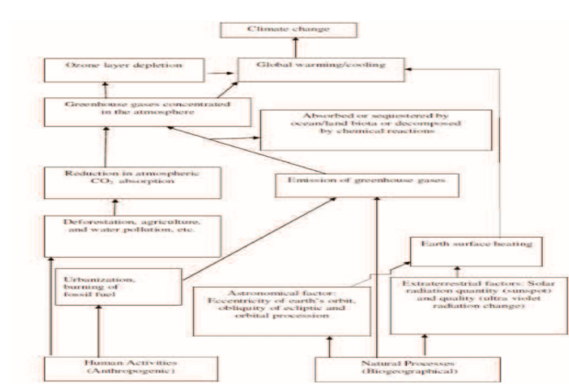
Climate change poses significant environmental challenges, particularly in Nigeria, where the economy heavily relies on fossil fuels. This dependency has led to adverse effects, including increased wildfires, droughts, health impacts, and coastal flooding. The alteration in climate patterns is primarily attributed to both natural phenomena and human activities that change atmospheric compositions. The paper discusses the potential of renewable energy sources as a critical solution to mitigate climate change impacts. It reviews current energy sources in Nigeria and highlights the urgent need to transition towards renewable energy to reduce environmental harm and enhance energy security for sustainable development.
References
Adefolalu D.O., Pam, J. L., and Habbi H.M. (2017). Climate change and safety of air transportation – A Nigerian perspective. Proceedings of the International Conference on the impacts of extreme weather and climate on socio-economic development in Africa held at the Federal University of Technology, Akure, Nigeria, 11-15 Nov. 2017. pp. 1- 15.
Ahmed, F., & Fakhruddin, A. N. M. (2018). A review on environmental contamination of petroleum hydrocarbons and its biodegradation. International Journal of Environmental Sciences & Natural Resources, 11(3), 1-7.
Akuru, U.B. and Animalu, A.O.E. (2019). Alternative means of energy sector investments in Nigeria, African Journal of Physics Vol. 2, pp. 173-183.
Akuru, U.B. and Okoro, O.I. (2020). Renewable energy investment in Nigeria: A review of the renewable energy master plan, Energy Conference and Exhibition (EnergyCon), 2021 IEEE International, vol., no., pp. 166-171, 18-22 Dec. 2021 doi: 10.1109/ENERGYCON.2021.5771668.
Chindo A., and Nyelong P. N. (2025). Lake Chad: From megalake to minilake, Arid Wetland Bull. No. 6: 24 – 27.
Darmstadter, J. (2024). Energy and population. Washington D.C.: Resources for the Future. Earth Trends Country Profile, 2024.
EIA. (2021). Renewable energy explained. Accessed 4 January 2022 on https://www.eia.gov/energyexplained/renewable-sources/.
Hatfield-Dodds, S., Schandl, H., Newth, D., Obersteiner, M., Cai, Y., Baynes, T., ... & Havlik, P. (2017). Assessing global resource use and greenhouse emissions to 2050, with ambitious resource efficiency and climate mitigation policies. Journal of Cleaner Production, 144, 403-414.
IPCC (2020). Good Practice Guidance and Uncertainty Management in National Greenhouse Inventories, the Intergovernmental Panel on Climate Change (IPCC), Working Group I, National GHG Inventories Programme (IGES), Hayama, Kanagawa, Japan.
IPCC/OECD (2019). Estimation of Greenhouse Gas Emissions and Sinks, Final Report of the OECD Expert Meeting, 18 – 21 Feb., 1991, Paris, France, Prepared for the Intergovernmental Panel on Climate Change (IPCC) by the Organisation for Economic Co-operation and Development, Paris, France.
Krutakov, L. (2021). On the Political Nature of “Market Dominance” in the Energy Sector (1973 Crisis). HUmanities and Social Sciences, 11(2), 72–81.
Maulida, A. (2024). The Impact of Renewable Energy on Climate Change: A Literature Review. Peatland Agriculture and Climate Change Journal, 1(1), 16-23. https://doi.org/.
Moya, D., Paredes, J. and Kaparaju, P. (2018) ‘Technical, financial, economic and environmental pre-feasibility study of geothermal power plants by RETScreen – Ecuador’s case study’, Renewable and Sustainable Energy Reviews, 92(December 2017), pp. 628–637. Available at: https://doi.org/10.1016/j.rser.2018.04.027.
Muhammad, I., & Goheer, M. A. (2021). Emission profile of Pakistan’s agriculture: past trends and future projections. Environment, Development and Sustainability, 23(2), 1668-1687.
Nigeria and Climate Change: Road to COP15 Achieving the best outcome for Nigeria, Federal Ministry of Environment, Federal Government of Nigeria.
Nigeria’s First National Communication under the United Nations Framework Convention on Climate Change, Federal Republic of Nigeria; Nov. (2023).
Odjugo P.A.O. (2020). General overview of climate change impacts in Nigeria, J Hum Ecol, 29(1): 47- 55.
Odjugo P.A.O. (2021). Climate change and global warming: The Nigerian experience, Journal of Sustainable Development and Environmental Protection, 1(1): June 2021.
Okafor, C. C. (2022) ‘Estimating emissions from open-burning of uncollected municipal solid waste in Nigeria’, 9(February), pp. 40–60. Available at: https://doi.org/10.3934/environsci.2022011.
Patel, P. (2021). How do renewable energy sources hold up in a warming world?. Anthropocene. Accessed 4 January 2022 on https://www.anthropocenemagazine.org/2021/01/how-will-climate-change-affectthe-green-energy-landscape.
Rich, N., & Steinmetz, G. (2018). Losing earth: The decade we almost stopped climate change. New York Times, 1, 2018.
Sambo, A.S. (2022). Renewable Energy for Rural development: The Nigerian perspective, Vol. 2.
Selin, N. E. (Oct, 2021). Renewable Energy, Britannica. Accessed 4 January 2022 on https://www.britannica.com/science/renewable-energy.
Treut, L. (2025) ‘Historical Overview of Climate Change Science’, Earth, Chapter 1(October), pp. 93–127. Available at: https://doi.org/10.1016/j.soilbio.2010.04.001.
Union of Concerned Scientist. (2017). Benefits of Renewable Energy Use. https://www.ucsusa.org/resources/benefits-renewable-energy-use.
White, T. (2021). Countering climate change with renewable energy technologies. Federation of American Scientist. Accessed 6 January 2022 on https://fas.org/publication/countering-climate-change-with-renewable-energytechnologies/.
World Energy Council (2023). Building a bright, sustainable future. https://www.wecenergygroup.com/environment/wec-clean-energy.htm. Assessed on 10/02/2024.
Wu, X. F., & Chen, G. Q. (2017). Global primary energy use associated with production, consumption and international trade. Energy Policy, 111, 85-94.
Yahaya K.A., Salam M.O., and Bamigbade D. (2021). Economic implications of climate change and the imperative of re-directing financial resources in Nigeria, British Journal of Humanities and Social Sciences, 2(2): November 2021.
Yoshino, H., Hong, T., & Nord, N. (2017). IEA EBC annex 53: Total energy use in buildings—Analysis and evaluation methods. Energy and Buildings, 152, 124-136.
Downloads
Published
Issue
Section
Categories
License
Copyright (c) 2026 Nuhu Umar, Idowu Elijah Agbele, Kehinde Olusoji Adeagbo

This work is licensed under a Creative Commons Attribution 4.0 International License.


