
RESOURCE DEPENDENCE AND MACROECONOMIC ADJUSTMENT: A VAR ANALYSIS OF OIL PRICE SHOCKS IN NIGERIA
DOI:
https://doi.org/10.33003/fjs-2025-0912-4184Keywords:
: Vector Autoregressive (VAR), Real Gross Domestic Product (GDP), Oil Price Shocks (OPC)Abstract
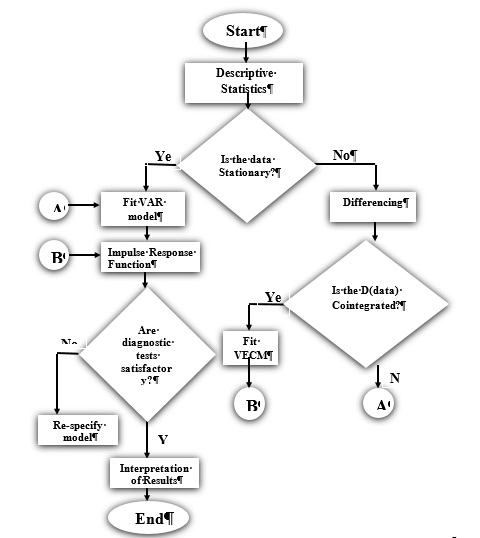
Nigeria’s heavy reliance on oil revenue makes its economy highly vulnerable to fluctuations in global oil prices, often triggering inflationary pressures and unstable growth. This study investigates the macroeconomic adjustment mechanisms to oil price shocks in Nigeria from 1994 to 2023, addressing the gap in empirical evidence on how oil dependence shapes domestic price and interest rate responses. Using a Vector Auto regression (VAR) model with quarterly data on oil price (OPC), real gross domestic product (RGDP), inflation rate (INF), and interest rate (INT) from the Central Bank of Nigeria, the study applies unit root and stability diagnostics, impulse response functions, and variance decomposition to capture both short- and long-run dynamics. Results indicate that oil price shocks significantly increase inflation and interest rates (p < 0.05), while RGDP responds positively to oil price changes at lag 3 before declining in later periods. Inflation negatively affects RGDP at lags 2–3, confirming short-term overheating effects. The model explains 78% of RGDP, 71% of inflation, 80% of interest rate, and 70% of oil price variations, affirming strong predictive power. These findings support the resource dependence theory and Dutch Disease hypothesis, revealing that oil-driven growth amplifies macroeconomic volatility The study recommends economic diversification, fiscal savings for future shocks, and reforms to boost agriculture and manufacturing. Prudent management of government spending and interest rates is essential to ensure price stability and long-term growth.
References
Abaas, M. S., Chygryn, O., Kubatko, O. & Pimonenko, T. (2018). Social and economic drivers of national economic development: the case of OPEC countries. Problems and Perspectives in Management, 16(4), 155-168. doi: https://doi.org/10.21511/ppm.16(4).2018.14
Akinola, A, O., (2022), 'The Nigerian Oil Economy and the Rentier State', in T. Falola, and M. M. Heaton (Eds.), The Oxford Handbook of Nigerian History. Oxford University Press, (2022; online edn, Oxford Academic, 18 2022), https://doi.org/10.1093/oxfordhb/9780190050092.013.27.
Apere O. & Ijomah A. M. (2013). Macroeconomic Impact of Oil Price Levels and Volatility in Nigeria. International Journal of Academic Research in Economics and Management Sciences 2(4), 15-25.
Bamaiyi, G. (2024). Effect of oil price shocks on selected macroeconomic variables in Nigeria (1990-2021). International Journal of Development and Economic Sustainability. 12(1), 12-25.
Corden, W. M., & Neary, J. P. (1982). Booming Sector and De-industrialisation in a Small Open Economy. The Economic Journal, 92(368), 825–848.
Corden, W.M. “Boom Sector and Dutch Disease Economics: Survey and Consolidation.” Oxford Economic Papers 36, no. 3(1984): 359-80.
Egbe, U. U., Stephen, A. S., Emmanuel, O., and Uno, K. A. (2022). Vector Auto-Regressive (VAR) model of some Nigeria economic indicators. Journal of Science, Engineering and Technology. 9(2), 87-100.
Gbadamosi I.I., Ayoola F.J., Adeosun O.T. (2022), Crude Oil Price and Macroeconomic Variables Nexus: Impact on Nigeria’s Economic Growth. African Journal of Mathematics and Statistics Studies 5(3), 126-141. DOI: https://doi.org/10.52589/AJMSSGWHHVFP0
Ikechi, K. S & Anthony, N. (2020) Global Oil Price Shocks and Effects on Economic Growth: An Econometric Investigation of Nigeria. International Journal of Innovation and Economic Development, 6(4), 7-26, http://dx.doi.org/10.18775/ijied.1849-7551-7020.2015.64.2001
Oduyemi, G., & Owoeye, T. (2020). Oil Price Fluctuation and Health Outcomes in an Oil Exporting Country: Evidence from Nigeria. International Journal of Energy Economics and Policy, 10(4), 212–220. https://econjournals.com/index.php/ijeep/article/view/9266
Onakoya, A. B., and Agunbiade, O. A. (2020). Oil sector performance and Nigerian macroeconomic variables. International Journal of Economics, Management and Accounting. 1(2020), 35-62.
Osintseva, M. A (2021) Influence of Oil Factor on Economic Growth in Oil-exporting Countries. International Journal of Energy Economics and Policy, 12(1), 217-224, DOI: https://doi.org/10.32479/ijeep.11794
Pfeffer, J., & Salancik, G. R. (1978). The external control of organizations: A resource dependence perspective. New York, NY: Harper & Row.
Umar, G., and Kilishi, A. A. (2010). Oil price shocks and the Nigeria economy: A variance autoregressive (VAR) Model. International Journal of Business and Management. 5(8).
Downloads
Published
Issue
Section
Categories
License
Copyright (c) 2025 Ahmadu A. N., Yakubu N., Muhammad S., Balansana K. I.

This work is licensed under a Creative Commons Attribution 4.0 International License.


