
CANCER HEALTH RISKS ASSESSMENT FROM SELECTED BOREHOLE AND WELL WATER SAMPLES IN DUTSE, JIGAWA STATE, NIGERIA
DOI:
https://doi.org/10.33003/fjs-2026-1001-4565Keywords:
Radon Concentration, Health Risk Assessment, Excess Lifetime Cancer Risk (ELCR), Jigawa State, Liquid Scintillation CountingAbstract
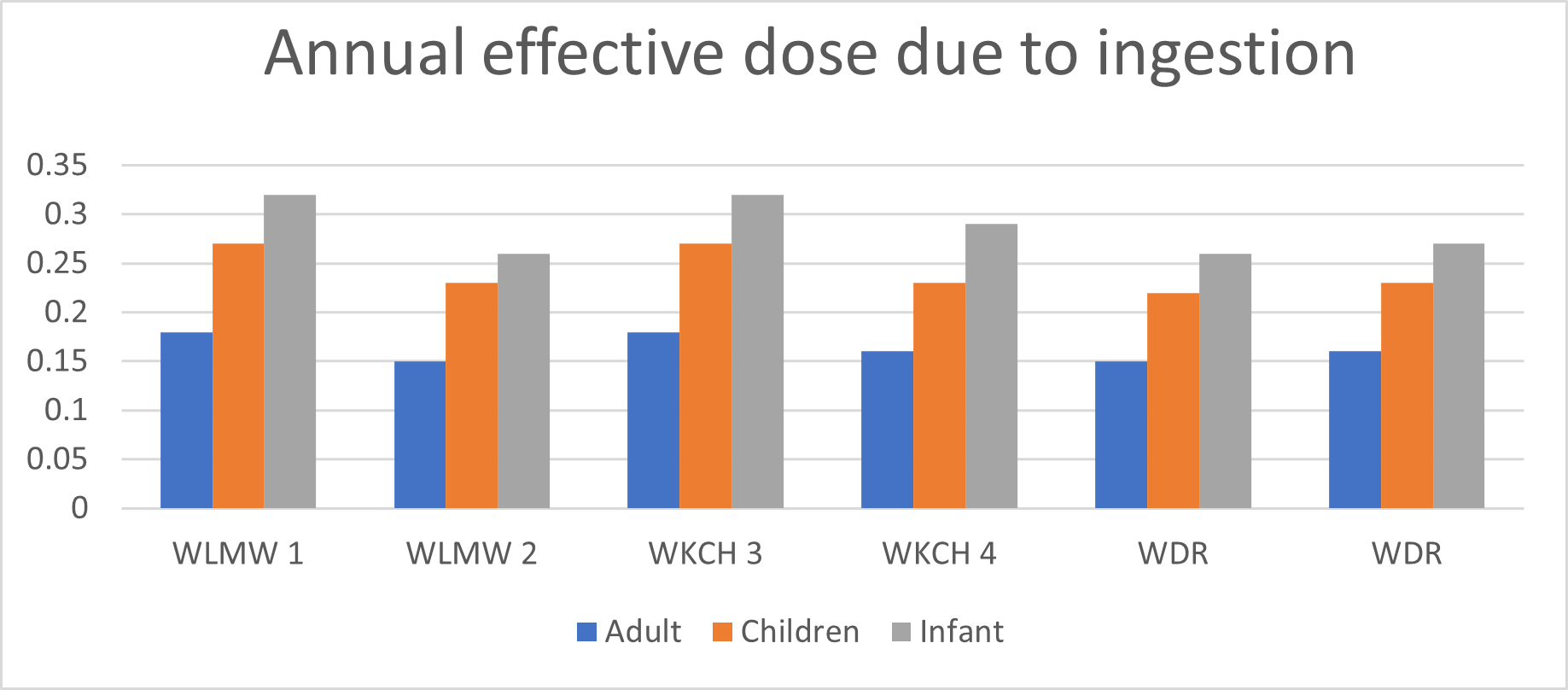
Radon being one of the major radioactive elements to human health among those contributing to background radiation. Due to its relatively heavy particles, radon’s alpha radiation can only travel short distances. While it cannot penetrate the skin, it can be inhaled and accumulate in the lungs. Herein, a total of ten borehole and well water samples was collected across five different selected wards in Dutse, the state capital of Jigawa state and analyze for Radon concentration. Liquid scintillation counter located at Ahmadu Bello University Zaria, Centre for energy research Zaria, was used to analyzed samples. The mean value of Radon concentration for well and borehole water samples was found to be 22.39 and 22.39 Bql-1 respectively, which exceeded the acceptable range of 10 Bql-1 by WHO (1993), and the world average value of 11.1 Bq/L set by the USEPA (1999); UNSCEAR (1993), and SON (2003). The annual effect tive dose and excess life cancer risk due to inhalation were found to be below the standard recommended value of WHO. However, for the annual effective dose and excess life cancer risk due to ingestion for both well and borehole water samples were found to be above the recommended value set by different standard organization. The finding of this study revealed that water used in these samples location is not safe for drinking and other domestic uses. As such we strongly recommended that the water used in these locations should undergo special treatment before used to avoid any possible health risk associated...
References
Abdulrasheed, J Muhammed, U.M Dankawu, S Isyaku, Isah H. Gumel, A. Yakubu (2025). Assessment of health Risk associated with Radon concentration for well water Sample in Katagum, Bauchi, Nigeria Dutse Journal of Pure and Applied Sciences (DUJOPAS), Vol. 11 No. 3b September 2025
Abba, L, Nasiru, R, Garba, N. N. and Ahmed, Y. A, (2020). Assessment of Annual Effective Dose Due to Inhalation and Ingestion of Radon in Water Samples from the Cement Industrial Area Of Sokoto, North-Western Nigeria. FUDMA journal of science Vol. 4 No., pp 615– 619.
Adams S. (2017). Assessment of radon-222 in some selected water sources at dutsin-ma town, Dutsin-ma local government area, katsina state. FUDMA journal of science Vol. 6 No., pp 147 – 153.
Abdulrasheed A, J. Muhammed, Abba Alhaji Bala, U.M Dankawu, N. Zubairu, H.Y Hafeez (2024) Assessment of Excess Life Cancer Risk from Radon Concentration in Borehole water Samples collected from Katagum LGA, Bauchi State, Nigeria” Dutse Journal of Pure and Applied Sciences (DUJOPAS), Vol. 10 No. 1c 2024
Adamoh Nojeeb Oyeyemi (2021) risk impact assessment of natural occurring radioactive materials (NORMS) from operation activities in uke gold mine in karu Nasarawa. Int. J. Environ. Sci. 11:493–508.
Aminu Kalip, (2020). Measurement of Radon Concentration in Borehole and Well Water, and Estimation of Indoor Radon Levels in Jos, Plateau State, Nigeria. International Journal of Pure and Applied Science Vol. 19 No.9
Ajiboye, Y., Isinkaye M. O., Badmus, G. O., Faloye, O. T. & Atoiki, V. (2022). Pilot groundwater radon mapping and assessment of health risk from heavy metals in drinking water of southwest, Nigeria.
Daniela Pacella, Filomena Loffredo, Maria Quarto (2023). Knowledge, risk perception and awareness of radon risks: A Campania region survey” Journal of Radiation research and applied science 16 10072
Dankawu, U. M., Adamu, G. D., Mahraz, M. N., Benedict, J. N., Yakubu, A. and Uzair. M. (2021). Determination of Radon Concentration and The Annual Effective Dose Due Inhalation for Some Borehole and Well Water Supply in Dutse, Jigawa State Nigeria. Journal of Science, Technology, Mathematics and Education (JOSTMED), Vol. 16 pp 22-24.
Dankawu, U. ., Ghosh, D., Naskar, A. ., David, G. ., Sharfaddeen, M. ., Salihu, A. . M., Shuwa, H. ., Yakubu, A., Isyaku, S., Olabimtan, S. ., Abdulrasheed, A., & Zarma, S. . (2024). Assessment of outdoor gamma exposure levels at some borehole and well sites in Dutse, Nigeria. Dutse Journal of Pure and Applied Sciences, 9(4b), 11–22. https://doi.org/10.4314/dujopas.v9i4b.2
Dankawu, U. M., Shuaibu, H. Y., Maharaz, M. N., Zangina, T., Lariski, F. M., Ahmadu, M., Zarma, S. S., Benedict, J. N., Uzair, M., Adamu, G. D., & Yakubu, A. (2022). Estimation of excess life cancer risk and annual effective dose for boreholes and well water in Dutse, Jigawa State Nigeria. Dutse Journal of Pure and Applied Sciences, 7(4a), 209–218. https://doi.org/10.4314/dujopas.v7i4a.22
EU. European Commission, (1998). European drinking water directive 98/83/EC of 3rd November 1998 on the quality of water intended for human consumption. Official J L 330. Official. Journal of the European Commission.
EU. European Commission, (2001). Commission recommendation of 20th December 2001 on the protection of the public against exposure to radon in drinking water. 2001/982/Euratom, L344/85.Official Journal of the European Commission
Garba N. N., N. Rabi’u, B. B. M. Dewu, U. Sadiq, H.A. Kutama, (2017). Annual Effective Dose Due To 222Rn Concentration in Well and Borehole Water Source of Zaria and Environs, Nigeria. Yusuf Maitama Sule University, Kano Faculty of Science 3rd Annual International Conference
Garba, Z. N. and Hussaini, A. R. (2018), Assessment of Radon Concentration in Underground Well Water from Selected Parts of Kaduna Metropolis. Chem Search Journal 9(2): 8 – 12,
Jidele P. A., Dosunmu O. G., Kolapo A., Ajayi K. F.,&Ademola K. A. (2021). Measurement of radon and potentially toxic elements concentrations in groundwater around Ota, Ogun State, Nigeria. International Journal of Environmental Quality, ISSN 2281-4485 - Vol. 42 (2021):42-49.
Kalip A. (2020). Measurement of radon concentration in borehole and well water, and estimation of indoor radon levels in Jos, Plateau State, Nigeria. International Journal of Pure and applied Science Vol. 19 No. 19
SON.(2003). Standard Organization of Nigeria (Inorganic constituents for drinking water Quality)
USEPA, United States Environmental Protection Agency, (1999). Health risk reduction and cost Analysis for radon in drinking water. Federal Register, Washington D.C. 64(38), 9559. Washington.
Tabar, E. and H. Yakut, (2014). Radon measurements in water samples from the thermal springs Of Yalova basin, Turkey. J Radioanal Nucl Chem 299:311–319
USEPA. (1993). (United States environmental protection agency) federal register 40 parts 141 and 142: National primary drinking water regulations; radionuclides: Proposed rule. U.S. Government Printing Office, Washington D.C. EPA/570/991/700.
UNSCEAR, (1993). United Nations Scientific Committee on the Effects of Atomic Radiation: Sources and effects of ionizing radiation, UNSCEAR report to the General assembly with Scientific annexes, Volume II. New York: United Nations.
UNSCEAR, (1999). United Nations Scientific Committee on the Effects of Atomic Radiation: Sources and effects of ionizing radiation, UNSCEAR report to the General assembly with Scientific annexes, Volume II. New York: United Nations;
WHO (2009). Handbook on indoor Radon, A public Health perspective WHO Guidelines Approved by Guidelines Review Committee Geneva; Word Health Organization
WHO. (1993). World Health Organization. (1993). Guidelines for drinking-water quality. Vol.1, 2nd ed.World Health Organization, Geneva.
WHO. (1993). World Health Organization. Guidelines for drinking-water quality. Vol.1, 2nd ed World Health Organization, Geneva.
WHO. (2004). (World health organization). Guidelines for drinking water quality. Vol. 1 3rd ed. World Health Organization.
WHO. (2008) World health organization. Guidelines for drinking water quality. Incorporating first and Second Addenda 3rd ed. WHO press, Geneva. Switzerland.
SON, (2003). Standard Organization of Nigeria (Inorganic constituents for drinking water Quality).
Yashaswini, T., Ningappa, C., Niranjan, R. S., & Sannappa, J. (2020). Radon Concentration Level in Ground and Drinking Water around Kabini River Basin, Karnataka. Journal of the Geological Society of India, 95(3), 273–278. https://doi.org/10.1007/s12594-020-1425-0
SS Zarma, NN Garba, N. Rabiu, U.M Dankawu, S. Bello, C.E. Ndikilar (2023). Assesment of heavy metal concentration in drinking water sources from some selected districts of michika, Adamawa state, Nigeria. Dutse Journal of Pure and Applied Sciences (DUJOPAS), Vol. 9 No. 1a March 2025
Downloads
Published
Issue
Section
Categories
License
Copyright (c) 2026 Umar M. Dankawu, A. Magaji, Tahir Adullahi, Nasiru Bala, Mam Ishaku, Nasiru Yakubu, M. M. Sharfaddeen, Ibrahim M. Musa, Abubakar S. Abdulaziz, Umar Ismail, Amina M. Danmadami, Fatima M. Lariski, Mustaph Shehu, Hassan Haruna, Bunu A. Mele, Adamu A. Kazaure, Salihu M. Abba, Muhammad N. Zakar, Shafiu I. Musa, Adamu G. K. David, Salisu Abdu, Aliyu M. Shaawanatu

This work is licensed under a Creative Commons Attribution 4.0 International License.


